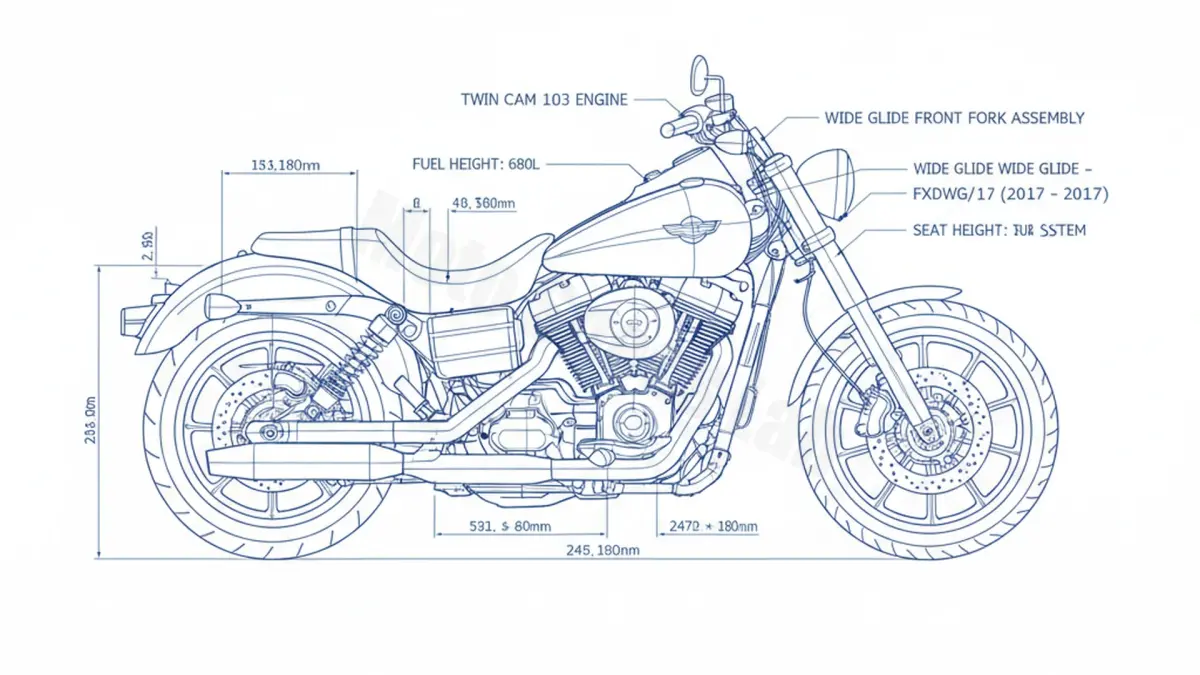
| Component | Specification |
|---|---|
| Engine Oil | H-D 360 20W50 (2.8 L) |
| Front Tire | 80/90-21 M/C 54V |
| Rear Tire | 180/60B17 M/C 75V |
| Tire Pressure | F: 2.06 bar (30 psi) / R: 2.76 bar (40 psi) |
| Battery | 65989-97D |
| Spark Plug | H-D 6R12 (Gap: 0.97–1.09 mm) |
Engineering Heritage: The Final Evolution of the Dyna Chassis
The 2017 Harley-Davidson Dyna Wide Glide (FXDWG/17) stands as a historical milestone in the Motor Company’s lineage. It represents the final factory production year of the Dyna chassis before the platform was unified with the Softail line in 2018. The Wide Glide name itself carries a legacy dating back to 1980, being the first factory custom to utilize the wide-spaced 41mm fork tubes—a design choice originally exclusive to the FL series touring bikes—paired with a skinny 21-inch front wheel for a distinct ‘chopper’ silhouette.
Technical Deep Dive: The Twin Cam 103 (High Output)
At the heart of the FXDWG/17 is the air-cooled Twin Cam 103 engine, optimized for Euro 4 emissions standards. This 1690cc powerplant is known for its robust low-end torque, peaking at approximately 130 Nm. The engine utilizes a sequential port fuel injection (ESPFI) system, which provides smooth throttle response despite the stringent environmental constraints of the Euro 4 era.
Lubrication and Maintenance
For optimal thermal management in this air-cooled V-Twin, MotoSpecsLab recommends the factory-specified H-D 360 20W50 mineral-based oil. The system requires 2.8 liters for a standard change with filter. Maintaining the correct oil viscosity is critical for the hydraulic lifters and the chain-driven cam tensioners, which were significantly improved in this generation compared to early Twin Cam units.
Chassis and Handling Specifications
The Wide Glide’s handling is defined by its 34-degree rake and the 21-inch front wheel. While this setup prioritizes straight-line stability and aesthetic presence, it requires precise tire maintenance to avoid ‘low-speed flop.’ The recommended 80/90-21 front tire must be kept at 2.06 bar (30 psi), while the 180/60B17 rear tire requires 2.76 bar (40 psi) to support the weight of the steel frame and passenger loads.
Electrical System & Ignition
The FXDWG/17 utilizes the 65989-97D battery, an AGM (Absorbed Glass Mat) unit designed to withstand the high vibration environment of the rubber-mounted Dyna engine. For ignition, the H-D 6R12 spark plugs are standard. To ensure efficient combustion and prevent fouling, the gap must be precisely set between 0.97 and 1.09 mm.
Editor’s Verdict
The FXDWG/17 is more than a motorcycle; it is a collector’s piece representing the pinnacle of the Dyna’s ‘active’ chassis design. Its rubber-mounted engine provides a visceral feel that modern counterbalanced engines often lack. For the technician, it remains a straightforward machine to service, provided one adheres to the specific torque values and fluid capacities outlined in this guide.