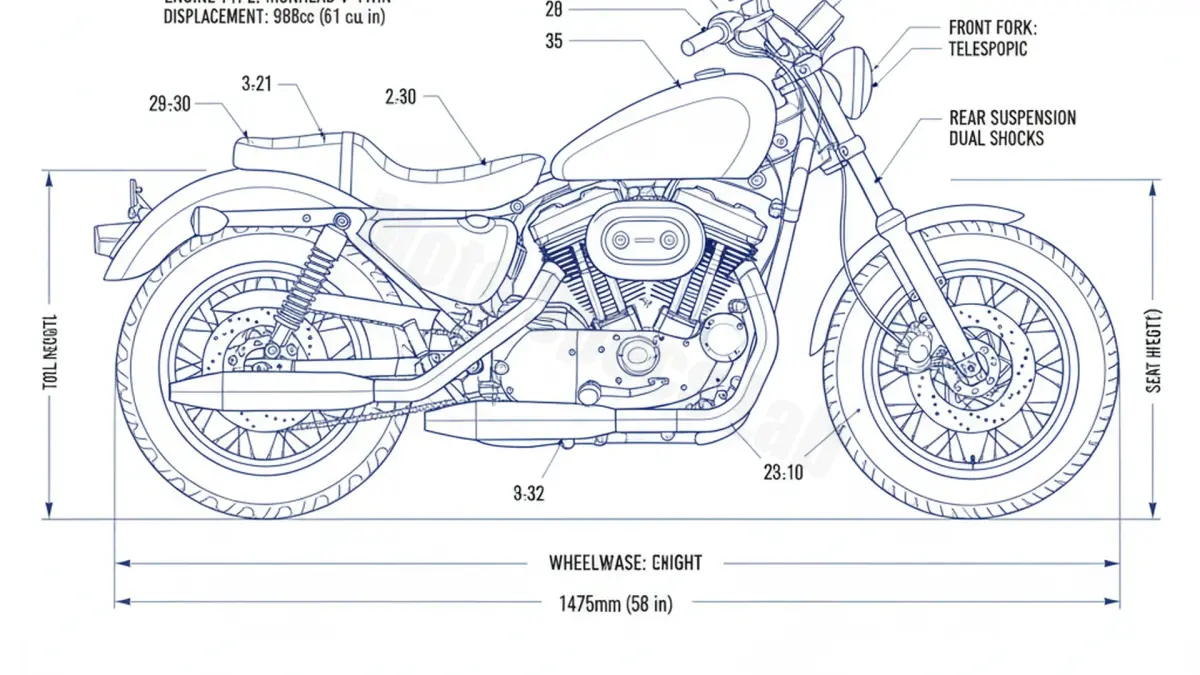
| Quick Specs: Harley-Davidson Sportster 1000 (72-XLH) | |
|---|---|
| Production Years | 1972-1985 |
| Engine Type | 1000cc (61 cu in) Ironhead V-Twin |
| Oil Specification | SAE 50 (Grade 105) / SAE 40 (Grade 75) (2.8 L) |
| Tire Sizes | F: 3.75 x 19 / R: 4.25 x 18 |
| Tire Pressure | F: 1.7 bar (24 psi) / R: 1.8 bar (26 psi) |
| Battery Type | YB16L-B |
| Spark Plug | HD No. 4 (Champion L12Y) |
A pivotal moment in Milwaukee history occurred in 1972: Harley-Davidson increased the Sportster’s displacement from 883cc to 1000cc. This was not merely a bore increase; it was a strategic engineering response to the ‘Superbike’ wars of the early 70s, marking the birth of the 61-cubic-inch Ironhead that would define the raw, mechanical soul of the Sportster line for over a decade.
Engineering Analysis: The 1000cc Ironhead V-Twin
The XLH 1000 series (including the touring-oriented XLT and the ‘Roadster’ XLS) represents the peak of the overhead-valve Ironhead era. These machines are characterized by their separate engine and transmission castings sharing a common primary case—a design that requires meticulous attention to lubrication. Unlike modern Evo engines, the Ironhead utilizes a dry-sump oiling system that is highly sensitive to oil viscosity.
Maintenance Guide & Technical Protocols
1. Lubrication System
For the 1972-1985 models, oil choice is critical for thermal management. MotoSpecsLab recommends SAE 50 (Grade 105) for summer operations and SAE 40 (Grade 75) for cooler climates. The system requires 2.8 liters. Owners should regularly check the oil tank level, as these engines are known for ‘sumping’ if left sitting for extended periods.
2. Ignition and Electrical
The electrical system relies on the YB16L-B battery. Given the high compression of the 1000cc jugs, maintaining a peak charge is essential for the starter motor’s longevity. For combustion, the HD No. 4 (Champion L12Y) spark plugs remain the gold standard. Gaps should be checked every 2,500 miles to ensure consistent firing under load.
3. Chassis and Tires
The handling dynamics of the XLH are heavily influenced by its period-correct tire dimensions: 3.75 x 19 at the front and 4.25 x 18 at the rear. To maintain the intended trail and rake stability, pressures must be kept strictly at 1.7 bar (24 psi) front and 1.8 bar (26 psi) rear. Over-inflating leads to a harsh ride on the classic telescopic forks.
Editorial Verdict: The MotoSpecsLab Review
The Sportster 1000 is a machine for the ‘mechanical purist.’ While it lacks the refinement of the later Evolution engines (1986+), it offers an visceral connection to the road that modern motorcycles cannot replicate. The torque curve is immediate and punchy. However, potential owners must be prepared for ‘wrench-heavy’ ownership, particularly regarding primary chain adjustments and rocker box gaskets.
Frequently Asked Questions (FAQ)
How often should I change the oil?
In vintage Ironhead models, we recommend an oil change every 2,000 to 2,500 miles due to the lack of modern filtration efficiency and the higher operating temperatures of the iron cylinders.
Can I use synthetic oil in my 1972 Sportster?
While possible, MotoSpecsLab advises caution. High-zinc mineral oils are often better suited for the wider tolerances and seal materials used in the 1972-1985 production run.
What is the difference between the XLH and XLX?
The XLH was the standard electric-start model, while the XLX-61 (introduced in the early 80s) was a stripped-down, ‘budget’ version designed to provide a raw canvas for customizers, though they share the same 1000cc powertrain specs.