| Specification | Value |
|---|---|
| Model Series | GSX-R 1000 L5/L6 (WVCY/15) |
| Production Years | 2015–2016 |
| Engine Oil | SAE 10W-40 API SF/SG/SH/SJ (JASO MA/MA2) – 3.0 L |
| Tire Dimensions | F: 120/70 ZR17 / R: 190/50 ZR17 |
| Standard Pressure | F: 2.5 bar (36 psi) / R: 2.9 bar (42 psi) |
| Battery Type | YT12A-BS |
| Spark Plug | NGK CR9EIA-9 |
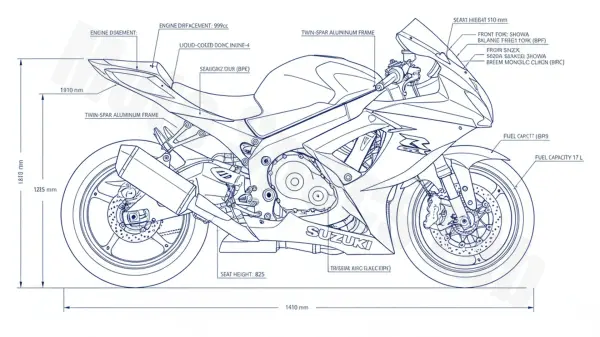
The 2015-2016 Suzuki GSX-R 1000 L5/L6 represents the pinnacle of the refined WVCY chassis architecture. A unique engineering highlight of this specific generation is the implementation of the 30th Anniversary Edition livery, commemorating the 1985 GSX-R750 F. Technically, this era was defined by the final optimization of the long-stroke 999cc inline-four before the variable valve timing (VVT) era, offering a linear torque curve that many purists still prefer over modern electronic-heavy iterations.
Engineering Evolution & Performance
The L5 and L6 models are distinguished by their Brembo Monobloc radial-mount calipers and the Showa Big Piston Forks (BPF). By removing many internal components found in cartridge forks, the BPF design utilizes a larger piston which results in more consistent damping and significantly improved front-end feedback during hard braking transitions. The Suzuki Drive Mode Selector (S-DMS) provides three distinct fuel injection and ignition maps, allowing the rider to tailor the 182hp output to road conditions.
Maintenance Guide: MotoSpecsLab Standards
Lubrication System
For the WVCY/15 engine, we recommend a high-quality synthetic 10W-40 oil meeting JASO MA2 standards to ensure wet-clutch longevity. The refill capacity is 3.0 Liters. Intervals should not exceed 6,000 km (4,000 miles) for street use or after every track weekend for competitive riders.
Electrical & Ignition
The L5/L6 utilizes the NGK CR9EIA-9 Iridium spark plug. These are critical for the high-compression combustion chamber. Ensure the gap is checked even on new plugs. The YT12A-BS battery should be maintained with a smart charger if the bike is stored for more than two weeks, as the ECU has a slight parasitic draw.
Chassis & Tires
Maintaining the 2.5/2.9 bar pressure ratio is vital for the 190/50 rear tire profile. Deviating from these pressures significantly alters the contact patch geometry, which can lead to premature cupping on the front tire or stability issues at high lean angles.
Frequently Asked Questions
What is the difference between the L5 and L6?
Mechanically, the L5 and L6 are identical. The primary differences lie in the aesthetic options, specifically the 30th Anniversary paint schemes and updated MotoGP-inspired graphics for the 2016 model year.
Can I use a 190/55 rear tire?
While the OEM spec is 190/50, many riders switch to a 190/55 for a quicker turn-in. Note that this will slightly increase the ride height and may affect the speedometer accuracy slightly.