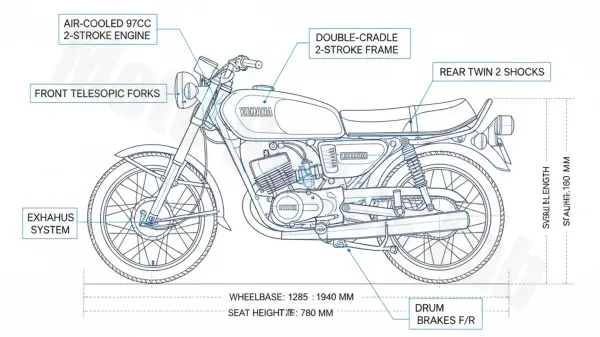
| Specification | Detail |
|---|---|
| Production Years | 1977 – 1981 |
| Engine Type | Two-Stroke Single, Torque Induction |
| Gearbox Oil | SAE 10W-30 Type SE (0.65 L) |
| Spark Plug | NGK BP7HS |
| Battery | 6N4-2A-4 (6V) |
| Tire Size | F: 2.50-18 | R: 2.75-18 |
Historical Engineering Highlight: The Yamaha RS 100 DX (1Y8) distinguished itself from its predecessors by incorporating the refined ‘Torque Induction’ reed-valve system. Unlike standard piston-port engines of the era, this design allowed for a broader powerband and significantly improved fuel efficiency, making it one of the most reliable 100cc two-strokes of the late 1970s. The ‘DX’ variant specifically signaled the inclusion of a front disc brake in many markets, a luxury for small-displacement bikes at the time.
Technical Analysis
The 1Y8 chassis is a masterclass in lightweight engineering. Weighing in at approximately 90kg dry, the power-to-weight ratio provided nimble urban handling. The 97cc air-cooled engine was paired with Yamaha’s proprietary Autolube system, which eliminated the need for manual pre-mixing of fuel and oil, utilizing a separate oil tank and pump that varied delivery based on throttle position.
Maintenance Guide
Lubrication System
For the gearbox, MotoSpecsLab recommends 0.65 Liters of SAE 10W-30 Type SE. Given the age of these units, ensure the oil is changed every 3,000 km to prevent clutch slippage and gear wear. For the Autolube system, always use a high-quality JASO FC or FD rated two-stroke injector oil to minimize carbon buildup in the exhaust port.
Electrical and Ignition
The RS 100 DX operates on a 6-volt electrical system powered by a 6N4-2A-4 battery. Ignition timing is critical for these two-stroke units; ensure the NGK BP7HS spark plug is gapped correctly to maintain a crisp throttle response. A fouled plug is often the first sign of an over-rich Autolube pump setting or a clogged air filter.
Wheels and Tires
Proper inflation is vital for the stability of the 18-inch wheels. Maintain the front tire (2.50-18) at 1.8 bar (26 psi) and the rear (2.75-18) at 2.0 bar (28 psi). Over-inflation on these lightweight rims can lead to excessive vibration, while under-inflation compromises cornering precision.
Editor’s Verdict
The Yamaha RS 100 DX – 1Y8 remains a benchmark for vintage small-capacity motorcycles. Its mechanical simplicity, combined with the then-advanced Torque Induction system, offers a tactile riding experience that modern commuters lack. For collectors and restorers, maintaining the 6V electrical system and the Autolube pump’s calibration are the keys to longevity.