| Component | Specification |
|---|---|
| Engine Type | Liquid-cooled, single-cylinder 4-stroke engine |
| Model Code | 0G31/25 (Euro 5+) |
| Engine Oil | SAE 15W-50, API SJ / JASO MA2 (1.6 L) |
| Tires (F/R) | 110/80 R19 / 150/70 R17 |
| Tire Pressure | F: 1.7 bar (24.7 psi) / R: 1.9 bar (27.6 psi) |
| Spark Plug | NGK LMAR9E-J |
| Battery | YTX9-BS (12V / 8Ah) |
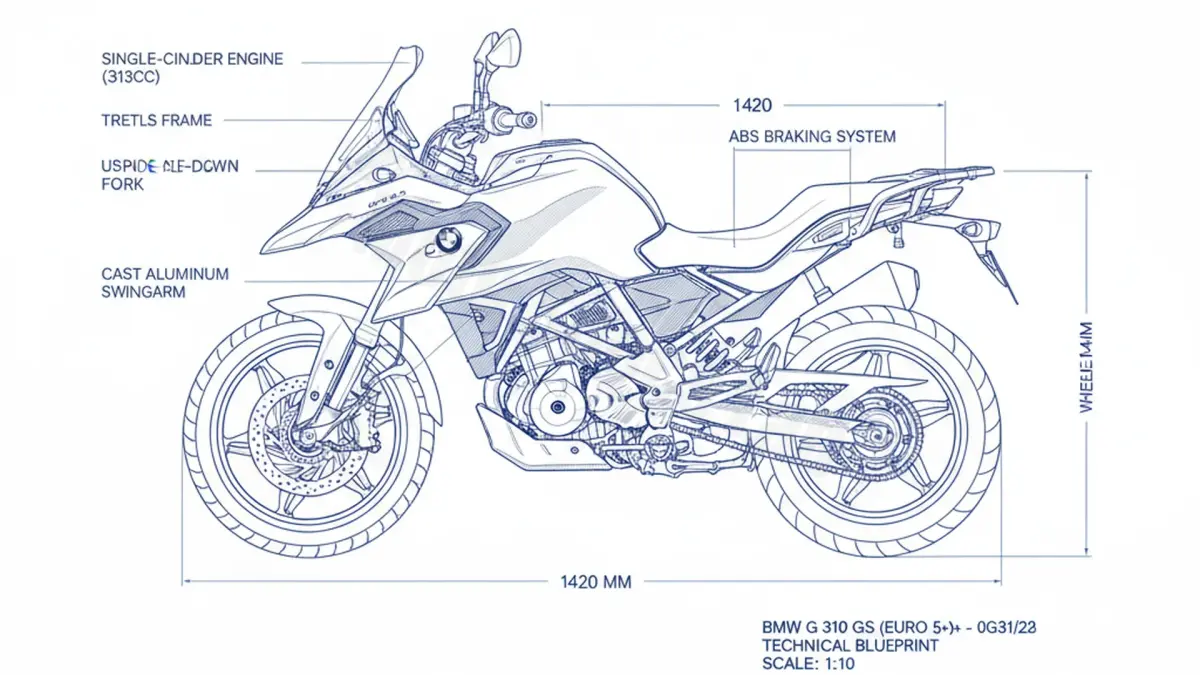
The BMW G 310 GS stands as a unique feat of engineering in the sub-500cc category, most notably for its reversed cylinder head design. Unlike traditional layouts, the intake is positioned at the front and the exhaust at the rear. This allows for a straight-path air intake and a forward-tilted cylinder, shifting the center of gravity towards the front wheel and enabling a longer swingarm within a compact wheelbase for superior agility and stability.
Engineering Overview: The Euro 5+ Evolution
With the transition to the Euro 5+ (0G31/25) standards, BMW Motorrad refined the 313cc powerplant with an electronic throttle (ride-by-wire) and an automatic idle boost. These updates ensure smoother throttle response and prevent stalling when pulling away. For the technician, this means a shift toward electronic diagnostics, though the mechanical heart remains accessible for routine maintenance.
Maintenance Essentials
Lubrication System
The G 310 GS requires a precise 1.6 liters of SAE 15W-50 oil. It is critical to use oil meeting JASO MA2 standards to ensure the wet clutch operates without slippage. Given the high-revving nature of this single-cylinder engine, oil shear is a factor; MotoSpecsLab recommends strictly adhering to the 10,000 km (6,000 miles) interval or annual change.
Ignition and Electrical
The 0G31/25 variant utilizes the NGK LMAR9E-J spark plug. This long-reach plug is essential for the deep combustion chamber of the reversed-head engine. The electrical system is supported by a YTX9-BS AGM battery. Ensure terminals are torqued correctly to prevent vibration-induced ECU errors common in single-cylinder platforms.
Chassis and Tires
Equipped with a 19-inch front and 17-inch rear setup, the G 310 GS is sensitive to tire pressure. For solo riding on asphalt, the factory recommendation of 1.7 bar (front) and 1.9 bar (rear) provides the optimal contact patch. Deviating from these pressures can significantly impact the performance of the ABS and traction control systems calibrated for these specific rolling radii.
Professional Verdict
The BMW G 310 GS (Euro 5+) is a masterclass in packaging. While its maintenance requirements are straightforward, the precision of its components—from the specific spark plug heat range to the oil viscosity—demands adherence to OEM specifications to maintain its ‘GS’ pedigree. For the owner-mechanic, it remains one of the most rewarding entry-level adventure bikes to maintain.