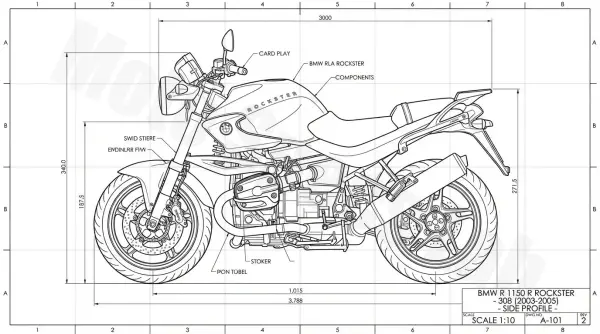
Ultimate Maintenance Guide: BMW R 1150 R Rockster (2003–2005)
The BMW R 1150 R Rockster (internal code 308) remains one of the most distinctive “Oilhead” boxers ever produced. Released to celebrate BMW’s 80th anniversary, it stripped the standard R 1150 R of its conservative styling, adding aggressive paint schemes, the headlight assembly from the R 1150 GS, and the wider rear wheel from the R 1100 S.
Produced between 2003 and 2005, the Rockster is a mechanical masterpiece, but like all high-performance German machinery, it demands a rigorous maintenance schedule. This guide provides a comprehensive overview of the service requirements needed to keep your 1130cc Boxer engine purring and your chassis stable.
1. Maintenance Schedule Overview
BMW recommends a minor service every 6,000 miles (10,000 km) and a major service every 12,000 miles (20,000 km). However, given the age of these motorcycles, annual fluid changes are highly recommended regardless of mileage.
| Component | Frequency | Action |
|---|---|---|
| Engine Oil & Filter | 6,000 Miles / Annual | Replace |
| Valve Clearances | 6,000 Miles | Check/Adjust |
| Transmission Fluid | 12,000 Miles / 2 Years | Replace |
| Final Drive Oil | 12,000 Miles / 2 Years | Replace |
| Spark Plugs | 12,000 Miles | Replace (Check for Twin-Spark) |
| Alternator Belt | 36,000 Miles / 4 Years | Inspect/Replace |
| Brake/Clutch Fluid | Annual / 2 Years | Flush & Bleed |
2. Engine Oil and Filter Change
The R 1150 R Rockster uses an air and oil-cooled Boxer engine. Because it lacks a large radiator, the engine oil plays a critical role in cooling. Using high-quality oil is non-negotiable.
Required Specs:
- Oil Type: High-quality mineral or semi-synthetic 20W-50 (API SF, SG, or SH).
- Capacity: Approximately 3.75 Liters (with filter).
- Tooling: 17mm socket for the drain plug, BMW-specific oil filter wrench.
Procedure:
- Warm the engine to operating temperature to ensure the oil flows freely.
- Place the bike on its center stand on level ground.
- Remove the drain plug (17mm) located on the bottom of the engine. Warning: The oil will be hot.
- Use the specialized oil filter tool to remove the recessed filter.
- Lubricate the rubber gasket of the new filter with fresh oil and hand-tighten.
- Replace the crush washer on the drain plug and torque to 32 Nm.
- Fill with oil and check the sight glass after a short test run.
3. Valve Clearance Adjustment
One of the most rewarding DIY tasks on a Rockster is the valve adjustment. Boxers are sensitive to valve clearances; if they are out of spec, you will experience increased vibration, poor fuel economy, and “ticking” noises.
Note: This must be performed on a stone-cold engine (let it sit overnight).
Specifications:
- Intake: 0.15 mm
- Exhaust: 0.30 mm
The Process:
- Remove the spark plug covers and the spark plugs.
- Remove the cylinder head covers (be prepared for a small amount of residual oil).
- Find Top Dead Center (TDC) for the cylinder you are working on. You can do this by inserting a plastic straw into the spark plug hole and rotating the rear wheel in 6th gear until the piston is at its highest point on the compression stroke.
- Use feeler gauges to check the gap. If the gauge slides with slight resistance (“like a hot knife through butter”), it is correct.
- If adjustment is needed, loosen the 10mm locknut and turn the adjuster screw. Re-tighten and re-check.
- Repeat for the other cylinder.
4. Transmission and Final Drive Service
Unlike most motorcycles, the Rockster has a separate gearbox and a shaft drive (Paralever). These require specific gear oils. Failure to change the final drive oil is a leading cause of premature bearing failure.
Gearbox:
- Oil: 75W-90 or 80W-90 GL-5 Gear Oil.
- Capacity: 0.8 Liters (Fill until the oil reaches the bottom of the filler hole threads).
Final Drive:
- Oil: 75W-90 or 80W-90 GL-5 Gear Oil.
- Capacity: 0.25 Liters.
- Tip: Always remove the filler plug before the drain plug. If the filler plug is seized and you’ve already drained the oil, you’re stuck!
5. The Spark Plug Configuration (Single vs. Twin Spark)
Early 2003 Rocksters may be “Single Spark” models, while late 2003 through 2005 models are usually “Twin Spark.” The Twin Spark system was introduced to solve the “surging” issues common in the R 1150 series.
- Single Spark: One plug per cylinder (NGK BKR7EKC).
- Twin Spark: Two plugs per cylinder. The primary plug is in the center (BKR7EKC), and the secondary plug is located at the bottom of the cylinder head (NGK DCPR8EKC).
Check your cylinder heads; if there is a plastic strip covering the center and a lead going to the bottom, you have a Twin Spark.
6. Air Filter and Poly-V Alternator Belt
The air filter is located under the fuel tank. While the tank does not need to be fully removed, it must be lifted and propped up to access the airbox. Inspect the airbox for any oil residue, which can indicate an overfilled crankcase.
The Alternator Belt (Poly-V belt) is located behind the plastic cover at the front of the engine. These belts can crack over time. If the belt snaps, you lose your charging system.
- Check tension every 12,000 miles.
- Replace every 36,000 miles or 4 years.
- Ensure the belt is tightened to the point where it can be twisted 90 degrees with your fingers, but no more.
7. The Integrated ABS (iABS) Braking System
The 2003-2005 Rockster is equipped with the BMW EVO braking system with Integral ABS (often called “Whizzy Brakes” due to the sound of the servo motors). This is the most complex part of the bike’s maintenance.
Warning: Flushing the iABS system is significantly more difficult than a standard brake bleed. It involves two separate circuits: the “Control Circuit” (lever to ABS pump) and the “Wheel Circuit” (ABS pump to calipers).
If you are not an experienced mechanic, it is highly recommended to have a BMW specialist perform the brake fluid flush every two years. If the fluid is neglected, the internal valves of the ABS pump can corrode, leading to a repair bill that often exceeds the value of the motorcycle.
8. Chassis and Suspension: Telelever and Paralever
The Rockster features BMW’s unique suspension setup:
- Telelever (Front): Check the ball joint boot for cracks. If the rubber boot is split, dirt will enter the joint and destroy it.
- Paralever (Rear): Check for play in the pivot bearings. Grab the rear wheel at the 6 and 12 o’clock positions and shake. If there is movement, the pivot bearings may need adjustment or replacement.
- Driveshaft: Inspect the rubber boots (gaiters) for tears. If you see oil leaking from the boots, it indicates a failing seal in the transmission or final drive.
9. Fuel System Maintenance
The fuel filter on the R 1150 R Rockster is located inside the fuel tank. This is a tedious job that involves removing the fuel pump plate assembly. Many owners choose to “externalize” the fuel filter to make future changes easier, though this requires custom fuel line routing.
If your Rockster hesitates under load or has a high-pitched whine coming from the tank, it is likely time for a new fuel filter and an inspection of the internal U-bend hoses, which are known to crack over time.
10. Critical Torque Settings
To maintain the structural integrity of your BMW, always use a torque wrench:
- Engine Oil Drain Plug: 32 Nm
- Oil Filter: 11 Nm
- Transmission Drain/Fill: 30 Nm
- Final Drive Drain/Fill: 23 Nm
- Spark Plugs: 20 Nm
- Wheel Bolts (Rear): 105 Nm (Tighten in a cross pattern)
- Front Caliper Bolts: 30 Nm
Conclusion
The BMW R 1150 R Rockster is a robust, “bulletproof” machine if the maintenance is respected. The Boxer engine is just getting started at 50,000 miles, and many examples exceed 150,000 miles with proper care. By performing your own oil changes, valve adjustments, and inspections, you not only save money but also develop a deeper bond with one of BMW’s most unique naked bikes.
Disclaimer: This guide is for informational purposes only. Always consult your official BMW service manual before performing repairs. Safety is paramount when working on a motorcycle.