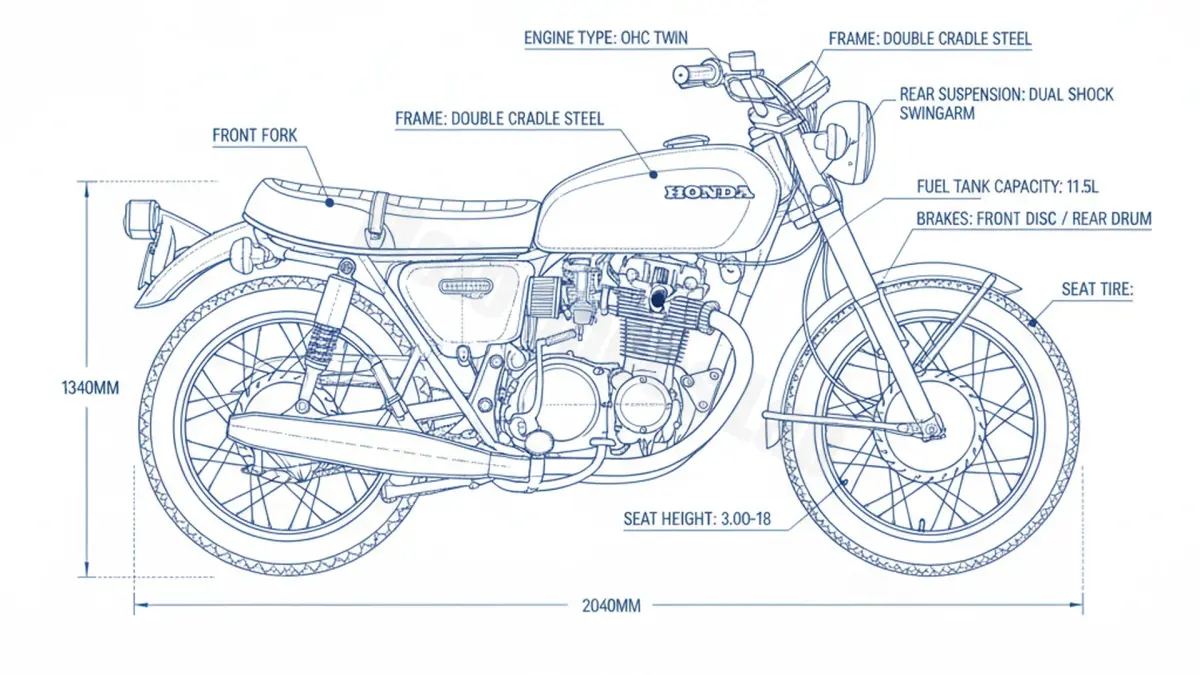
| Attribute | Specification |
|---|---|
| Production Years | 1974 – 1976 |
| Engine Type | Parallel Twin, 4-stroke |
| Oil Type | SAE 10W-40 (JASO MA/MA2) |
| Oil Capacity | 2.0 L (Dry) / 1.5 – 1.6 L (Change) |
| Spark Plug | NGK B8ES (Gap: 0.7 – 0.8 mm) |
| Tire Size | F: 3.00-18 / R: 3.50-18 |
| Battery | 12N12A-4A-1 (YB12A-A) |
While often overshadowed by the larger CB360, the Honda CB 250 G holds a unique place in engineering history as one of the first small-displacement twins to feature a factory-standard 6-speed gearbox. This was not merely for performance; it was a strategic engineering response to the tightening noise and emission regulations in the mid-1970s European market, allowing the engine to operate more efficiently within its power band.
Technical Engineering Overview
The CB 250 G (CB250G) was developed as a successor to the CB 250 K series. Beyond the extra gear, it introduced a revamped chassis and a front disc brake system that significantly improved safety compared to its predecessor’s drum setup. The engine is a SOHC parallel twin that thrives on high-RPM stability, though it requires precise maintenance of its cam chain tensioner—a known focal point for vintage Honda enthusiasts.
Maintenance Guide
Lubrication System
For the CB 250 G, oil is the lifeblood of the top end. We recommend a high-quality SAE 10W-40 motorcycle-specific oil meeting JASO MA/MA2 standards. Because these engines utilize a centrifugal oil filter rather than a modern spin-on cartridge, regular changes every 1,500–2,000 miles are critical to prevent sludge buildup. A standard oil change requires 1.5 to 1.6 liters.
Ignition & Electrical
The ignition system relies on contact breaker points. To ensure crisp throttle response, the NGK B8ES spark plugs must be gapped strictly to 0.7 – 0.8 mm. If the bike struggles to start or idles poorly, the mechanical advance unit should be checked for sticking. The electrical system is powered by a 12N12A-4A-1 (YB12A-A) battery; ensure the charging system is outputting at least 13.5V at 4,000 RPM.
Tires and Handling
To maintain the nimble handling characteristics of this 1970s classic, stick to the original tire dimensions: 3.00 – 18 on the front and 3.50 – 18 on the rear. Correct tire pressure is vital for stability: 1.8 bar (26 psi) for the front and 2.0 bar (28 psi) for the rear (increase to 2.2 bar/32 psi when carrying a passenger).
Editorial Verdict
The Honda CB 250 G is a masterclass in mid-70s transitional engineering. While it may lack the raw torque of the 360cc variant, the 6-speed transmission makes it a more engaging and technically interesting ride for the collector. It remains a robust, accessible entry point into the world of vintage Japanese motorcycles (UJM).