
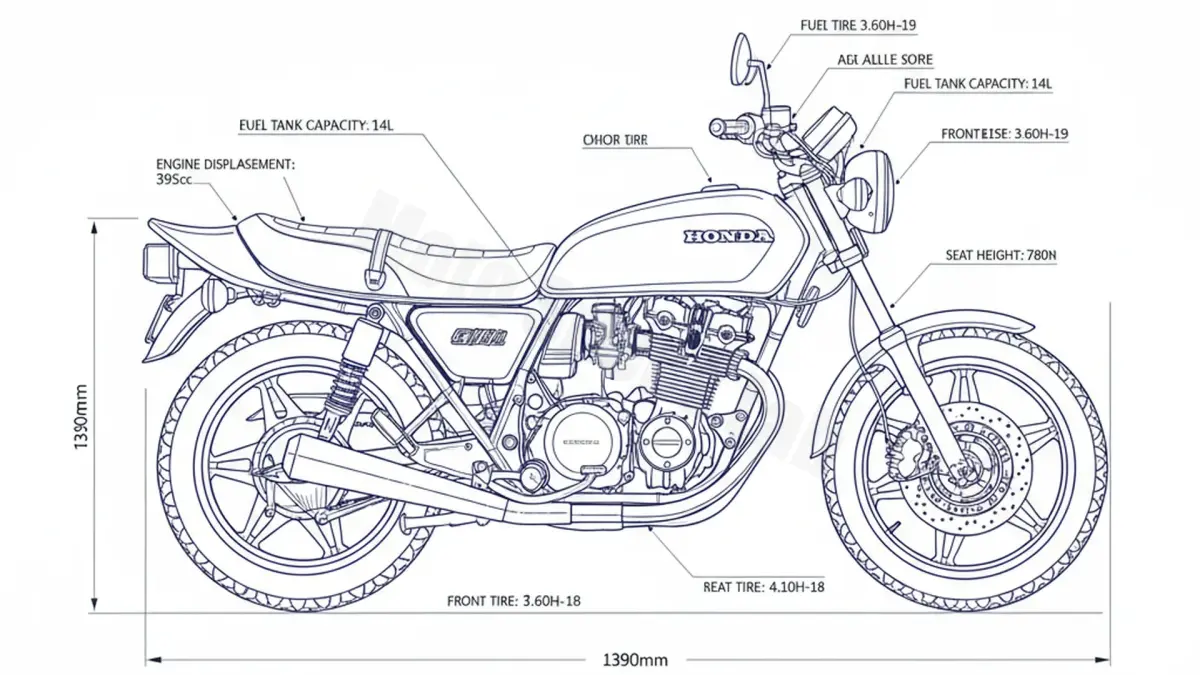
| Specification | Value |
|---|---|
| Production Years | 1977 – 1985 |
| Engine Oil | SAE 10W-40 JASO MA (2.5 L) |
| Tires (Front/Rear) | F: 100/90-19 / R: 110/90-18 |
| Tire Pressure | F: 2.0 bar (28 psi) / R: 2.0 bar (28 psi) |
| Battery Type | YB12A-A |
| Spark Plug | NGK D8EA |
Engineering Highlight: The Comstar Revolution
The Honda CB 400 N, often referred to as the ‘Euro-Sport’, holds a unique position in motorcycling history as one of the primary platforms for Honda’s revolutionary Comstar wheels. Unlike traditional spoked wheels that required constant tensioning or heavy cast wheels of the era, the Comstar design utilized pressed steel blades riveted to a light alloy rim. This provided the rigidity of a cast wheel with the slight flex characteristic of spokes, marking a significant engineering transition in the late 1970s.
Technical Overview: The Pentroof Powerplant
At the heart of the CB400T/N is a sophisticated 395cc parallel-twin engine. What set this machine apart from its contemporaries was the 3-valve-per-cylinder Pentroof head. By utilizing two intake valves and one large exhaust valve, Honda engineers achieved superior volumetric efficiency and better combustion flow compared to standard two-valve designs. This allowed the CB 400 N to deliver a smooth, linear power band that made it a favorite for both urban commuting and spirited ‘Euro-Sport’ touring.
Maintenance Essentials
Lubrication System
For optimal engine longevity and clutch performance, the CB 400 N requires 2.5 Liters of SAE 10W-40 oil. It is critical to use oil with the JASO MA specification to ensure the wet clutch does not slip. Given the air-cooled nature of this engine, regular oil changes every 3,000 miles (5,000 km) are highly recommended to prevent thermal breakdown.
Ignition and Electrical
The electrical system relies on a YB12A-A battery. Reliable ignition is provided by NGK D8EA spark plugs. Owners should regularly check the plug gap (standard 0.6–0.7mm) to maintain crisp throttle response. The CDI ignition system on these models is generally robust, but aging wiring harnesses should be inspected for corrosion, particularly around the ground points.
Chassis and Tires
Handling is significantly influenced by tire choice and pressure. The factory-specified 100/90-19 front and 110/90-18 rear tires should be maintained at a consistent 2.0 bar (28 psi). Modern compound tires in these classic sizes can vastly improve the lean-angle stability compared to the original 1970s rubber.
MotoSpecsLab Verdict
The Honda CB 400 N / CB400T remains a masterclass in transitional engineering. It bridged the gap between the ‘Universal Japanese Motorcycle’ (UJM) of the early 70s and the more specialized sportbikes of the 80s. For the modern collector or vintage rider, it offers a reliable, mechanically transparent experience with enough technical sophistication to remain relevant on today’s roads.