| Component | Specification |
|---|---|
| Model Range | 2014 – Present |
| Engine Oil | SAE 10W-30 (JASO T 903 MA) (3.2L Manual / 3.4L DCT) |
| Front Tire | 120/70 ZR 17 M/C (58W) |
| Rear Tire | 160/60 ZR 17 M/C (69W) |
| Tire Pressure | F: 2.5 bar (36 psi) / R: 2.9 bar (42 psi) |
| Battery | YTZ12S |
| Spark Plug | NGK IFR6G-11K (Gap: 1.0 – 1.1 mm) |
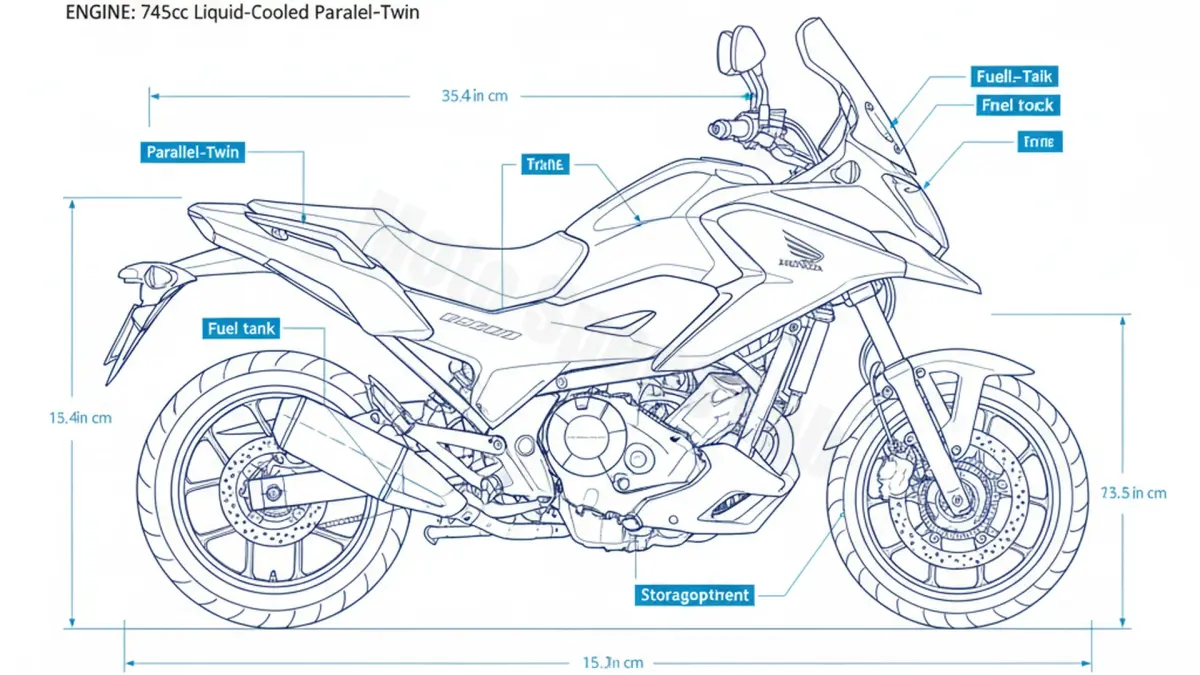
Engineering Highlight: The Honda NC 750 X is a marvel of efficiency, utilizing an engine architecture derived from the Honda Jazz (Fit) automobile. By canting the parallel-twin cylinders forward at a 62-degree angle, Honda lowered the center of gravity and created the industry-leading 23-liter ‘frunk’ (front trunk) where the fuel tank typically resides, redefining the utility-to-performance ratio in the adventure-sport category.
Technical Overview: The NC750X/26 Platform
Since its evolution from the 700 series in 2014, the NC750X (internal code NC750X/26) has served as the benchmark for practical motorcycling. Its long-stroke engine design prioritizes low-to-mid-range torque over high-RPM horsepower, mirroring the power delivery of a modern diesel engine. This makes it an exceptionally fuel-efficient platform, capable of exceeding 70 mpg (US) under optimal conditions.
Lubrication and Transmission Maintenance
Maintenance requirements differ slightly between the standard manual and the Dual Clutch Transmission (DCT) variants. While both utilize SAE 10W-30 oil meeting the JASO T 903 standard MA, the DCT model requires an additional 0.2 liters (3.4L total) to accommodate the hydraulic actuators and secondary oil filter. Ensuring the use of JASO MA certified oil is critical to prevent clutch slippage in both configurations.
Ignition and Electrical System
The NC750X utilizes high-performance NGK IFR6G-11K iridium spark plugs. These are designed for longevity, but the gap must be precisely maintained between 1.0 and 1.1 mm to ensure consistent combustion in the high-torque twin. The electrical system is anchored by the YTZ12S battery, which provides the necessary cold cranking amps to fire the heavy pistons in cold weather.
Chassis and Handling
The machine rides on 17-inch wheels, emphasizing its road-biased ‘crossover’ nature. For optimal handling and tire longevity, pressures must be strictly maintained at 2.5 bar (36 psi) front and 2.9 bar (42 psi) rear. Given the bike’s forward-leaning engine weight bias, maintaining the front tire pressure is essential for preventing ‘cupping’ and ensuring steering precision.
MotoSpecsLab Editorial Verdict
The Honda NC 750 X is often called the ‘Swiss Army Knife’ of motorcycles. While it lacks the raw aggression of a sportbike, its technical reliability and engineered practicality are unmatched. For the long-distance commuter or the pragmatic tourer, the NC750X/26 remains one of the most cost-effective and dependable platforms in the world today.
Frequently Asked Questions
Q: How often should I change the oil?
A: Honda recommends a 12,000 km (approx. 8,000 miles) interval, though many owners opt for 6,000 km intervals to maintain DCT shift smoothness.
Q: Can I use 10W-40 oil?
A: While 10W-40 is common, Honda specifically recommends 10W-30 for the NC series to optimize fuel economy and internal lubrication flow at lower operating temperatures.