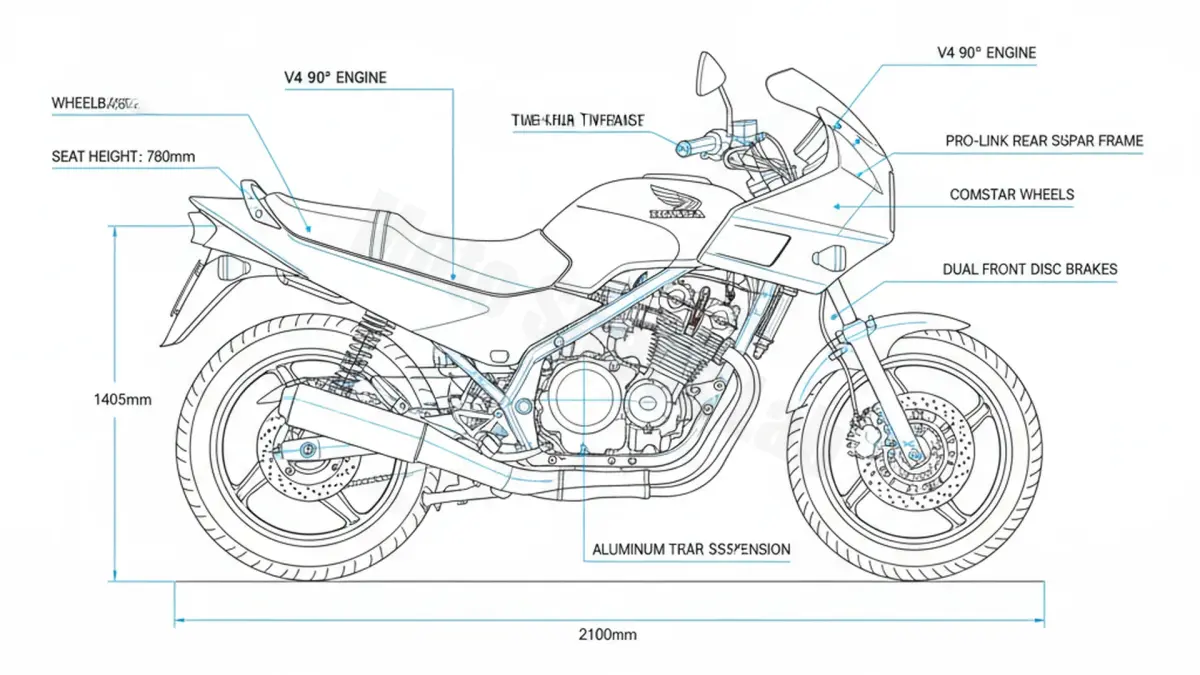
| Specification | Data |
|---|---|
| Production Years | 1984 – 1986 |
| Engine Configuration | 90° V4, DOHC, 16-Valve |
| Engine Oil | SAE 10W-40 (API SE or SF) |
| Oil Capacity | 2.5L (Change) / 3.0L (Filter) / 3.5L (Dry) |
| Tire Size (Front) | 100/90-16 54H |
| Tire Size (Rear) | 110/90-18 61H |
| Spark Plug | NGK DPR8EA-9 / Denso X24EPR-U9 |
| Battery | YB12A-A |
The Honda VF 500 F, widely revered as the “Baby Interceptor,” holds a unique place in motorcycling history as the first production machine to successfully miniaturize the complex 90-degree V4 racing architecture into a mid-sized chassis. Unlike its larger siblings, the PC12 utilized a specific 360-degree crankshaft design that provided a distinct exhaust note and power delivery profile, engineered specifically to compete with the dominant two-strokes of the mid-1980s.
Technical Engineering Overview
At the heart of the PC12 is a liquid-cooled, 498cc V4 engine. This unit was an engineering marvel for its time, featuring gear-driven cams in its early racing iterations, though the street version utilized a sophisticated chain-drive system. The 90-degree V-angle provides inherent primary balance, resulting in a remarkably smooth power delivery that climbs to a high redline. The chassis features the then-revolutionary 16-inch front wheel paired with an 18-inch rear, designed to facilitate rapid turn-in and mimic the handling characteristics of Grand Prix racers.
Maintenance & Service Guidelines
Proper maintenance is critical for the longevity of the V4 engine, particularly regarding lubrication and cooling. As the Editor-in-Chief of MotoSpecsLab, I recommend strict adherence to the following technical parameters:
Lubrication System
The VF 500 F requires high-quality mineral or semi-synthetic oil meeting API SE or SF standards. The viscosity of choice is SAE 10W-40. Because the V4 engine runs significantly hotter in the rear cylinders, maintaining the correct oil level is non-negotiable. Note the varying capacities: 2.5 liters for a simple drain, 3.0 liters when the filter is replaced, and 3.5 liters for a complete rebuild.
Ignition and Electrical
For optimal combustion efficiency, the NGK DPR8EA-9 or Denso X24EPR-U9 must be used. The electrode gap should be precision-set between 0.8 mm and 0.9 mm. The electrical system relies on a YB12A-A lead-acid battery; given the age of these machines, ensuring clean ground connections is vital to prevent regulator/rectifier failure.
Tires and Handling
The PC12 uses a staggered wheel setup that is sensitive to pressure changes. The front 100/90-16 and rear 110/90-18 should be maintained at 2.25 bar (32 psi) for solo riding. If carrying a passenger or heavy luggage, the rear pressure must be increased to 2.8 bar (40 psi) to maintain carcass stability and prevent overheating.
Summary
The Honda VF 500 F/FII PC12 remains a testament to Honda’s ‘Golden Age’ of engineering. While demanding more meticulous maintenance than a contemporary parallel twin, the rewards of the V4’s power band and the ‘Interceptor’ heritage make it a peerless classic for the technical enthusiast.