| Specification | Data |
|---|---|
| Model | Honda VFR 750 F – RC36/L-P |
| Production Years | 1990-1993 |
| Engine Oil | SAE 10W-40 API SE, SF, or SG (3.1 L) |
| Tire Dimensions | F: 120/70 ZR 17 / R: 170/60 ZR 17 |
| Tire Pressure | F: 2.5 bar (36 psi) / R: 2.9 bar (42 psi) |
| Battery Type | YTX12-BS |
| Spark Plug | NGK CR8EH-9 (Gap: 0.8–0.9 mm) |
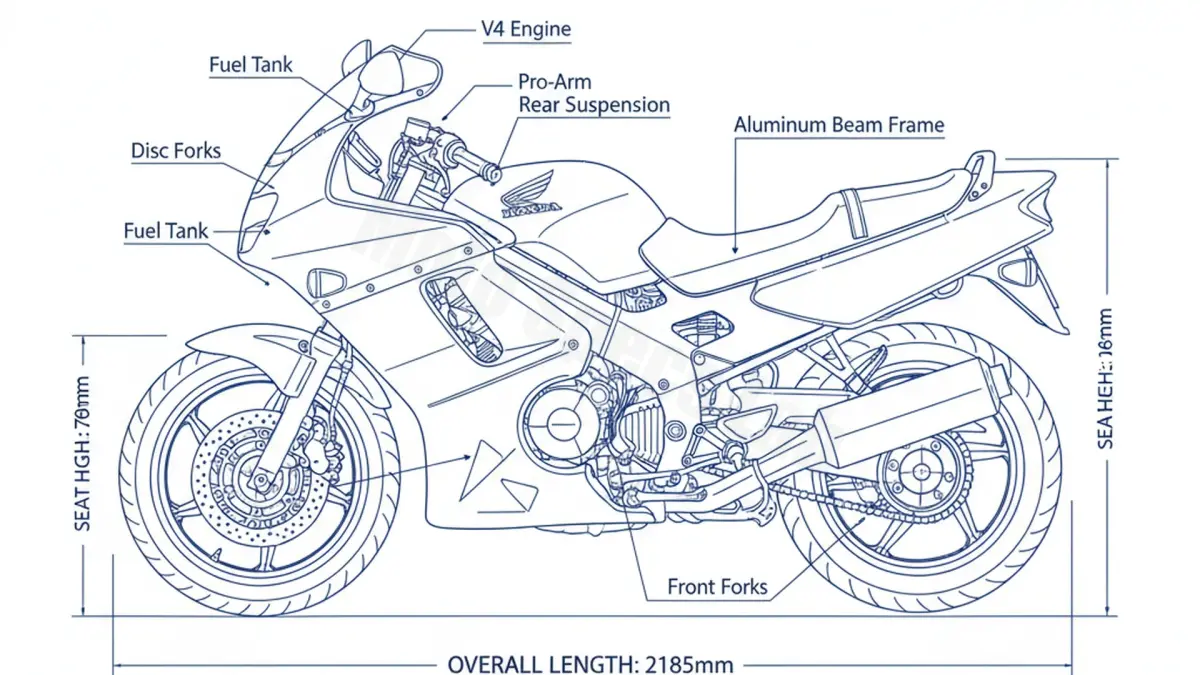
A defining moment in motorcycle history occurred with the introduction of the RC36: it was the first mass-production motorcycle to utilize the ELF-designed Pro-Arm single-sided swingarm, a technology directly trickled down from Honda’s multi-million dollar NR750 endurance racing program to improve rear wheel change speeds and chassis rigidity.
Technical Review: The Interceptor’s Golden Era
At MotoSpecsLab, we classify the RC36 (1990–1993) as the high-water mark for Honda’s over-engineering philosophy. While its predecessor established the VFR’s reliability, the RC36 refined the 748cc 90-degree V4 engine into a masterpiece of smooth power delivery. The most critical technical feature remains the gear-driven camshafts. By eliminating timing chains, Honda ensured permanent valve timing precision and created the iconic mechanical ‘whine’ that defines the VFR’s acoustic signature.
The frame moved to a massive twin-spar aluminum design, which, coupled with the 41mm Showa cartridge forks, offered a level of stability that contemporary sports bikes struggled to match. While heavy by modern standards, the RC36 balances its mass with exceptional aerodynamics and a center of gravity that favors high-speed touring stability.
Maintenance Guide & Technical Specs
1. Engine Lubrication
To preserve the gear-driven cam assembly, high-quality mineral or semi-synthetic oil is recommended. The RC36 requires 3.1 liters of SAE 10W-40 meeting API SE, SF, or SG standards. Avoid modern ‘Energy Conserving’ oils which may cause the wet clutch to slip.
2. Ignition & Electrical
The VFR 750 F utilizes NGK CR8EH-9 spark plugs. Given the compact nature of the V4 head, ensuring the correct gap of 0.8–0.9 mm is essential for preventing low-end hesitance. The electrical system relies on a YTX12-BS battery. Owners should periodically inspect the regulator/rectifier connectors, as this remains the only known ‘weak point’ in the bike’s otherwise bulletproof electrical architecture.
3. Chassis & Running Gear
The RC36 is sensitive to tire profile and pressure. For optimal handling, maintain 2.5 bar (36 psi) in the front and 2.9 bar (42 psi) in the rear. The 170/60 rear tire was wide for its era, and modern radial compounds significantly enhance the bike’s cornering clearance.
Frequently Asked Questions
Q: How often should the valves be checked?
A: Honda recommends inspection every 16,000 miles (24,000 km). However, due to the gear-driven cams, these engines are known to hold their tolerances exceptionally well.
Q: Can I use 10W-50 oil?
A: In hotter climates, 10W-50 is acceptable, but 10W-40 remains the factory standard for the widest range of operating temperatures.