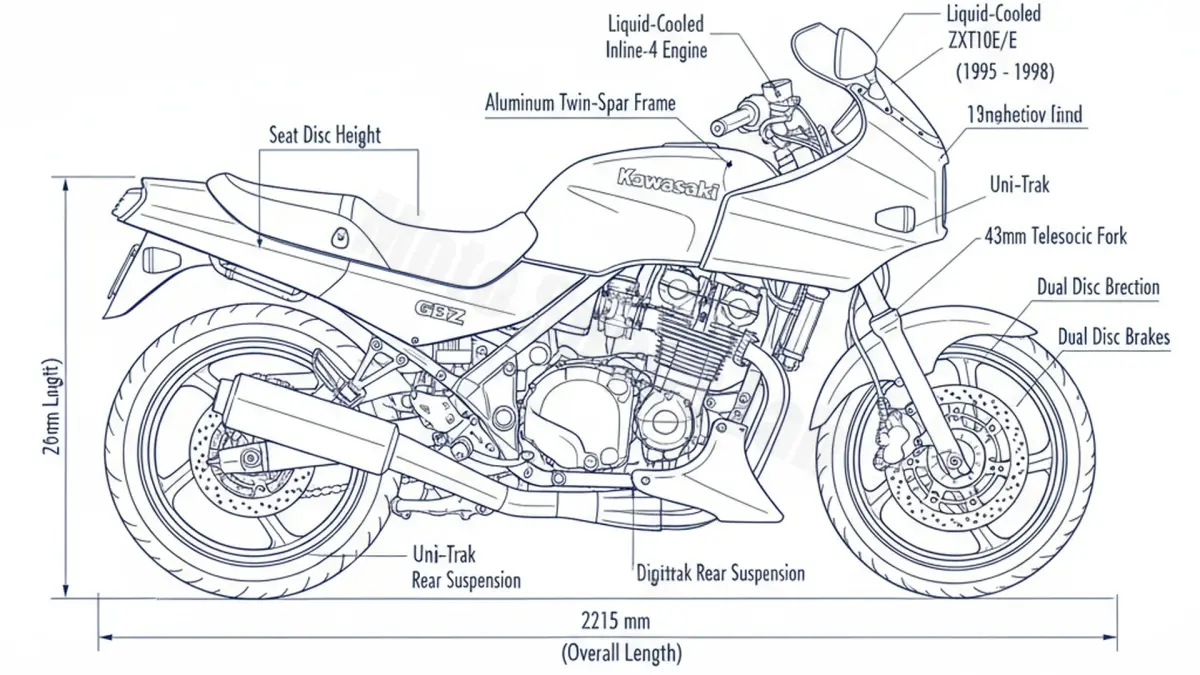
| Component | Specification |
|---|---|
| Production Years | 1995 – 1998 |
| Engine Oil | SAE 10W-40 API SE, SF, or SG (3.7 L) |
| Tire Dimensions | F: 120/70 ZR 17 / R: 170/60 ZR 17 |
| Tire Pressure | F: 2.5 bar (36 psi) / R: 2.9 bar (42 psi) |
| Spark Plug | NGK CR9EK |
| Battery Type | YTX14-BS |
Historical Context & Engineering Highlight: The Kawasaki GPZ 1100 (ZXT10E) represents a pivotal moment in 1990s motorcycle engineering. While its predecessor, the GPZ 900R, defined the superbike era, the ZXT10E was engineered as the ‘Gentleman’s Express.’ A unique engineering highlight of this model is its 1089cc powerplant—a strategically detuned version of the legendary ZZ-R1100 (ZX-11) engine. By utilizing smaller 36mm carburetors and revised cam profiles, Kawasaki engineers successfully shifted the power curve to deliver immense low-to-mid-range torque, making it one of the most effortless high-speed tourers of its decade.
Technical Review: Performance Meets Stability
The ZXT10E chassis was designed for high-speed stability. Unlike the aggressive, twitchy nature of pure sportbikes, the GPZ 1100 features a longer wheelbase and a steel perimeter frame that provides a planted feel even when fully loaded with luggage. The inclusion of the NGK CR9EK dual-electrode spark plugs ensures consistent ignition across the rev range, which is critical for the high-compression nature of this 16-valve inline-four.
Maintenance Guide & Expert Insights
Proper lubrication is the lifeblood of the ZXT10E. At MotoSpecsLab, we recommend strictly adhering to the 3.7 Liter capacity of SAE 10W-40. Given the engine’s lineage from the high-performance ZX-11, using modern synthetic oils meeting API SG standards will significantly extend the life of the cam lobes, a known wear point in high-mileage Kawasaki fours.
Tire Management
Handling on the GPZ 1100 is highly sensitive to tire pressure. To maintain the intended steering geometry, the 120/70 ZR 17 front must be kept at 2.5 bar (36 psi). The 170/60 ZR 17 rear requires 2.9 bar (42 psi) to prevent carcass deformation under the bike’s considerable dry weight of approximately 242kg.
Electrical System
The YTX14-BS battery is the standard for this model. Owners should ensure the charging system is outputting between 14.0V and 14.5V at 4,000 RPM, as the ZXT10E’s ignition system is sensitive to voltage drops, which can lead to fouled plugs or difficult cold starts.
Expert Verdict
The Kawasaki GPZ 1100 (ZXT10E) remains a masterclass in ‘real-world’ performance. It lacks the electronic aids of modern machinery but compensates with mechanical over-engineering and a smooth, linear power delivery that modern bikes often struggle to replicate. For the collector or the long-distance commuter, it offers a level of mechanical soul and reliability that justifies its legendary status in the Kawasaki lineup.