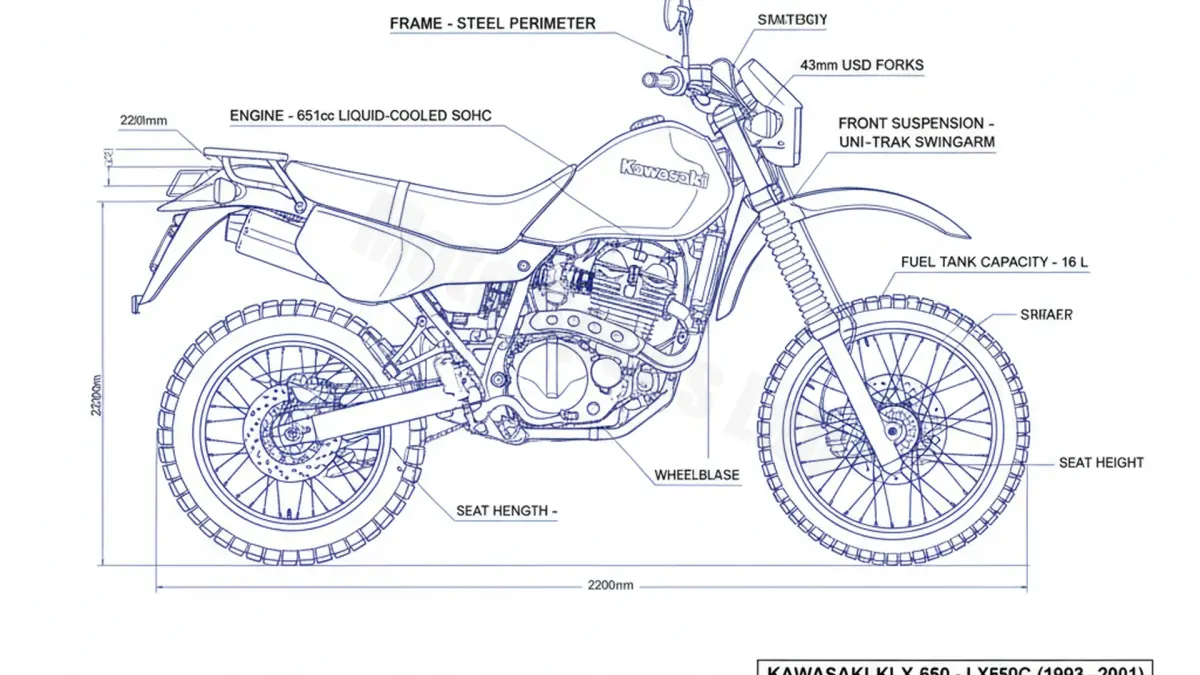
| Quick Specs: Kawasaki KLX 650 (LX650C) | |
|---|---|
| Production Years | 1993–1996 |
| Engine Type | 651cc Liquid-Cooled DOHC Single |
| Engine Oil | SAE 10W-40 (API SE, SF, SG) | 2.1L (Filter Change) |
| Tires (F/R) | 90/90-21 54S / 120/90-17 64S |
| Spark Plug | NGK DPR8EA-9 (0.8–0.9 mm gap) |
| Battery | YTX9-BS |
The Kawasaki KLX 650 (LX650C) holds a unique place in dual-sport history as one of the first production motorcycles to utilize a high-tensile steel perimeter frame—a design philosophy directly inherited from Kawasaki’s KX motocross line. Unlike its contemporary, the KLR650, the KLX 650 featured a Nikasil-plated cylinder and an automatic decompression system, positioning it as a more performance-oriented alternative to the traditional adventure-touring segment.
Engineering Overview
The LX650C variant was the street-legal sibling to the off-road-only ‘R’ model. While it gained weight due to a larger battery, electric starter, and steel fuel tank, it maintained a sophisticated suspension setup. The 43mm inverted cartridge forks offered superior rigidity compared to the conventional forks found on competitors of the era. The engine, a 651cc DOHC four-valve single, was designed for high-torque delivery across the mid-range, making it a formidable machine for both fire roads and technical trails.
Maintenance Specifications
Maintaining the KLX 650 is straightforward but requires precision to ensure the longevity of the Nikasil-plated bore. Below are the critical service parameters:
Lubrication System
- Oil Grade: SAE 10W-40 (API SE, SF, or SG).
- Periodic Change: 1.9 Liters.
- With Filter Replacement: 2.1 Liters.
- Total Dry Capacity: 2.5 Liters.
Wheels and Chassis
- Front Tire: 90/90-21 54S (Standard Pressure: 1.50 bar / 22 psi).
- Rear Tire: 120/90-17 64S (Standard Pressure: 1.50 bar / 22 psi).
- Passenger Load: Increase rear pressure to 2.00 bar (28 psi).
Electrical and Ignition
- Spark Plug: NGK DPR8EA-9.
- Electrode Gap: 0.8–0.9 mm.
- Battery: 12V 8Ah (YTX9-BS).
Editorial Review: The MotoSpecsLab Verdict
At MotoSpecsLab, we evaluate the LX650C as a “lost gem” of the 90s. Its engineering was arguably ahead of its time for a dual-sport. The perimeter frame provides a level of chassis feedback that the KLR650 simply cannot match. However, owners should be aware that parts for the KLX-specific engine components are becoming rarer than those for its KLR cousin. For the enthusiast who prioritizes handling and mechanical character over long-distance comfort, the KLX 650 remains a top-tier vintage choice.
Frequently Asked Questions
Q: Can I use synthetic oil in the KLX 650?
A: Yes, provided it meets the API SE, SF, or SG standards and does not contain friction modifiers that could cause the wet clutch to slip.
Q: How often should I check the valve clearances?
A: For the LX650C, we recommend checking valve clearances every 10,000 km (6,000 miles) to ensure the DOHC system operates efficiently.