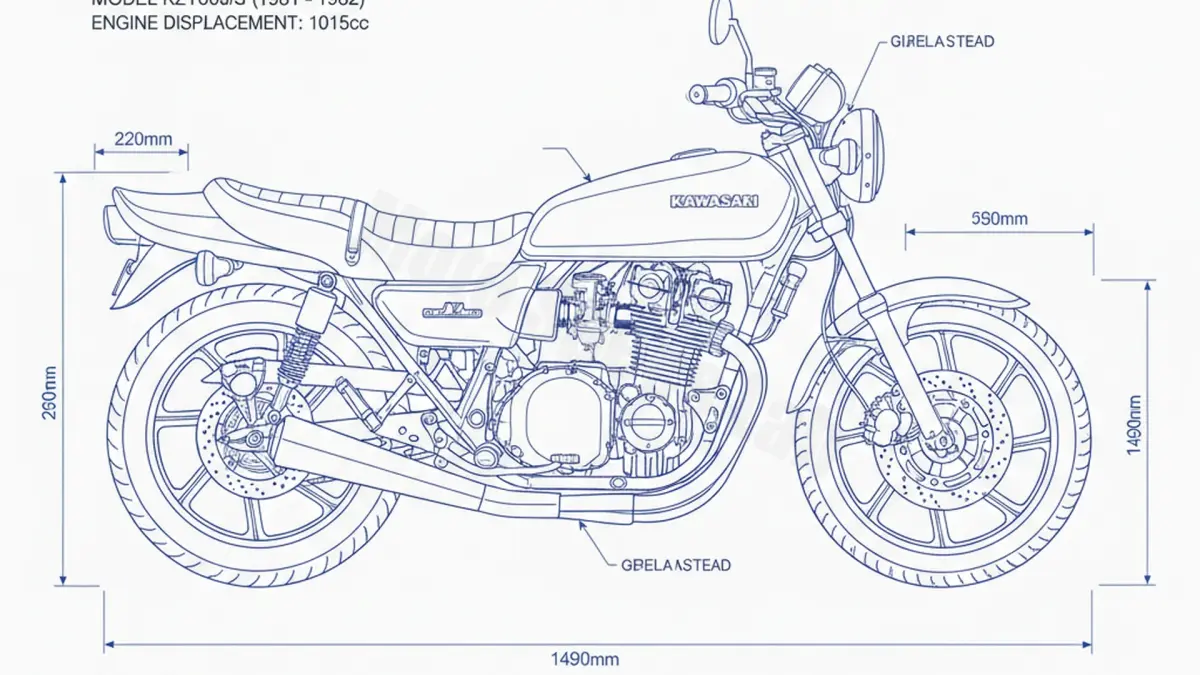
| Component | Specification |
|---|---|
| Engine Type | 998cc, 4-Cylinder, 4-Stroke, DOHC |
| Production Years | 1981 – 1983 |
| Oil Requirement | SAE 10W-40 to 20W-50 (API SE, SF, SG) |
| Tire Size (F/R) | 100/90 V19 / 120/90 V18 |
| Battery Type | YB14L-A2 |
| Spark Plug | NGK B8ES / BR8ES (0.7-0.8 mm gap) |
The Kawasaki Z 1000 J (KZT00J/J) represents a pivotal moment in Japanese motorcycle engineering. While its predecessors focused on raw displacement, the ‘J’ model was specifically engineered with a reduced displacement of 998cc to comply with the 1000cc limit newly imposed by AMA Superbike racing regulations. This strategic downsizing, paired with a more robust crankcase and redesigned cylinder head, provided the mechanical DNA for Eddie Lawson’s legendary championship victories.
Technical Engineering & Performance
Moving away from the 1015cc block of the Z1000 MKII, the Z 1000 J utilized a shorter stroke and larger valves to improve high-RPM breathing. The KZT00J frame saw significant reinforcements over previous generations, offering improved torsional rigidity to handle the increased power output and more aggressive cornering loads. It was the bridge between the ‘Universal Japanese Motorcycle’ (UJM) era and the modern era of dedicated superbikes.
Maintenance Guide: Keeping the Legend Alive
Lubrication System
The air-cooled inline-four is highly sensitive to oil quality and temperature. MotoSpecsLab recommends high-zinc content oils to protect the flat-tappet cam followers.
- Capacity: 3.2 Liters for a standard change; 3.7 Liters for a dry engine.
- Viscosity: 10W-40 or 10W-50 for temperate climates; 20W-40 or 20W-50 for high-heat environments.
- Service Interval: Every 3,000 – 5,000 km to maintain optimal shear stability.
Ignition & Electrical
The Z 1000 J transitioned to an electronic ignition system, significantly reducing the maintenance burden compared to older points-based systems. For optimal combustion, use NGK B8ES or the resistor-type BR8ES plugs, ensuring the gap is precisely set between 0.7mm and 0.8mm. The electrical system is supported by a YB14L-A2 lead-acid battery; however, modern AGM equivalents are a popular upgrade for reliability.
Chassis & Tires
Handling on the KZT00J is heavily dependent on maintaining correct tire pressures. The bike features a 19-inch front and 18-inch rear wheel configuration, typical of early 80s performance machines.
- Front Pressure: 2.0 bar (28 psi).
- Rear Pressure: 2.25 bar (32 psi) for solo riding; increase to 2.5 bar (36 psi) for dual riding or heavy luggage.
The MotoSpecsLab Verdict
The Kawasaki Z 1000 J is more than a vintage motorcycle; it is a racing homologation masterpiece. For collectors and enthusiasts, maintaining the KZT00J requires a commitment to period-correct specifications and high-quality lubricants. When properly tuned, the ‘J’ model offers a visceral, mechanical riding experience that modern fuel-injected bikes simply cannot replicate.