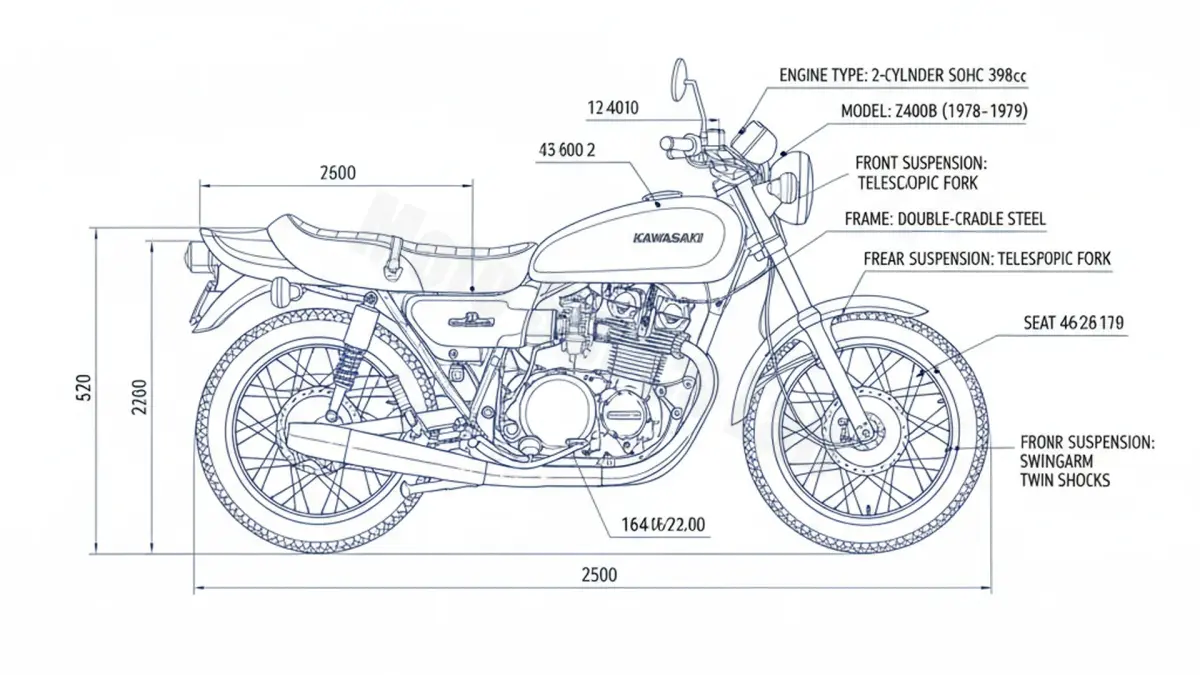
| Specification | Detail |
|---|---|
| Production Years | 1978 – 1980 |
| Engine Type | 2-Cylinder Parallel Twin (4-Stroke) |
| Oil Capacity | 2.0 L (Change) / 2.5 L (Dry) |
| Oil Grade | SAE 10W-40 to 20W-50 (API SE/SF) |
| Tire Size (Front/Rear) | 3.25 – 18 4PR / 3.50 – 18 4PR |
| Spark Plug | NGK B7ES |
| Battery | YB12A-A |
A unique engineering hallmark of the Kawasaki Z 400 B was its pioneering use of a dynamic counter-balancer system. In an era where parallel twins were notorious for high-frequency vibrations that could numb a rider’s hands, Kawasaki implemented a chain-driven balance shaft to counteract the inertia of the 180-degree crankshaft. This made the Z400 one of the smoothest middleweight commuters of the late 1970s.
Technical Engineering Overview
The K4/B variant represents the evolution of Kawasaki’s mid-sized air-cooled twins. Unlike the more aggressive Z-series fours, the Z 400 B focused on torque delivery and mechanical reliability. The SOHC (Single Overhead Cam) design provided a balance between performance and ease of maintenance, making it a favorite for both urban commuters and touring enthusiasts in the late 70s.
Maintenance Guide: Keeping the Twin Alive
Lubrication System
The Z 400 B is sensitive to oil quality. For modern operation, we recommend a high-quality mineral or semi-synthetic SAE 10W-40 or 20W-50 meeting API SE/SF standards. During a standard oil change, the engine requires 2.0 liters. If the engine has been completely stripped (dry), the capacity increases to 2.5 liters. Regular intervals are crucial to prevent wear on the overhead cam journals.
Tires and Handling
Equipped with 18-inch wheels both front and rear, the Z 400 B maintains a classic profile. The factory-recommended pressures are essential for stability: 1.8 bar (26 psi) for the front and 2.0 bar (29 psi) for the rear. If you are carrying a passenger or heavy luggage, the rear pressure should be increased to 2.25 bar (32 psi) to prevent sidewall deformation.
Electrical and Ignition
The ignition system relies on the NGK B7ES spark plug. This heat range is optimal for the air-cooled cylinders. The electrical system is powered by a YB12A-A battery. Given the age of these machines, ensure all ground connections are free of corrosion to maintain the efficiency of the charging system.
MotoSpecsLab Verdict
The Kawasaki Z 400 B (K4/B) remains a testament to Kawasaki’s ability to refine the parallel-twin formula. While it may lack the raw power of the larger Z1, its mechanical harmony and straightforward maintenance schedule make it an exceptional choice for vintage enthusiasts. Proper adherence to the fluid and pressure specifications listed above will ensure this machine continues to run smoothly for decades to come.