| Attribute | Specification |
|---|---|
| Production Years | 2020 – 2021 (EURO 4) |
| Engine Type | 998cc Supercharged Inline-4 |
| Engine Oil | SAE 10W-40 (API SG-SM / JASO MA2) |
| Oil Capacity | 4.0 L (with filter change) |
| Tire Dimensions | F: 120/70 ZR 17 | R: 190/55 ZR 17 |
| Tire Pressure | F: 2.5 bar (36 psi) | R: 2.9 bar (42 psi) |
| Spark Plug | NGK SILMAR9B9 (Gap: 0.8 – 0.9 mm) |
| Battery Type | YTZ10S |
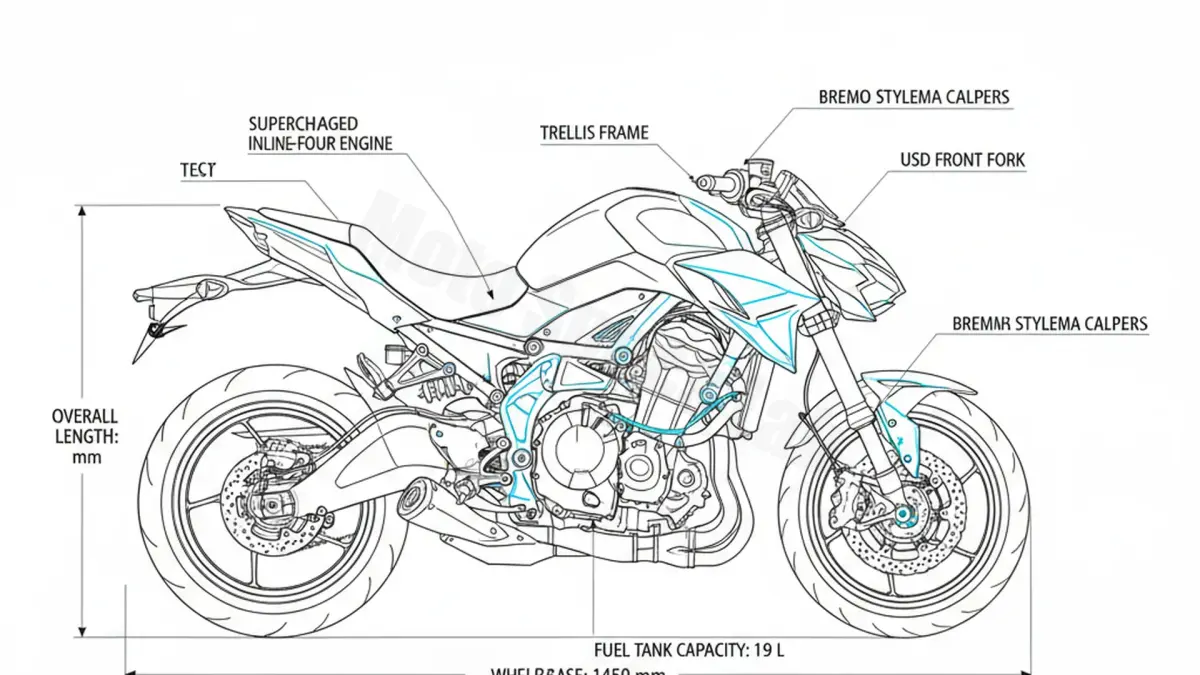
The Kawasaki Z H2 (ZR1000K) stands as a landmark in motorcycle engineering, being the only mass-produced “naked” hyper-naked to utilize a balanced supercharger—a proprietary technology developed not just by Kawasaki’s motorcycle division, but through a cross-industry collaboration with the Kawasaki Aerospace Company and the Corporate Technology Division. This synergy resulted in a forced-induction system so efficient it requires no bulky intercooler, maintaining the aggressive Sugomi silhouette while delivering 200hp.
Engineering Overview
At the heart of the ZR1000K is the 998cc power unit. Unlike the track-focused H2R, the Z H2’s supercharger is tuned for a broader powerband, emphasizing low-to-mid-range torque. The planetary gear drive spins the impeller up to 9.2 times the crankshaft speed, reaching nearly 110,000 RPM. This requires a high-strength trellis frame designed specifically to manage the heat dissipation and torsional stress unique to forced induction.
Maintenance Guide
1. Lubrication System
Given the high thermal loads of a supercharged engine, oil quality is paramount. Use only high-performance synthetic SAE 10W-40 meeting JASO MA2 standards. The supercharger shares the engine oil, making regular intervals critical.
- Capacity (with filter): 4.0 Liters
- Capacity (dry): 4.7 Liters
2. Ignition & Electrical
The Z H2 utilizes specialized NGK SILMAR9B9 iridium spark plugs. These are designed to withstand the increased cylinder pressures of the supercharged intake charge. The gap must be precisely set between 0.8 and 0.9 mm. For the electrical system, the YTZ10S battery provides the high cold-cranking amps required for the high-compression start-up cycle.
3. Chassis & Tires
To handle the 137 Nm of torque, the Z H2 is fitted with 190/55 ZR 17 rear rubber. Maintaining the factory pressure of 2.9 bar (42 psi) in the rear is essential for tire longevity and to prevent overheating the carcass during high-speed acceleration. The front 120/70 ZR 17 should be kept at 2.5 bar (36 psi) to ensure steering precision under the heavy braking loads provided by the Brembo M4.32 calipers.
Expert Verdict
The EURO 4 iteration of the Z H2 (2020-2021) represents the purest expression of Kawasaki’s “Supercharged” philosophy in a street-naked format. While maintenance is more intensive than a naturally aspirated Z1000, the engineering overhead is justified by the linear, relentless power delivery that remains unmatched in the segment. For owners, adhering to the 4.0L oil capacity and specific NGK plug gaps is the difference between peak performance and mechanical compromise.