
| Attribute | Specification |
|---|---|
| Model Designation | ZRT00PPA (Z H2) |
| Production Years | 2020 – Present |
| Engine Oil | SAE 10W-40 API SG-SM JASO MA/MA1/MA2 (4.1 L) |
| Tire Dimensions | F: 120/70 ZR 17 / R: 190/55 ZR 17 |
| Tire Pressure | F: 2.5 bar (36 psi) / R: 2.9 bar (42 psi) |
| Battery Type | YTZ10S |
| Spark Plug | NGK SILMAR9B9 |
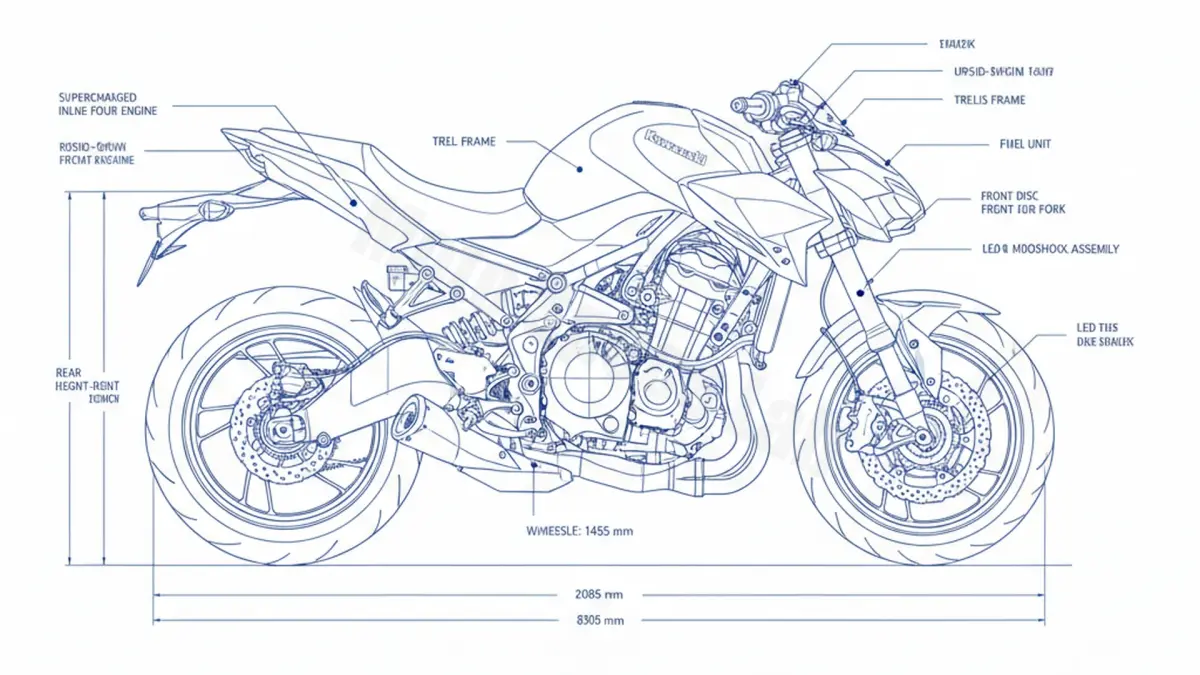
The Kawasaki Z H2 (ZRT00PPA) represents a watershed moment in motorcycling history, being the only production naked motorcycle to utilize a balanced supercharger. Unlike traditional turbochargers that rely on exhaust gas temperature, the Z H2’s centrifugal supercharger is driven by a planetary gear train off the crankshaft, spinning up to 110,000 RPM. This engineering feat, developed in collaboration with Kawasaki’s Aerospace Company, allows the Z H2 to deliver linear power without the massive heat soak typically associated with forced induction.
Engineering Overview: The Balanced Supercharger
The ZRT00PPA engine is not merely a Ninja H2 engine detuned for street use; it is a specialized ‘Balanced Supercharged’ unit. The impeller is machined from a single forged aluminum block using 5-axis CNC technology to ensure structural integrity at extreme rotational speeds. This design prioritizes low-to-mid-range torque, making the 200PS output accessible in real-world riding conditions rather than just at the redline.
Maintenance Protocol: Lubrication and Cooling
Given the high thermal loads of a supercharged engine, oil quality is paramount. The Z H2 requires 4.1 liters of SAE 10W-40 meeting JASO MA2 standards. The oil doesn’t just lubricate the transmission and cylinders; it is the primary cooling medium for the supercharger’s planetary gear system. MotoSpecsLab recommends a strict 7,500-mile (12,000 km) interval, though high-performance users should consider 4,000-mile intervals to preserve the impeller bearings.
Chassis and Ignition Systems
The trellis frame is specifically engineered to provide a balance of stiffness and flex, dissipating the heat from the engine more effectively than a twin-spar aluminum frame. For ignition, the NGK SILMAR9B9 iridium plugs are mandatory. These long-reach plugs are designed to resist the high-pressure environment of the combustion chamber under boost. Using a standard plug can lead to pre-ignition or catastrophic engine failure.
Wheel and Tire Configuration
Handling the 137 Nm of torque requires precise tire management. The ZRT00PPA utilizes a 190/55 ZR 17 rear profile to provide a larger contact patch at lean. Maintaining the factory-specified 2.9 bar (42 psi) in the rear is critical; lower pressures can cause excessive carcass deformation under the immense torque load of the supercharger, leading to premature wear or traction control interference.
Frequently Asked Questions
How often should the supercharger be inspected?
Kawasaki recommends a visual inspection of the supercharger intake and impeller every 15,000 miles (24,000 km). Ensure there is no oil residue in the intake, which could indicate a seal failure.
Can I use a different battery than the YTZ10S?
The YTZ10S is a high-CCA (Cold Cranking Amp) battery required to turn over the high-compression, supercharged 998cc inline-four. Using a battery with lower CCA may result in starting difficulties and electronic errors in the IMU (Inertial Measurement Unit).