
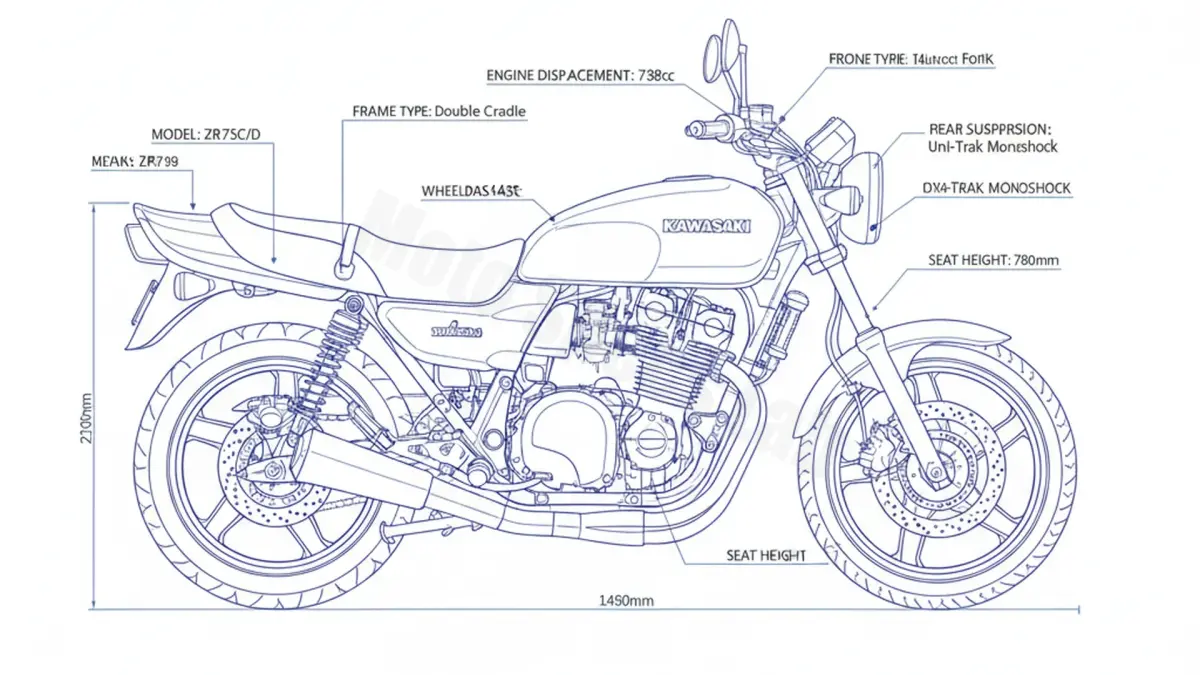
| Component | Specification |
|---|---|
| Production Years | 1991–2006 |
| Engine Type | Air-cooled, 4-stroke, Inline-four, DOHC |
| Engine Oil | SAE 10W-40 (API SE/SF/SG) (3.5 L) |
| Tires (Front/Rear) | F: 120/70-17 58V / R: 150/70-17 69V |
| Tire Pressure | F: 2.25 bar (33 psi) / R: 2.5 bar (36 psi) |
| Battery Type | YB12AL-A |
| Spark Plug | NGK DR8ES |
Engineering Highlight: The Return of the Air-Cooled Legend
The Kawasaki Zephyr 750 holds a unique place in motorcycling history as the catalyst for the 1990s “retro-naked” boom. Unlike its contemporaries that were chasing liquid-cooled, aerodynamic supremacy, the Zephyr 750 was an intentional engineering homage to the legendary 1972 Z1. Its most notable technical feat is the refinement of the Z650-derived engine architecture; Kawasaki engineers utilized a proven, bulletproof bottom-end but redesigned the cylinder head and cooling fins to create a visual and mechanical masterpiece that prioritized mid-range torque and aesthetic symmetry over raw top-end power.
Technical Review & Performance
From a technical standpoint, the ZR750C/D series is defined by its simplicity and reliability. The air-cooled 738cc inline-four engine is remarkably robust, provided the thermal limits are respected. The chassis is a traditional steel double-cradle design which, while heavier than modern aluminum frames, provides the classic flex and feel desired by enthusiasts of the era. The “D” models (RS version) featured spoked wheels, further leaning into the vintage aesthetic without compromising the 17-inch wheel diameter that allows for modern radial tire fitment.
Maintenance Guide
Lubrication System
For optimal engine longevity, the Zephyr 750 requires 3.5 liters of SAE 10W-40 oil. Given the air-cooled nature of the engine, it is critical to use oils meeting at least API SE, SF, or SG standards. In warmer climates, a slightly higher viscosity may be considered, but 10W-40 remains the factory standard for all-around performance.
Ignition & Electrical
The ignition system relies on NGK DR8ES spark plugs. These should be inspected every 6,000 km for electrode wear and carbon fouling. The electrical system is powered by a YB12AL-A lead-acid battery; ensure the electrolyte levels are maintained if using a non-sealed variant, as the Zephyr’s charging system is robust but can be taxing on older battery designs.
Tires and Handling
The Zephyr 750 utilizes a 120/70-17 front and a 150/70-17 rear. Maintaining precise pressures is vital for the bike’s neutral handling characteristics. MotoSpecsLab recommends 2.25 bar (33 psi) in the front and 2.5 bar (36 psi) in the rear for solo riding. Under-inflation leads to heavy steering and accelerated cupping of the front tire.
MotoSpecsLab Verdict
The Kawasaki Zephyr 750 (ZR750C/D) is a masterclass in functional nostalgia. It offers a mechanical purity that is increasingly rare. For the collector or the daily rider, its maintenance is straightforward, provided the owner adheres to the 3.5L oil capacity and specific NGK plug requirements. It remains one of the most accessible and rewarding Japanese classics on the market today.