
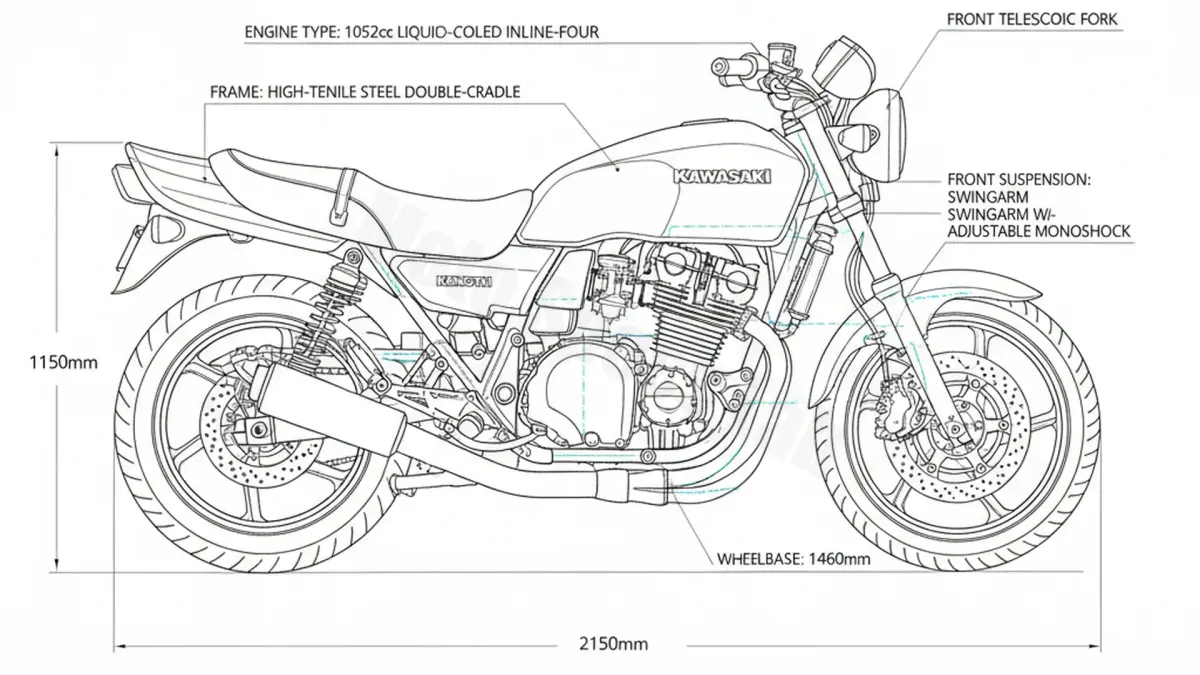
| Specification | Data |
|---|---|
| Production Years | 1997–2000 |
| Engine Type | 1052cc, Inline-4, DOHC |
| Oil Grade | SAE 10W-40 (API SE, SF, SG) |
| Oil Capacity | 3.0 L (Filter) / 3.5 L (Dry) |
| Tire Size | F: 120/70 ZR 17 / R: 170/60 ZR 17 |
| Tire Pressure | F: 36 psi / R: 42 psi |
| Battery | YTX14-BS |
| Spark Plug | NGK CR9EK (0.6–0.7mm gap) |
Engineering Highlight: Unlike many retro-styled nakeds of its era that used budget components, the ZRX 1100 featured a massive, over-engineered aluminum braced swingarm. This design was a direct functional homage to Eddie Lawson’s 1982 AMA Superbike championship-winning KZ1000R, providing the ZRT10C with significantly more lateral rigidity than its competitors.
The Powerplant: GPZ DNA
At the heart of the ZRT10C is a liquid-cooled 1052cc inline-four, derived from the legendary GPZ1100. Kawasaki engineers retuned the engine for the ZRX to prioritize mid-range torque over top-end rush. This was achieved through smaller 36mm Keihin CVK carburetors and revised cam profiles. The result is a ‘muscle bike’ that offers immediate throttle response from as low as 3,000 RPM, making it an exceptional platform for both urban riding and high-speed touring.
Maintenance Guide & Technical Essentials
Lubrication System
To maintain the longevity of the DOHC valvetrain, MotoSpecsLab recommends high-quality SAE 10W-40 oil meeting API SE, SF, or SG standards. During a standard service with a filter change, the engine requires 3.0 liters. If the engine has been disassembled (dry fill), the capacity increases to 3.5 liters. Regular oil analysis on these units often shows minimal wear even at high mileages, provided the 6,000-mile interval is respected.
Ignition and Electrical
The ZRX 1100 utilizes NGK CR9EK spark plugs. For optimal combustion efficiency and cold-start reliability, the gap must be precisely set between 0.6 mm and 0.7 mm. The electrical system is supported by a YTX14-BS battery; given the high compression of the 1052cc mill, maintaining a healthy CCA (Cold Cranking Amps) is vital to avoid starter clutch wear.
Chassis and Contact Patch
The ZRT10C handles best when utilizing its factory-specified tire pressures of 2.5 bar (36 psi) front and 2.9 bar (42 psi) rear. While modern tire compounds offer better grip than the original 1990s fitment, the 170/60 ZR 17 rear profile remains the sweet spot for maintaining the bike’s flickability without sacrificing the stability required for its 220kg+ dry weight.
Editor’s Verdict
The Kawasaki ZRX 1100 remains a benchmark in the Universal Japanese Motorcycle (UJM) category. Its blend of 1980s aesthetics and 1990s engineering reliability makes it a favorite among enthusiasts. From a technical perspective, the ZRT10C is remarkably accessible for home mechanics while offering the build quality that defined Kawasaki’s golden era of over-engineering.