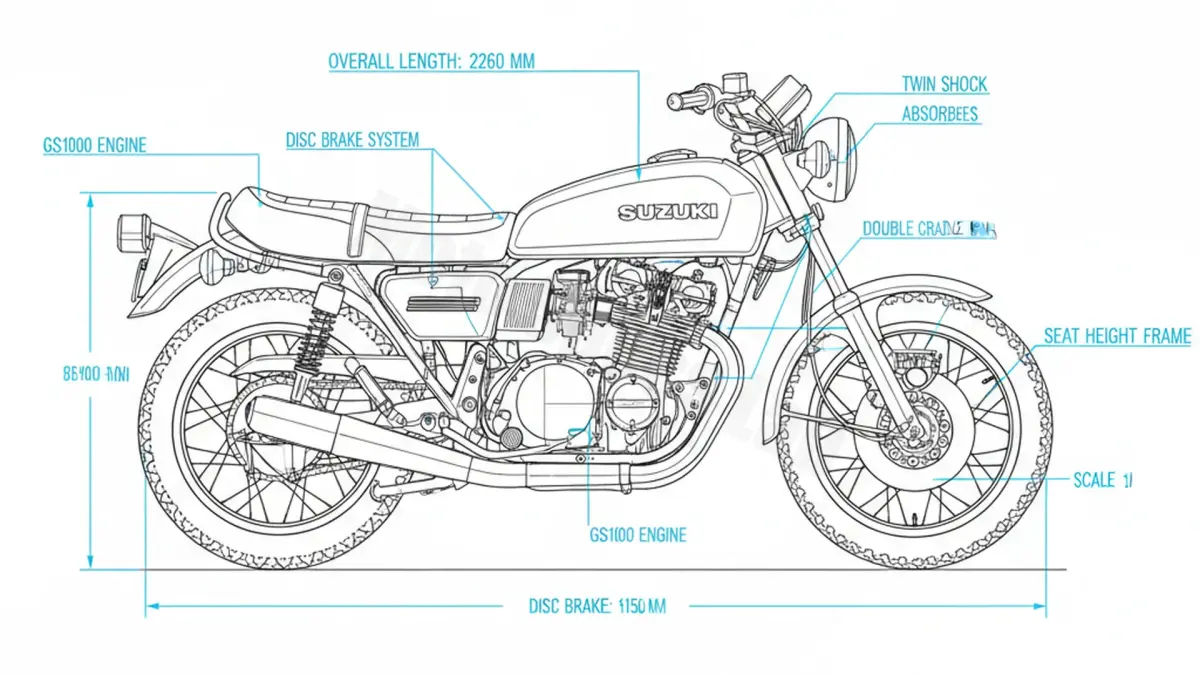
While competitors in the late 1970s were adding bulk to achieve power, Suzuki performed an engineering miracle: the GS 1000 was actually lighter than its 750cc predecessor. By utilizing a bored-out version of the GS750 engine and a redesigned, thin-walled frame, Suzuki created a machine that dominated the AMA Superbike championships and set a new standard for handling in the ‘Universal Japanese Motorcycle’ (UJM) era.
| Quick Specs: Suzuki GS 1000 D/E (1978-1980) | |
|---|---|
| Engine Type | 997cc, DOHC, Inline-Four |
| Engine Oil | SAE 10W-40 API SE/SF |
| Oil Capacity | 2.8 L (Change) / 3.2 L (Dry) |
| Tires (F/R) | F: 100/90-19 | R: 110/90-18 |
| Spark Plugs | NGK B8ES (0.7-0.8 mm gap) |
| Battery | YB14L-A2 |
Technical Overview: The GS Legacy
The Suzuki GS 1000 D/E represents the pinnacle of air-cooled, eight-valve technology. Its engine is renowned for a ‘bulletproof’ bottom end, featuring a pressed-together roller-bearing crankshaft that allows for high-RPM reliability. The ‘E’ designation typically referred to the cast alloy wheels, which improved tubeless tire compatibility and structural rigidity compared to the ‘D’ (spoke) models.
One of its most significant technical innovations was the introduction of air-assisted front forks and adjustable rear damping, providing a level of suspension tuning previously unseen on production street bikes. This allowed the GS1000 to remain stable at high speeds while offering a plush ride for touring.
Maintenance Guide & Essential Data
Lubrication System
For optimal performance of the wet clutch and internal gears, use a high-quality SAE 10W-40 oil meeting API SE or SF specifications. During a standard oil change, the system requires 2.8 liters. If the engine has been completely disassembled (dry), the capacity increases to 3.2 liters.
Chassis and Tires
Correct tire pressure is critical for maintaining the GS1000’s legendary handling. For solo riding, maintain 1.7 bar (25 psi) in the front and 2.0 bar (28 psi) in the rear. When carrying a passenger or heavy luggage, increase the rear pressure to 2.3 – 2.5 bar (32-36 psi) to prevent sidewall flex and heat buildup.
Ignition and Electrical
The GS1000 utilizes NGK B8ES spark plugs. To ensure efficient combustion and prevent fouling, the gap must be set precisely between 0.7mm and 0.8mm. The electrical system is supported by a YB14L-A2 battery; regular checks of the charging system (stator and regulator/rectifier) are recommended, as these are known weak points in vintage Japanese electronics.
Editorial Verdict
The Suzuki GS 1000 D/E remains a favorite among vintage enthusiasts not just for its performance, but for its approachability. It is a bike that rewards precise maintenance with modern-day reliability. From a technical standpoint, it is the quintessential example of how weight reduction can be as effective as raw horsepower.