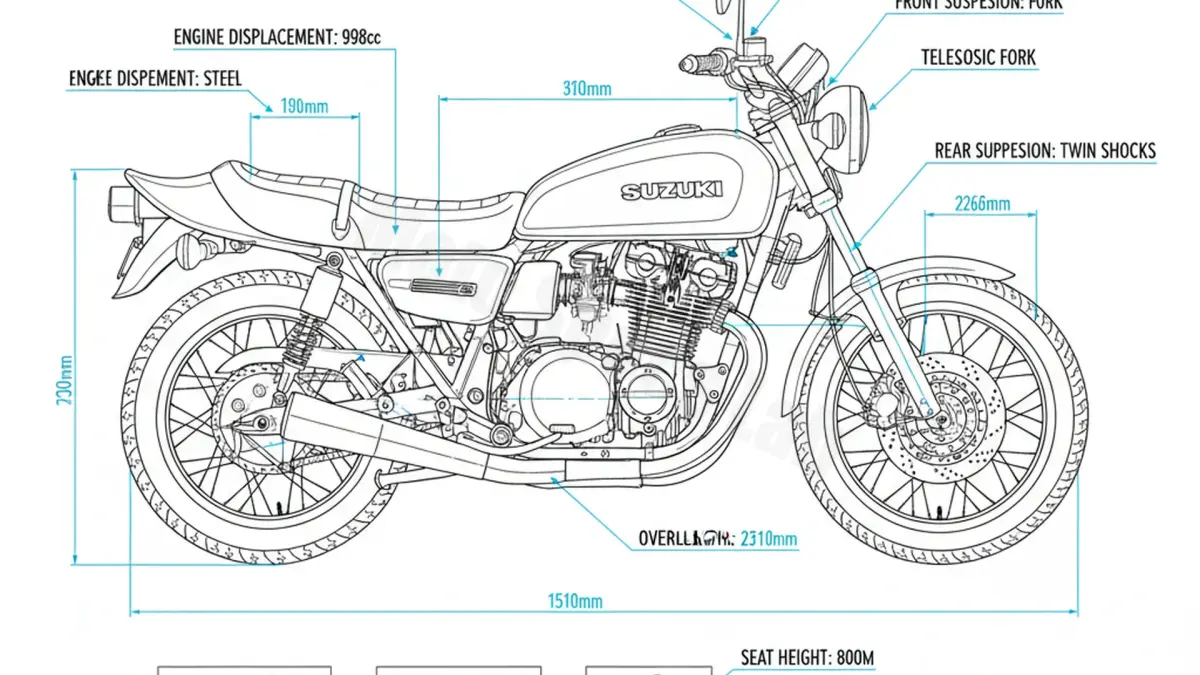
A unique engineering highlight of the Suzuki GS 1000 G (GS100G) is its hybrid DNA: Suzuki took the legendary, race-proven DOHC engine from the GS1000 and mated it to a sophisticated shaft-drive system derived from the GS850G. This created a ‘Super-Tourer’ that offered the reliability of a shaft-drive without sacrificing the raw, high-revving power that made the GS series the king of the late 1970s superbikes.
| Quick Specs: Suzuki GS 1000 G | |
|---|---|
| Production Years | 1980 – 1981 |
| Engine Type | 997cc, DOHC, Inline-4 |
| Drive Type | Shaft Drive |
| Oil Specification | SAE 10W-40 (API SE/SF) |
| Oil Capacity | 3.5 Liters |
| Spark Plug | NGK B8ES |
| Battery | YB14L-A2 |
| Front Tire | 100/90-19 (1.75 bar / 25 psi) |
| Rear Tire | 130/90-17 (2.00 bar / 28 psi) |
Technical Review: Performance Meets Endurance
The GS 1000 G represents the pinnacle of Suzuki’s early 80s ‘Universal Japanese Motorcycle’ (UJM) philosophy. While the chain-driven GS1000 was a track weapon, the ‘G’ model was engineered for the trans-continental traveler. The frame was reinforced to handle the weight of the shaft-drive assembly, and the suspension was tuned for a more compliant, plush ride.
From a technical standpoint, the 997cc engine remains one of the most over-engineered powerplants of the era. With a roller-bearing crankshaft and a robust DOHC valve train, the GS100G is capable of exceeding 100,000 miles with proper maintenance. The transition from chain to shaft drive resulted in a slight increase in unsprung weight, but Suzuki’s engineers mitigated ‘shaft-jacking’ (the tendency of the rear to rise under acceleration) better than many of their contemporaries.
Maintenance Guide & Essential Specifications
Lubrication System
The engine requires 3.5 liters of SAE 10W-40 oil. Given the vintage of the internal components, using an oil with sufficient ZDDP levels (API SE/SF standards) is critical for protecting the camshafts and flat tappets. Since this is a shared-sump design, ensure the oil is JASO MA rated if using modern synthetics to prevent clutch slippage.
Ignition & Electrical
To maintain crisp throttle response and cold-start reliability, the NGK B8ES spark plugs should be gapped to 0.6–0.7mm. The electrical system relies on a YB14L-A2 lead-acid battery; owners should regularly check the electrolyte levels, as the charging systems on these vintage Suzukis can run ‘hot’, leading to fluid evaporation.
Tires & Handling
The GS 1000 G uses a 19-inch front and 17-inch rear wheel configuration. For optimal stability and even tread wear, maintain 1.75 bar (25 psi) in the front 100/90-19 tire and 2.00 bar (28 psi) in the rear 130/90-17 tire. Note that these pressures are for solo riding; if touring with heavy luggage, the rear pressure should be increased to 2.25-2.50 bar.
Frequently Asked Questions
What is the recommended oil change interval?
For the GS 1000 G, we recommend changing the oil and filter every 3,000 miles (5,000 km) to prevent sludge buildup in the cooling passages.
Can I use a maintenance-free battery?
Yes, an AGM equivalent to the YB14L-A2 can be used, provided the charging system’s voltage regulator is functioning correctly (not exceeding 14.5V).
Why is the rear tire pressure lower than modern bikes?
Vintage bias-ply tires and the specific weight distribution of the GS100G’s shaft drive require these specific pressures to maintain the correct contact patch and heat dissipation.