
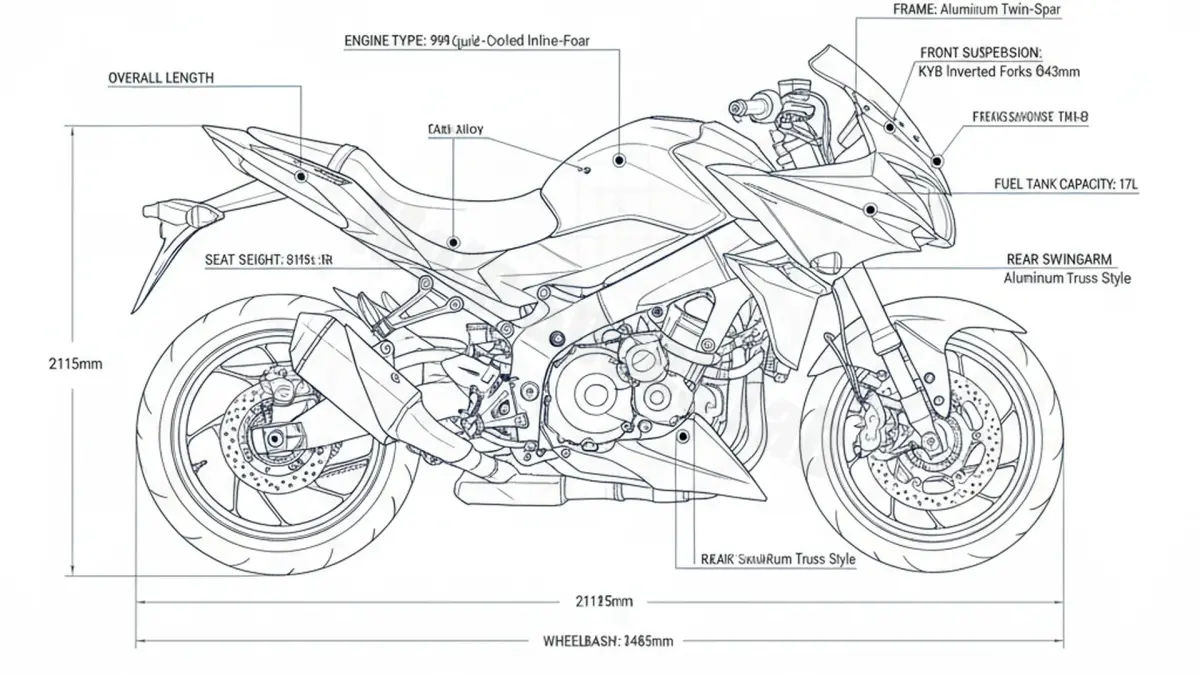
| Category | Specification |
|---|---|
| Production Years | 2015 – 2020 |
| Engine Heritage | 999cc Inline-4 (GSX-R1000 K5 Derived) |
| Engine Oil | SAE 10W-40 JASO MA2 (2.8 L) |
| Spark Plugs | NGK CR9EIA-9 |
| Battery Type | YT12A-BS |
| Tire Size (Front) | 120/70 ZR 17 |
| Tire Size (Rear) | 190/50 ZR 17 |
| Tire Pressure (F/R) | 2.5 bar / 2.9 bar (36/42 psi) |
The K5 Legacy: Engineering Excellence
The Suzuki GSX-S 1000 F (DG/F) stands as a masterclass in repurposed engineering. While most manufacturers develop new engines from scratch, Suzuki engineers recognized that the 2005-2008 GSX-R1000 (K5) architecture possessed a ‘long-stroke’ design (73.4mm x 59.0mm) that was inherently better suited for street torque than modern, over-square superbike engines. This heritage gives the GSX-S 1000 F a relentless midrange pull that defines the sport-touring experience.
Technical Performance Analysis
The DG/F designation represents the faired iteration of Suzuki’s liter-class naked. Unlike many competitors that detune their engines significantly, Suzuki retained the high-quality internal components of the K5, including the SCEM (Suzuki Composite Electrochemical Material) plated cylinders. The result is a machine that delivers linear power while maintaining the reliability expected of a high-mileage tourer.
Maintenance Guidelines
To maintain the high-performance standards of the GSX-S 1000 F, adherence to the following technical specifications is mandatory:
- Lubrication: Use a high-quality SAE 10W-40 JASO MA2 synthetic or semi-synthetic oil. The refill capacity is 2.8 liters.
- Ignition: The NGK CR9EIA-9 Iridium plugs are essential for maintaining the precise combustion required by the 32-bit ECM.
- Chassis & Tires: The 190/50 rear tire profile provides a stable contact patch for high-speed touring. Maintaining pressures at 2.5 bar (front) and 2.9 bar (rear) is critical for preventing cupping and ensuring neutral handling.
Frequently Asked Questions
What is the recommended battery for this model?
The GSX-S 1000 F uses a YT12A-BS battery. It is recommended to use an AGM (Absorbent Glass Mat) variant for better vibration resistance.
How often should spark plugs be replaced?
While Iridium plugs like the NGK CR9EIA-9 are long-lasting, they should be inspected every 12,000 km and typically replaced by 24,000 km to ensure optimal fuel mapping performance.