| Component | Specification |
|---|---|
| Model Year | 1991 (M) |
| Engine Type | 249cc 90° V-twin, 2-Stroke |
| Transmission Oil | SAE 10W-40 (API SF/SG, JASO MA/MA2) – 0.7 L |
| Front Tire | 110/70 R17 54H |
| Rear Tire | 150/60 R17 66H |
| Tire Pressure (F/R) | 2.0 bar (29 psi) / 2.2 bar (33 psi) |
| Battery | YTX4L-BS |
| Spark Plug | NGK BR9ECM |
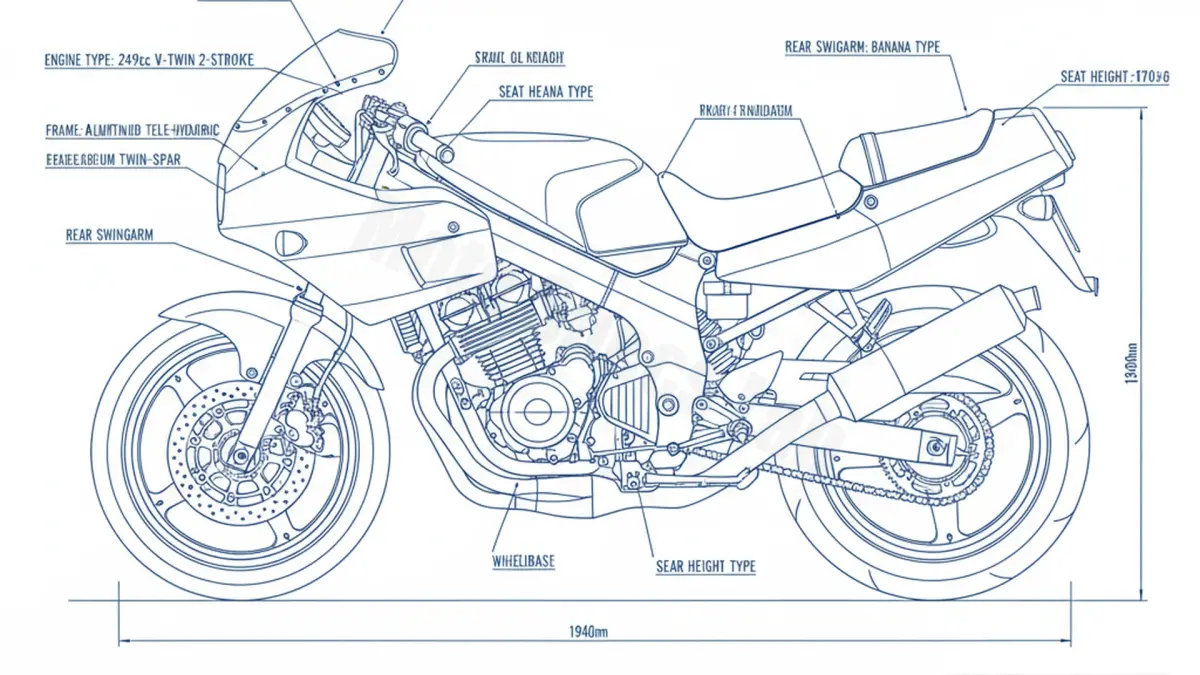
The 1991 Suzuki RGV 250 (M) VJ22B represents the zenith of the 250cc two-stroke era. A unique engineering highlight of this specific iteration is the introduction of the SAPL (Suzuki Advanced Performance Link) ‘banana’ swingarm. This asymmetrical design was not merely aesthetic; it was a direct trickle-down from Kevin Schwantz’s RGV500 Grand Prix bike, engineered specifically to allow both expansion chambers to exit on the right side for increased ground clearance and optimized exhaust resonance.
Engineering Excellence: The V-Twin Heart
The VJ22B utilizes a 90-degree V-twin engine featuring the AETC-II (Automatic Exhaust Timing Control) system. This three-stage power valve system drastically improved mid-range torque compared to its predecessor, the VJ21. For the 1991 ‘M’ model, Suzuki also upgraded to 34mm Mikuni Slingshot carburetors, providing a sharper throttle response that remains a benchmark for lightweight sportbikes.
Maintenance & Service Guidelines
To maintain the high-strung performance of the RGV 250, strict adherence to fluid and mechanical specifications is mandatory for engine longevity.
- Gearbox Lubrication: Use 0.7 Liters of a high-quality SAE 10W-40 oil. It must meet JASO MA/MA2 standards to ensure the wet clutch does not slip under the peaky power delivery.
- Ignition System: The NGK BR9ECM is the specific ‘compact’ plug designed for this head. Using standard-length plugs can lead to clearance issues with the frame and radiator.
- Tire Configuration: Handling is sensitive to profile. We recommend maintaining the factory 110/70 and 150/60 radial setup at 29 psi front and 33 psi rear for optimal contact patch deformation during cornering.
Chassis and Braking
The VJ22B frame is a sophisticated DC-ALBOX (Dual Compound Aluminum Box) twin-spar design. In 1991, Suzuki fitted 41mm inverted forks, a significant upgrade that reduced unsprung weight and increased front-end rigidity. Braking is handled by Tokico 4-piston calipers biting 300mm floating discs, providing stopping power that still feels contemporary today.
Technical FAQ
What is the oil capacity for a gearbox change?
A standard drain and refill requires exactly 0.7 Liters of 10W-40 motorcycle-specific oil.
What battery does the VJ22B use?
The model uses a compact YTX4L-BS maintenance-free lead-acid battery.
Why is the spark plug choice critical?
The ‘ECM’ designation in the NGK BR9ECM refers to its compact insulator height, necessary due to the tight packaging of the V-twin engine within the aluminum frame.