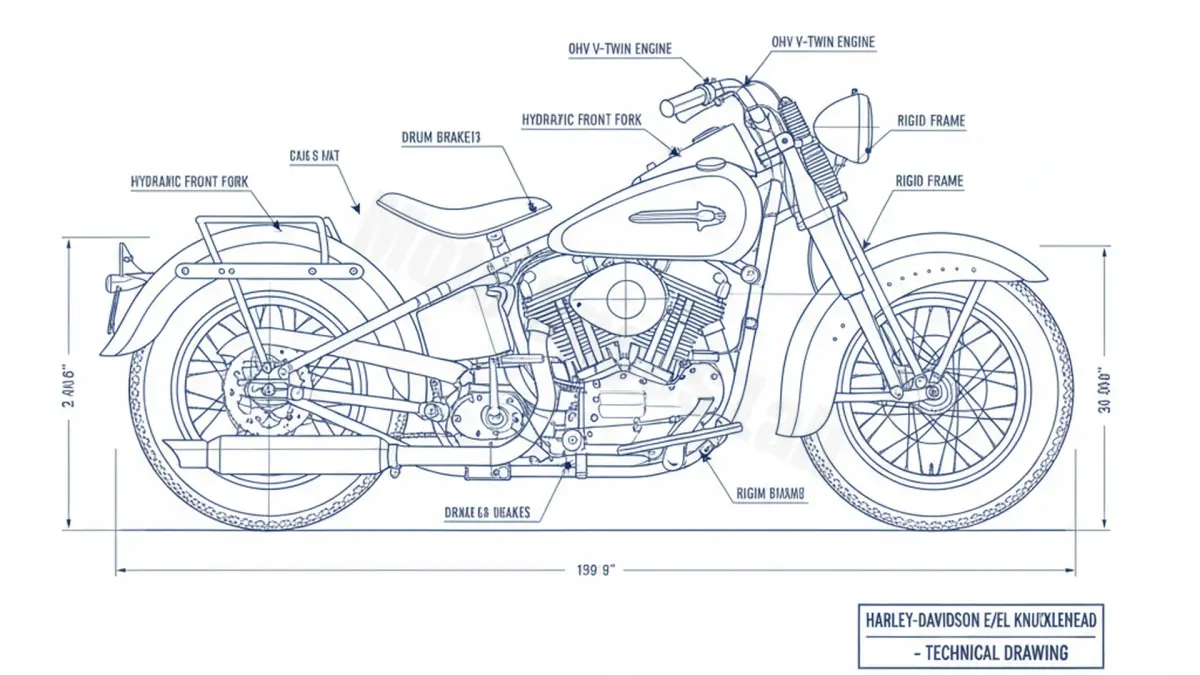
| Specification | Data |
|---|---|
| Production Years | 1936-1947 |
| Engine Displacement | 61 cu in (1,000 cc) OHV |
| Oil Capacity | 3.8 L (1.0 Gallon) |
| Tire Size | F: 4.50-18 / R: 4.50-18 |
| Electrical System | 6V 22Ah (Group 1) |
| Spark Plug | Champion No. 3 or No. 7 (18mm) |
The Engineering Milestone: A Historical Highlight
The 1936 Model E represents a pivotal moment in American motorcycling. While the ‘Knucklehead’ nickname (derived from the distinct shape of the rocker boxes) is now legendary, few realize that Harley-Davidson was so concerned about the reliability of their first production overhead-valve (OHV) V-twin that they initially omitted the model from their 1936 sales catalog. It was the first Harley-Davidson to feature a dry-sump oiling system and a recirculating lubrication circuit, setting the blueprint for every Big Twin that followed for the next 80 years.
Technical Review: The E-61 Powerplant
The ‘E’ and high-compression ‘EL’ variants utilized a 61 cubic inch engine that revolutionized the industry. Unlike the previous ‘Flathead’ sidevalve designs, the OHV configuration allowed for significantly better volumetric efficiency and heat dissipation. The ‘Knucklehead’ rockers were housed in polished covers that resembled a clenched fist, but the true innovation lay beneath: a four-speed constant-mesh transmission and a frame designed to handle the increased torque of the overhead-valve design.
Maintenance Guide: Preserving a Legend
1. Lubrication System
The Knucklehead is an air-cooled machine with high thermal demands. For optimal protection, use SAE 50 or SAE 60 straight-grade mineral oil during summer months. In colder climates (Winter), drop to SAE 30 or SAE 40. The system requires approximately 3.8 liters. Given the lack of modern filtration, frequent oil changes (every 1,000 miles) are recommended to prevent sludge buildup.
2. Ignition & Electrical
The E-61 utilizes a 6-volt electrical system. Maintenance of the 6V 22Ah (Group 1) battery is critical; ensure terminals are free of corrosion. For ignition, the 18mm Champion No. 3 or No. 7 plugs are standard. Ensure the gap is set correctly to compensate for the lower voltage output of the period-correct generator system.
3. Chassis & Tires
Handling on these vintage machines is highly sensitive to tire pressure. Running 4.50-18 tires on both ends, the front should be maintained at 0.8-1.0 bar (12-15 psi) and the rear at 1.2-1.5 bar (18-22 psi). Low pressures help provide the ‘cushion’ necessary for the rigid rear frame (hardtail) design common in this era.
Frequently Asked Questions (FAQ)
Q: Why is the Model E called a ‘Knucklehead’?
A: The name was coined by enthusiasts in the post-WWII era because the rocker arm covers resemble the knuckles on a human fist.
Q: Can I use modern multi-grade synthetic oil?
A: It is generally discouraged for original engines. Straight-grade mineral oils are better suited for the tolerances and seal materials used in 1936-1947 production.
Q: What is the difference between the E and EL models?
A: The ‘E’ was the standard-compression version (approx. 37-40 hp), while the ‘EL’ featured higher compression pistons for increased performance (approx. 40-45 hp).