
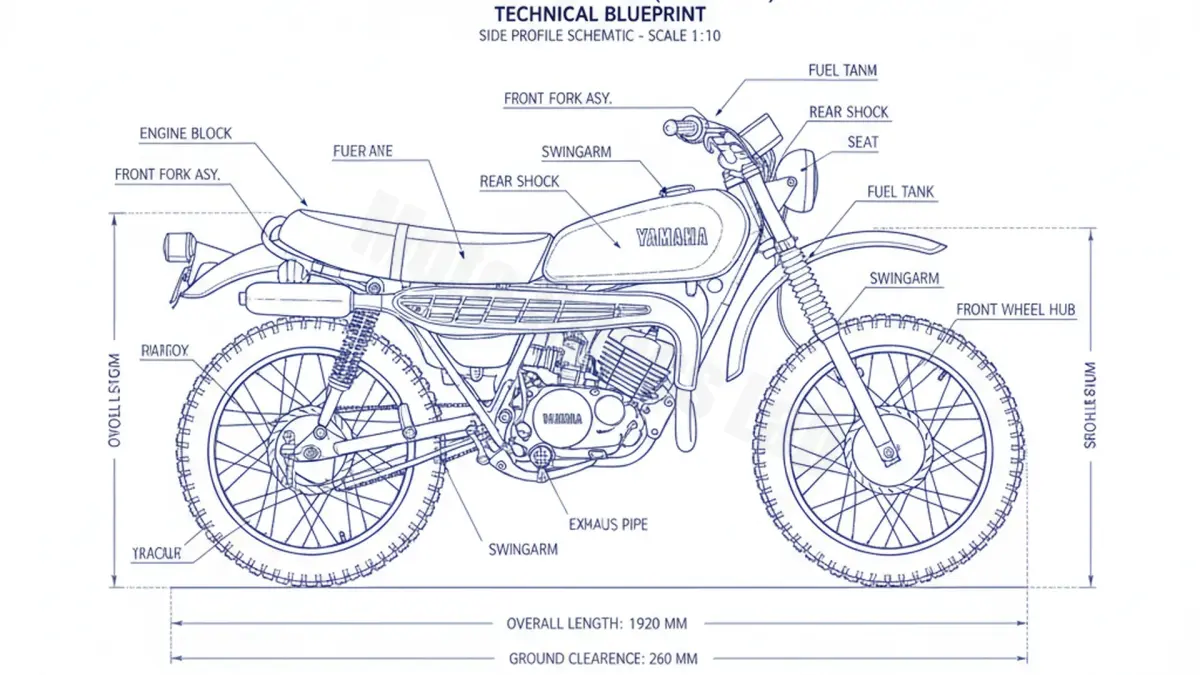
While many 50cc machines of the late 1970s were merely mopeds with off-road styling, the Yamaha DT 50 M (2M4) was engineered with a specific structural philosophy: it was one of the first small-displacement bikes to successfully implement a scaled-down version of Yamaha’s ‘Enduro’ frame geometry, providing genuine light-trail capability that outperformed its European competitors in durability.
| Component | Specification |
|---|---|
| Production Years | 1978 – 1980 |
| Engine Oil | SAE 10W-30 (Type SE or higher) (0.6 L) |
| Spark Plug | NGK B7HS |
| Tires (Front/Rear) | F: 2.50 – 19 4PR / R: 3.00 – 17 4PR |
| Tire Pressure | F: 1.5 bar (21 psi) / R: 1.8 bar (26 psi) |
| Battery Type | 6N4B-2A (6V System) |
Engineering Overview
The 2M4 variant represents a pivotal era for Yamaha’s DT (Dirt Track) series. Powered by a reliable air-cooled, two-stroke single-cylinder engine, the DT 50 M utilized a reed-valve induction system which provided a broader powerband than previous piston-port designs. This engineering choice allowed the 50cc powerplant to handle steep inclines that would stall other machines in its class.
Maintenance & Service Intervals
Lubrication System
The gearbox requires 0.6 liters of SAE 10W-30. For vintage engines of this era, MotoSpecsLab recommends using an oil with a ‘Type SE’ or higher rating. Given the age of these units, ensuring the Autolube pump is correctly synchronized is critical to prevent top-end seizures.
Ignition & Combustion
The NGK B7HS spark plug is the standard heat range for this model. Owners should inspect the electrode color regularly; a chocolate-brown hue indicates optimal air-fuel mixture. Because the DT 50 M uses a contact breaker (points) ignition system, checking the gap and timing every 3,000 km is essential for maintaining throttle response.
Chassis, Tires & Handling
The wheel configuration (19-inch front and 17-inch rear) provides a stable footprint for off-road excursions. Maintaining the correct tire pressure is vital for both rim protection and traction. We recommend 1.5 bar (21 psi) in the front and 1.8 bar (26 psi) in the rear for mixed-surface riding. The 4PR (Ply Rating) tires are necessary to handle the torque-load on the rear hub during trail climbs.
Electrical System
The DT 50 M operates on a 6V electrical system powered by a 6N4B-2A battery. This is a common failure point in restorations. Modern owners often struggle with dim lighting; this is usually due to poor grounding or aged wiring harnesses rather than the 6V output itself. Ensure all terminals are free of oxidation to maintain the integrity of the lighting circuit.
Editor’s Verdict
The Yamaha DT 50 M – 2M4 remains a masterclass in ‘over-engineering’ for the moped class. It offers a tactile, mechanical experience that modern fuel-injected bikes cannot replicate. For the collector or the vintage enthusiast, the 2M4 is a robust platform that, when maintained with the correct fluid specs and tire pressures, remains as capable today as it was in 1978.