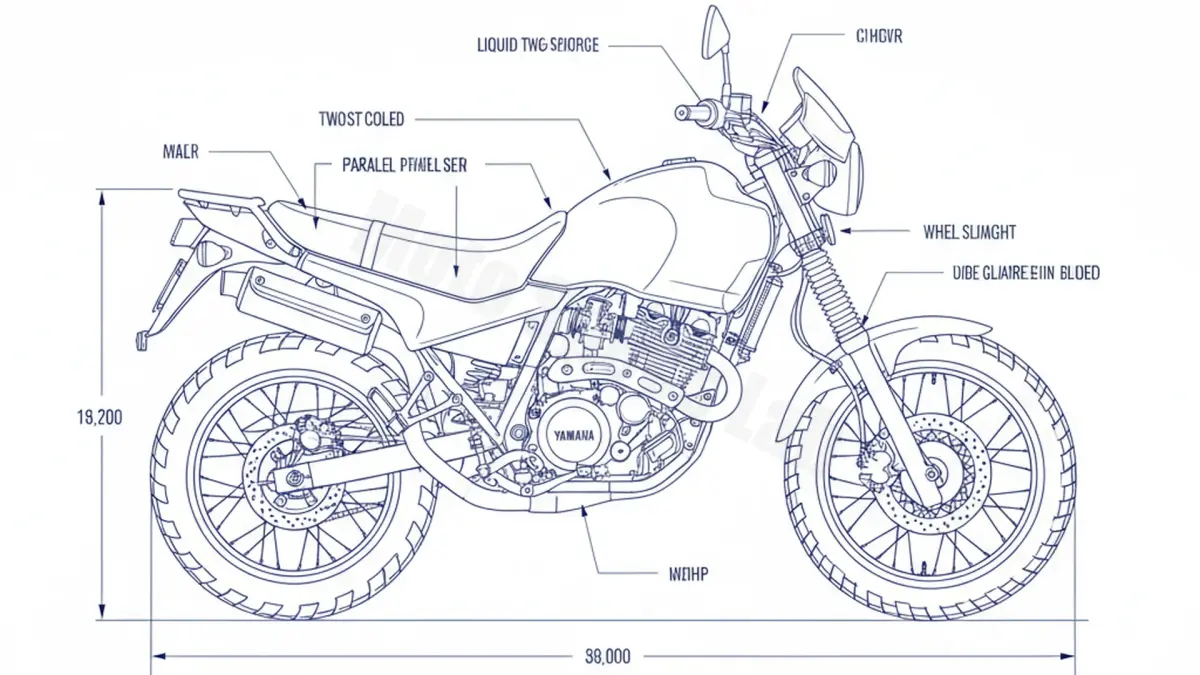
| Attribute | Specification |
|---|---|
| Production Years | 1988 – 1990 |
| Engine Type | Liquid-cooled, 2-stroke, Parallel-Twin (YPVS) |
| Engine Oil | SAE 10W-30 (API SE/SF/SG) (0.75 L) |
| Spark Plug | NGK BR9ES (0.7 – 0.8 mm gap) |
| Front Tire | 100/90-18 56H (1.75 bar / 25 psi) |
| Rear Tire | 120/80-17 61H (2.00 bar / 29 psi) |
| Battery | YB5L-B |
While the global motorcycling community is well-acquainted with the TDR 250, the Yamaha TDR 240 (3CL) remains a fascinating historical anomaly. Specifically engineered for the French market to comply with local insurance and licensing categories of the late 1980s, the 3CL variant featured a slightly reduced bore to bring the displacement down to 239cc. This allowed it to effectively pioneer the ‘Supermoto’ or ‘Dual-Sport’ performance category years before it became a mainstream segment.
Engineering Overview
The heart of the TDR 240 is its liquid-cooled, two-stroke parallel-twin engine, featuring Yamaha’s proprietary YPVS (Yamaha Power Valve System). This technology allowed for a broader powerband, providing the low-end torque necessary for urban riding while maintaining the explosive top-end performance typical of two-stroke racing heritage. The 3CL variant maintains the aggressive geometry and lightweight chassis that made the TDR series legendary for its flickability and ‘hooligan’ nature on twisty backroads.
Maintenance Guide & Technical Specs
Engine Lubrication and Filtration
For the gearbox and clutch assembly, MotoSpecsLab recommends SAE 10W-30 motor oil meeting API SE, SF, or SG standards. The total capacity is a precise 0.75 Liters. Regular changes are critical to preserve the integrity of the clutch plates under the high-revving nature of the twin-cylinder engine.
Ignition System
The TDR 240 utilizes NGK BR9ES spark plugs. To ensure optimal combustion and prevent fouling—a common issue in high-performance two-strokes—the electrode gap must be maintained between 0.7 and 0.8 mm. Inspecting the color of the ceramic insulator is the best diagnostic tool for monitoring the fuel-air mixture health.
Chassis and Contact Patch
The 3CL utilizes an 18-inch front and 17-inch rear wheel configuration, contributing to its unique handling characteristics.
- Front: 100/90-18 56H, pressurized to 1.75 bar (25 psi).
- Rear: 120/80-17 61H, pressurized to 2.00 bar (29 psi).
Maintaining these specific pressures is vital for the TDR’s sharp turn-in and stability during high-speed cornering.
Electrical System
The electrical load is managed by a standard YB5L-B battery. Given the age of these machines, ensuring clean ground connections and a healthy charging system is paramount to prevent CDI (Capacitor Discharge Ignition) failure.
MotoSpecsLab Verdict
The Yamaha TDR 240 – 3CL is more than just a sleeved-down TDR 250; it is a testament to Yamaha’s ability to adapt racing technology for specific regional demands. For collectors and enthusiasts, maintaining the 3CL to factory specifications is essential for preserving its unique ‘French-market’ pedigree and its status as a precursor to the modern supermoto movement.