| Component | Specification |
|---|---|
| Production Years | 2007–2014 |
| Engine Oil | SAE 10W-40 (API SG+, JASO MA) – 1.2 Liters |
| Tire Dimensions | F: 80/100-21 51M / R: 100/100-18 59M |
| Tire Pressure | 1.0 bar (15 psi) Front & Rear |
| Spark Plug | NGK CR9E (0.7–0.8 mm gap) |
| Battery | YTZ7S |
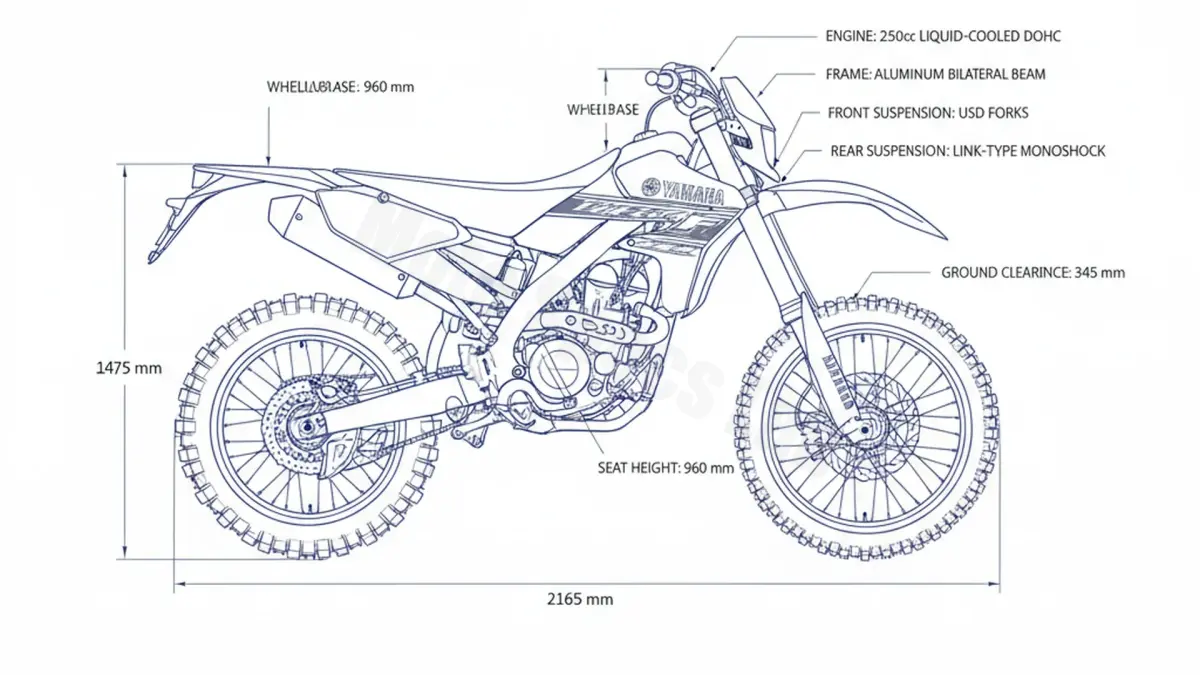
The 2007 debut of the Yamaha WR 250 F (CG30W/5UMV) marked a pivotal moment in enduro history. It was the year Yamaha finally transitioned the WR line to the advanced aluminum semi-double-cradle frame derived from the YZ250F motocrosser. This engineering shift replaced the traditional steel frame, resulting in a significant reduction in unsprung weight and a transformative improvement in chassis rigidity and cornering precision.
Engineering & Performance Analysis
The CG30W generation is powered by a liquid-cooled, 249cc, DOHC five-titanium-valve engine. While the YZ-F was designed for the track, the WR-F was tuned for the woods, featuring a wide-ratio five-speed transmission and a heavier flywheel to prevent stalling in technical sections. The Keihin FCR-MX37 carburetor provides crisp throttle response, though it requires precise jetting for altitude changes.
Suspension duties are handled by high-end Kayaba (KYB) components. The Speed Sensitive System (SSS) forks were a revelation for the era, offering a plush initial stroke that stiffens progressively to handle hard landings and high-speed G-outs.
Professional Maintenance Standards
To maintain the E-E-A-T standards expected by MotoSpecsLab, owners must adhere to a rigorous service schedule due to the high-revving nature of this 250cc powerplant.
- Lubrication: Use a high-quality 10W-40 synthetic-blend oil. The 1.2-liter capacity is relatively small; check levels every ride to prevent oil starvation.
- Ignition: The NGK CR9E plug is critical for heat dissipation. Ensure the gap is set strictly between 0.7mm and 0.8mm to avoid misfires under load.
- Chassis: Given the aluminum frame’s rigidity, check engine mount torques regularly. Vibrations can cause fasteners to back out over time.
- Tires: For enduro use, the 1.0 bar (15 psi) recommendation is a baseline. For muddy conditions, riders may drop to 12 psi, provided heavy-duty tubes or rim locks are utilized.
MotoSpecsLab Verdict
The WR 250 F (2007-2014) remains a benchmark for reliability in the 250cc four-stroke enduro class. It bridges the gap between the raw power of a race bike and the durability of a trail machine. While it lacks the fuel injection of later models, its mechanical simplicity and the superior SSS suspension make it a favorite for technical riders who prefer to do their own wrenching.
Frequently Asked Questions
What is the battery type for the WR 250 F?
The bike uses a YTZ7S battery, which is a compact, high-cranking AGM battery designed to fit the narrow subframe of the WR series.
How often should I change the oil?
For competitive use, oil should be changed every 500-800 km. For casual trail riding, 1,000 km intervals are acceptable, provided the 1.2L level is monitored.
Can I use automotive oil?
No. You must use oil that meets JASO MA specifications to ensure the wet clutch does not slip.