| Specification | Value |
|---|---|
| Production Years | 2000 – 2007 |
| Engine Type | 1063cc, Air-cooled, 75° V-twin |
| Oil Type | SAE 10W-40 or 20W-40 (API SE/SF/SG) |
| Battery | GT14B-4 |
| Spark Plug | NGK BPR7ES (0.7–0.8 mm gap) |
| Tires (F/R) | 130/90-16 67H / 170/80-15 M/C 77H |
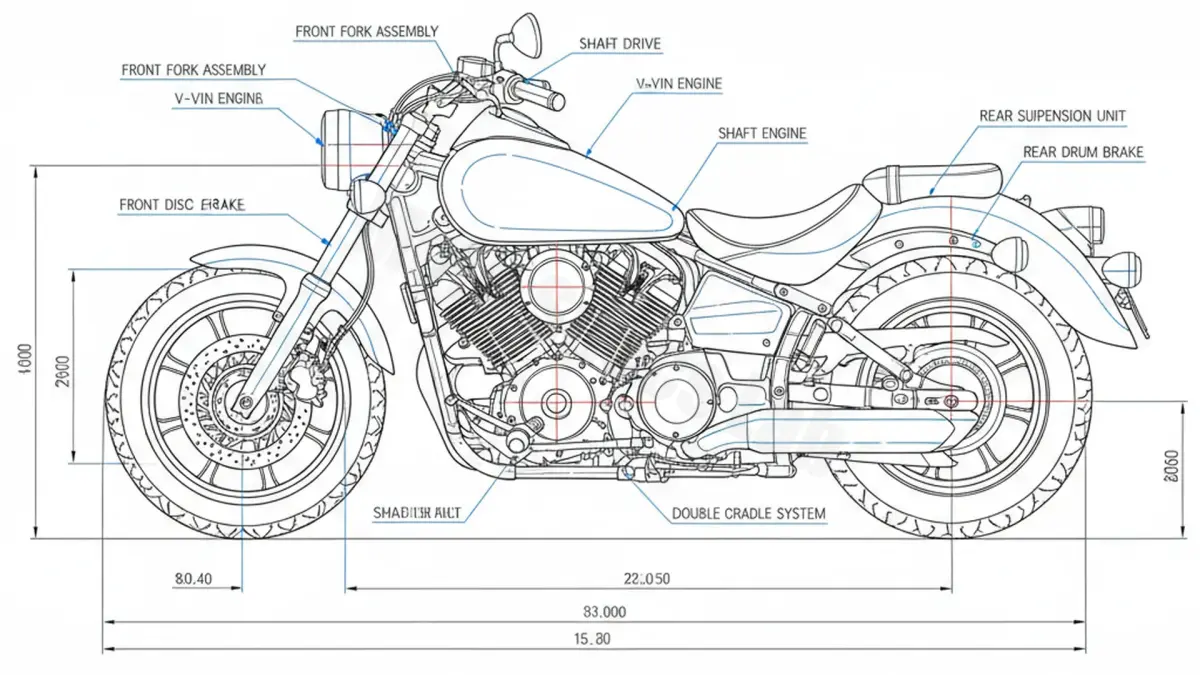
While many cruisers of the early 2000s were moving toward liquid cooling, the Yamaha XVS 1100 A Drag Star Classic (VP16) remained a purist’s machine. A unique engineering highlight of the VP16 is its direct heritage: the engine is a heavily refined evolution of the legendary Virago 1100 powerplant. However, for the Drag Star, Yamaha engineers swapped the Virago’s monocoque frame for a double-cradle steel chassis and replaced the chain-driven cams with a more traditional pushrod-actuated aesthetic, despite keeping the overhead cam (OHC) architecture for superior reliability and high-end breathing.
Technical Engine Performance
The VP16 is defined by its 1,063cc 75-degree V-twin. This specific angle provides a distinct exhaust note while balancing primary vibrations more effectively than a 45-degree configuration. The engine delivers approximately 62 hp and 85 Nm of torque, peaking early in the rev range to provide the ‘grunt’ expected of a heavy cruiser. Because it is air-cooled, thermal management is critical; owners must adhere strictly to the API SE/SF/SG oil specifications to ensure the rear cylinder remains within safe operating temperatures during low-speed cruising.
Maintenance Essentials
Lubrication System
The XVS 1100 uses a wet-sump system. When performing a standard oil change, you will require 3.0 liters. If you are replacing the oil filter—which is highly recommended every service due to the engine’s air-cooled nature—the capacity increases to 3.1 liters. For a completely dry engine (after a rebuild), the total capacity is 3.6 liters. MotoSpecsLab recommends a high-quality 20W-40 mineral or semi-synthetic oil in warmer climates to maintain viscosity stability.
Ignition and Electrical
The VP16 utilizes NGK BPR7ES spark plugs. Maintaining a precise gap of 0.7–0.8 mm is vital for preventing low-end hesitation. The electrical system is powered by a GT14B-4 battery. Given the high compression of the 1100cc twin, a healthy battery is essential; if the starter motor sounds sluggish, it is often a sign of a drop in Cold Cranking Amps (CCA) rather than a mechanical failure.
Chassis and Contact Patch
The ‘Classic’ designation brings a 130/90-16 front tire and a wide 170/80-15 rear tire, providing a planted feel. Tire pressure management is non-negotiable for handling: 2.25 bar (33 psi) at the front is standard. For the rear, 2.25 bar suffices for solo riders, but if you are carrying a passenger or heavy luggage, you must increase this to 2.50 bar (36 psi) to prevent sidewall overheating and erratic tracking.
MotoSpecsLab Editorial Verdict
The Yamaha XVS 1100 A (VP16) remains a benchmark for mid-to-large displacement cruisers. Its shaft drive offers low-maintenance longevity, and the OHC V-twin provides a level of mechanical sophistication that many competitors lacked. While the oil filter placement requires the removal of the front exhaust pipe on some model years (a common mechanical gripe), the overall build quality and engine resilience make the VP16 a top-tier choice for enthusiasts seeking a classic silhouette with Japanese reliability.