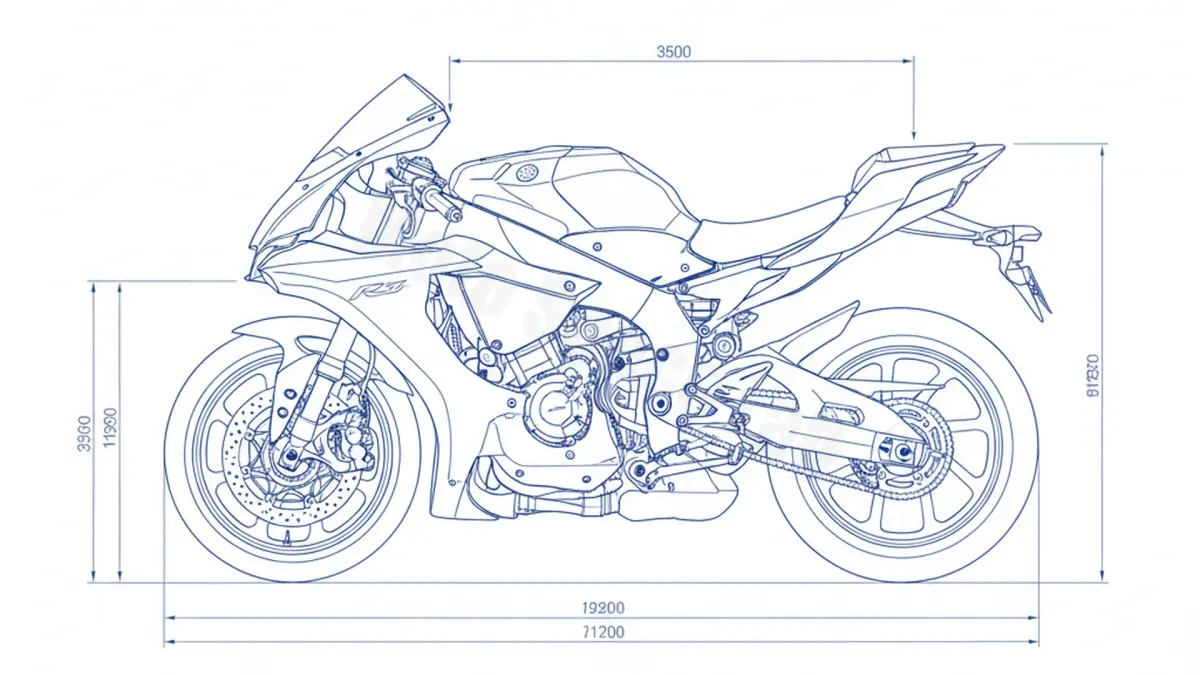
| Component | Specification |
|---|---|
| Model Generation | RN65 / R1M (2020 – Present) |
| Engine Type | 998cc Crossplane 4 (CP4), EURO 5 compliant |
| Engine Oil | Yamalube 4-S 10W-40 / 15W-50; JASO MA (3.9 L) |
| Tire Dimensions | F: 120/70 ZR 17 / R: 200/55 ZR 17 |
| Tire Pressure | F: 2.5 bar (36 psi) / R: 2.9 bar (42 psi) |
| Battery Type | ELIIY5 (Lithium-Ion) |
| Spark Plug | NGK LMAR9E-J |
The Yamaha YZF-R1M (RN65) represents the pinnacle of Japanese superbike engineering. A unique historical highlight of this specific iteration is that it was the first production motorcycle to integrate the Öhlins ERS NPX gas-charged cavitation-free front forks. This technology, derived directly from WorldSBK competition, utilizes a pressurized nitrogen system to eliminate oil cavitation, ensuring consistent damping performance under the extreme thermal loads of track use.
Engineering Analysis: The EURO 5 CP4 Heart
Despite the stringent constraints of EURO 5 emissions standards, Yamaha engineers successfully maintained the R1M’s 200PS output by redesigning the cylinder head, intake system, and Bosch fuel injectors. The RN65 platform features a refined Crossplane (CP4) crankshaft with an uneven 270°-180°-90°-180° firing order. This design minimizes inertial torque, providing the rider with a linear connection between the throttle and the rear wheel.
Maintenance & Service Fundamentals
For the RN65, precision is paramount. The 3.9-liter oil capacity requires high-shear stability lubricants. We recommend Yamalube 4-S 10W-40 for standard temperate climates, or 15W-50 for high-intensity track environments. The use of the ELIIY5 Lithium-ion battery is a critical weight-saving measure; however, it requires a dedicated LiFePO4-compatible charger to maintain cell health during storage.
Chassis and Electronics
The R1M is distinguished by its full carbon fiber bodywork and the Communication Control Unit (CCU), which allows riders to download GPS data and upload system settings via a smartphone app. The 200/55 rear tire profile is specifically chosen to maximize the contact patch at lean, working in tandem with the 6-axis IMU that governs the Slide Control (SCS) and Brake Control (BC) systems.
Technical FAQ
What is the recommended tire pressure for street use?
Yamaha specifies 2.5 bar (36 psi) for the front and 2.9 bar (42 psi) for the rear for general road conditions.
Can I use standard lead-acid batteries in the RN65?
No. The RN65 is designed for the ELIIY5 Lithium-ion battery. Using a standard lead-acid battery may interfere with the weight balance and charging system parameters.
How often should spark plugs be checked?
The NGK LMAR9E-J plugs should be inspected according to the service manual, typically every 12,000 km, though high-performance track use may necessitate more frequent intervals.