| Specification | Data |
|---|---|
| Model Year | 1976 |
| Engine Type | Single-cylinder, 2-stroke, Rotary Disc Valve |
| Engine Oil | SAE 10W-30 or 10W-40 (JASO MA) (0.7 L) |
| Tires (Front/Rear) | F: 2.75-21 4PR / R: 3.25-18 4PR |
| Tire Pressure | F: 1.25 bar (18 psi) / R: 1.50 bar (21 psi) |
| Battery | 6N6-3B (6V) |
| Spark Plug | NGK B8ES (Gap: 0.7-0.8mm) |
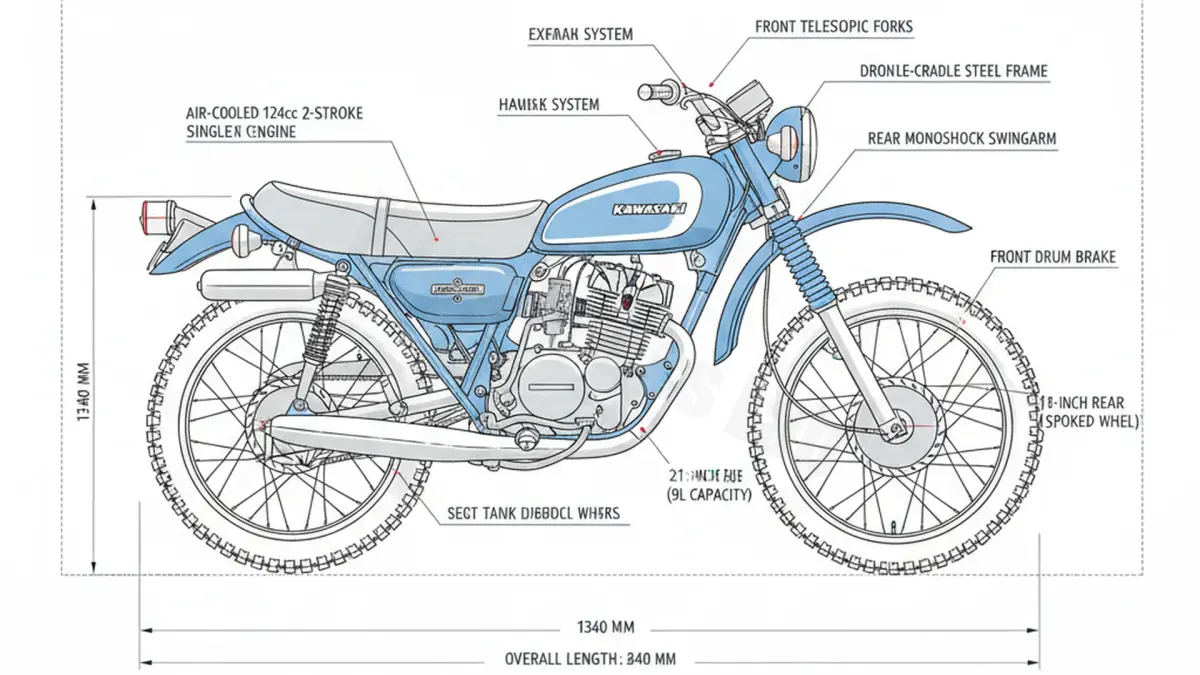
The 1976 Kawasaki KE 125 – K1 stands as a hallmark of mid-70s dual-sport engineering, distinguished primarily by its Rotary Disc Valve induction system. Unlike contemporary piston-port designs, the rotary valve allowed Kawasaki engineers to time the intake duration independently of piston movement, resulting in a broader powerband and significantly improved low-end torque—a critical advantage for a machine designed to transition seamlessly from urban streets to rugged trails.
Technical Engineering Overview
At its core, the KE 125 – K1 is powered by a 124cc two-stroke engine. The K1 variant represented a transition toward more robust off-road capability while maintaining street legality. The chassis geometry was optimized for stability on loose surfaces, featuring a 21-inch front wheel that provided superior obstacle clearance compared to the smaller wheels found on many entry-level bikes of the era.
Maintenance Guide & Specifications
To maintain the high-revving performance of the KE 125, adherence to factory specifications is paramount. As the Editor-in-Chief of MotoSpecsLab, I recommend the following maintenance protocols:
1. Lubrication System
The transmission requires 0.7 liters of SAE 10W-30 or 10W-40. It is essential to use a JASO MA rated oil to ensure the wet clutch operates without slipping. Regular oil changes every 2,000 miles (or seasonally) are recommended to prevent clutch debris from contaminating the transmission gears.
2. Ignition and Electrical
The electrical system utilizes a 6N6-3B 6-volt battery. Given the age of these machines, ensure all grounding points are free of corrosion. The combustion cycle relies on an NGK B8ES spark plug. For optimal ignition timing and fuel efficiency, the gap must be precisely set between 0.7mm and 0.8mm.
3. Wheel and Tire Setup
The KE 125 – K1 uses a staggered wheel setup: a 2.75-21 4PR front and a 3.25-18 4PR rear. For mixed-use riding, maintain tire pressures at 1.25 bar (18 psi) in the front and 1.50 bar (21 psi) in the rear. Lowering the pressure slightly for pure off-road use can increase the contact patch, but risks pinch flats on the vintage-style rims.
Editorial Verdict
The Kawasaki KE 125 – K1 is more than a vintage motorcycle; it is a testament to the efficacy of rotary valve technology. While it requires more specialized knowledge to tune than a standard piston-port engine, the reward is a crisp throttle response that remains competitive even by modern small-displacement standards. Proper maintenance of the 6V electrical system and the specific oil requirements will ensure this classic remains trail-ready for decades to come.