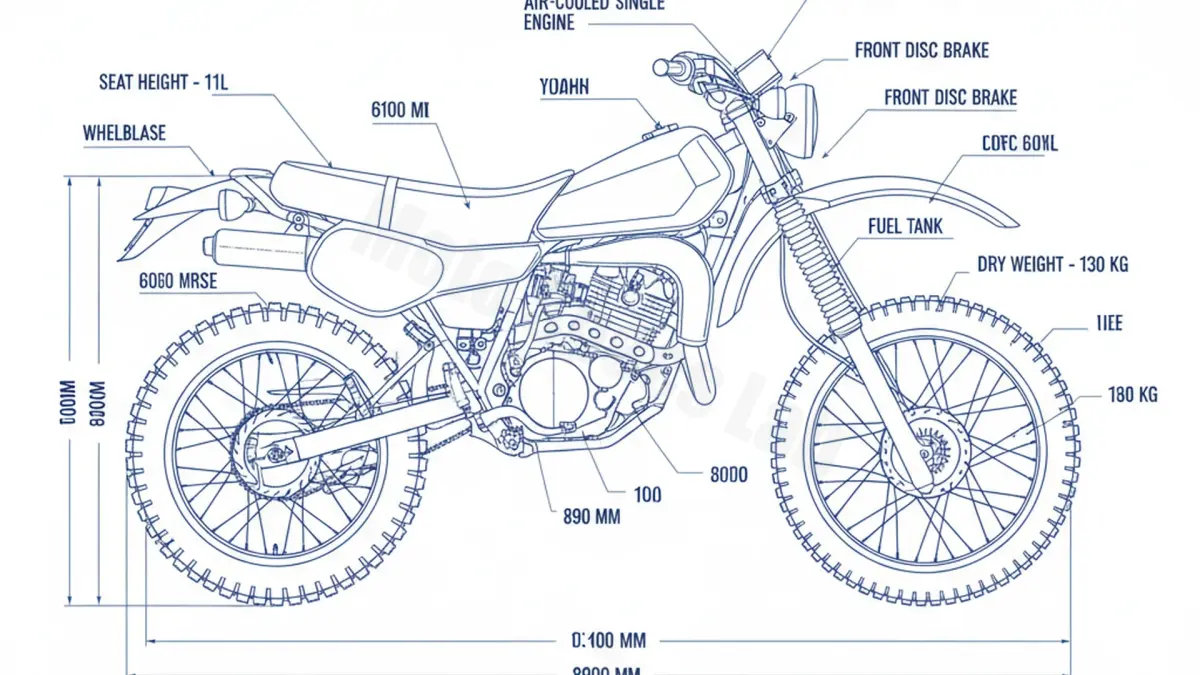
| Attribute | Specification |
|---|---|
| Model / Year | Yamaha TT 350 S (1TJ) / 1986 |
| Engine Type | 346cc, DOHC, 4-Valve, 4-Stroke |
| Oil Requirement | 1.4 L (SAE 10W-30 or 20W-40 API SE/SF) |
| Tire Size (Front/Rear) | 3.00-21 4PR / 4.60-18 4PR |
| Tire Pressure | 1.0 bar (14 psi) Front & Rear |
| Spark Plug | NGK DR8ES-L (Gap: 0.6–0.7 mm) |
| Battery System | None (C.D.I. Magneto) |
Engineering Highlight: The 1986 Yamaha TT 350 S (1TJ) is historically significant for being one of the first mass-production enduro bikes to successfully implement the Yamaha Dual Intake System (YDIS). This engineering feat used two carburetors—one primary and one secondary—to optimize air-fuel delivery across the entire RPM range, providing the low-end torque of a small engine with the high-end breathing of a larger displacement machine.
Technical Overview: The 1TJ Legacy
At MotoSpecsLab, we categorize the TT 350 S as a masterclass in mid-sized enduro design. Positioned between the agile 250cc and the heavy-hitting 600cc models, the 1TJ variant offered a dry weight and power-to-weight ratio that made it a favorite for technical trail riding. Its DOHC (Double Overhead Cam) four-valve head was advanced for the mid-80s, ensuring efficient combustion and thermal stability under load.
Maintenance Protocols
Lubrication System
The 1TJ requires 1.4 liters of oil. For vintage compliance and clutch health, we recommend high-quality mineral or semi-synthetic oils meeting API SE or SF standards. In temperate climates, 10W-30 is suitable, while 20W-40 is preferred for high-ambient temperature operation to prevent shear.
Ignition and Electrical
Unlike its road-going XT cousins, the TT 350 S is a pure-bred off-roader. It lacks a traditional battery, relying instead on a C.D.I. Magneto and a capacitor to manage electrical loads. This simplifies the bike significantly, eliminating the risk of a dead battery in remote locations. The NGK DR8ES-L spark plug must be gapped precisely between 0.6 and 0.7 mm to ensure consistent ignition timing.
Chassis and Contact Patch
The 21-inch front and 18-inch rear wheel configuration is the standard for serious enduro work. For optimal traction on soft to intermediate terrain, maintain a tire pressure of 1.0 bar (14 psi). Lowering the pressure further for extreme mud is common, but increases the risk of rim damage or tube pinch without rim locks.
Editorial Review: The MotoSpecsLab Verdict
The Yamaha TT 350 S – 1TJ remains a benchmark for balanced off-road performance. Its suspension, featuring air-adjustable front forks and a Monocross rear link, provides 280mm of travel that handles modern trail obstacles with surprising grace. While the kickstart-only nature requires a specific technique (finding TDC), the lack of a battery and starter motor keeps the machine lean and reliable. For collectors and vintage racers, the 1TJ is a robust, high-authority choice that exemplifies Yamaha’s golden era of four-stroke development.
Frequently Asked Questions
Q: Does the TT 350 S have an electric start?
A: No, the 1986 1TJ model is kickstart only, utilizing a manual decompression lever to assist in the starting process.
Q: Can I use modern synthetic oil?
A: While modern oils are superior, ensure they do not contain friction modifiers (moly) that can cause the wet clutch to slip. Always look for JASO MA compatibility if using modern synthetics.