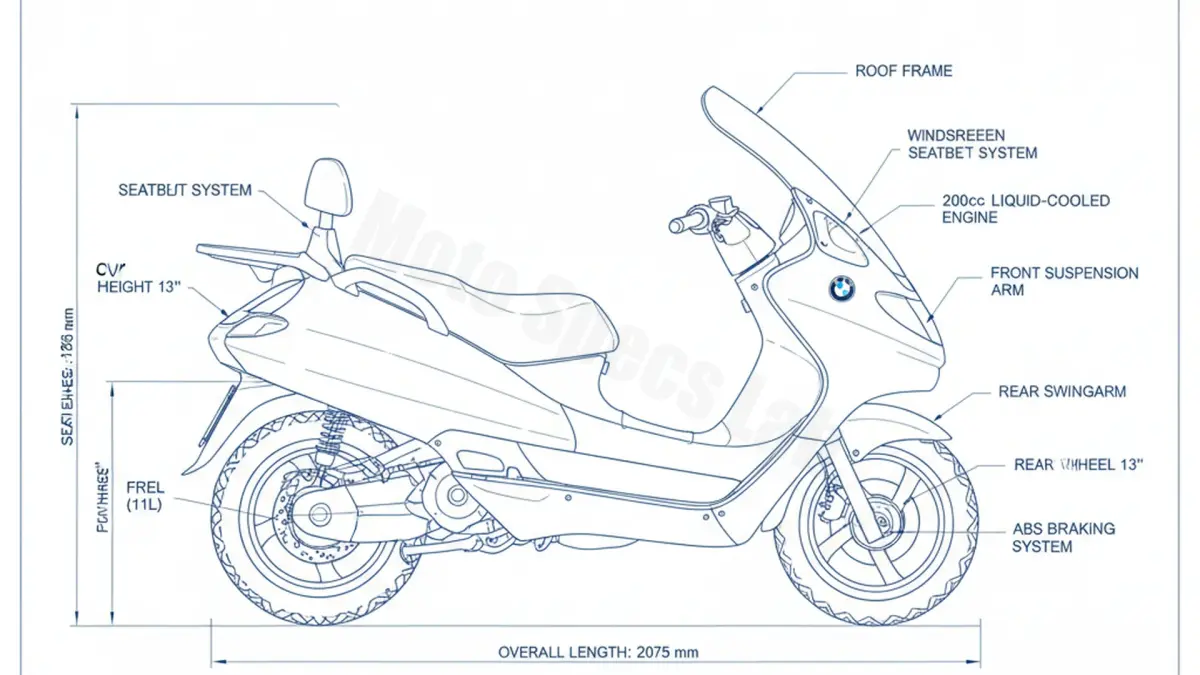
The BMW C1 200 remains one of the most polarizing and technically ambitious projects in motorcycling history. Unlike any other production two-wheeler, the C1 was designed with a rigid aluminum space-frame roll cage and a deformation zone above the front wheel, allowing it to achieve safety ratings comparable to European compact cars. In several jurisdictions, its unique twin-seatbelt system and head-restraint design legally exempted riders from wearing a helmet, a testament to BMW’s ‘Safety 360’ engineering philosophy.
| Attribute | Specification |
|---|---|
| Engine Type | Liquid-cooled, single-cylinder, 4-stroke (Rotax) |
| Displacement | 176 cc |
| Oil Specification | SAE 15W-50 API SJ |
| Oil Capacity | 1.2 Liters |
| Spark Plug | NGK CR8EB |
| Battery | YB14L-A2 |
| Front Tire | 120/70 – 13 53L (2.3 bar / 33.4 psi) |
| Rear Tire | 140/70 – 12 60L (2.5 bar / 36.3 psi) |
Technical Overview: The 200 Series Evolution
While the original C1 utilized a 125cc powerplant, the ‘200’ variant (actually 176cc) was introduced in 2001 to address the power-to-weight ratio concerns inherent in a machine weighing nearly 185kg dry. The Rotax-sourced engine features electronic fuel injection (BMS-C) and a four-valve cylinder head, providing a more robust torque curve essential for urban filtering and short-distance commuting. The Telelever-inspired front suspension and the heavy-duty center stand—mechanically linked to a lever in the cockpit—showcase BMW’s commitment to mechanical sophistication.
Maintenance & Service Guide
Lubrication System
The C1 200 engine is sensitive to oil quality due to its high-revving nature and the weight it must propel. Use a high-quality SAE 15W-50 semi-synthetic or synthetic oil meeting API SJ standards. The total capacity is 1.2 liters. Given the enclosed nature of the engine, monitoring oil levels via the sight glass is critical to prevent thermal degradation.
Ignition and Electrical
For optimal combustion and cold-start reliability, the NGK CR8EB spark plug is the factory-recommended component. The electrical system is supported by a YB14L-A2 battery. Due to the C1’s unique electronics (including the windshield wiper and optional seat heating), ensuring the battery is at peak health is vital for the longevity of the starter motor and fuel injection sensors.
Chassis and Safety Inspection
Tire maintenance is paramount for the C1’s stability. The front 13-inch and rear 12-inch wheels require precise pressures: 2.3 bar (33.4 psi) for the front and 2.5 bar (36.3 psi) for the rear. Under-inflation significantly impacts the low-speed handling of the heavy roll-cage structure. Additionally, the seatbelt retractors and the roll-cage mounting bolts should be inspected annually for torque and functionality as part of the safety cell integrity check.
Summary
The BMW C1 200 is more than a scooter; it is a mobile laboratory for safety engineering. For the modern collector or urban commuter, adherence to the specific 15W-50 oil requirements and maintaining the unique electrical components are the keys to preserving this piece of automotive history.