| Category | Specification |
|---|---|
| Production Years | 1986 – 1989 |
| Engine Oil | SAE 10W-40 (API SE/SF/SG JASO-MA) (2.4 L) |
| Tire Dimensions | F: 100/80-18 53H / R: 120/80-18 62H |
| Tire Pressure | F: 2.0 bar (29 psi) / R: 2.3 bar (33 psi) |
| Battery Type | YB3L-A |
| Spark Plug | NGK DPR8EA-9 |
Engineering Highlight: Unlike many of its contemporaries that chased the burgeoning ‘superbike’ arms race of the 1980s, the Yamaha SRX 600 (1XL) was a deliberate exercise in minimalism. Its most unique engineering feat was the YDIS (Yamaha Dual Intake System), which utilized two different carburetors—one primary for low-end response and one secondary for high-RPM flow—to solve the inherent breathing limitations of a large 600cc single-cylinder engine.
Technical Review
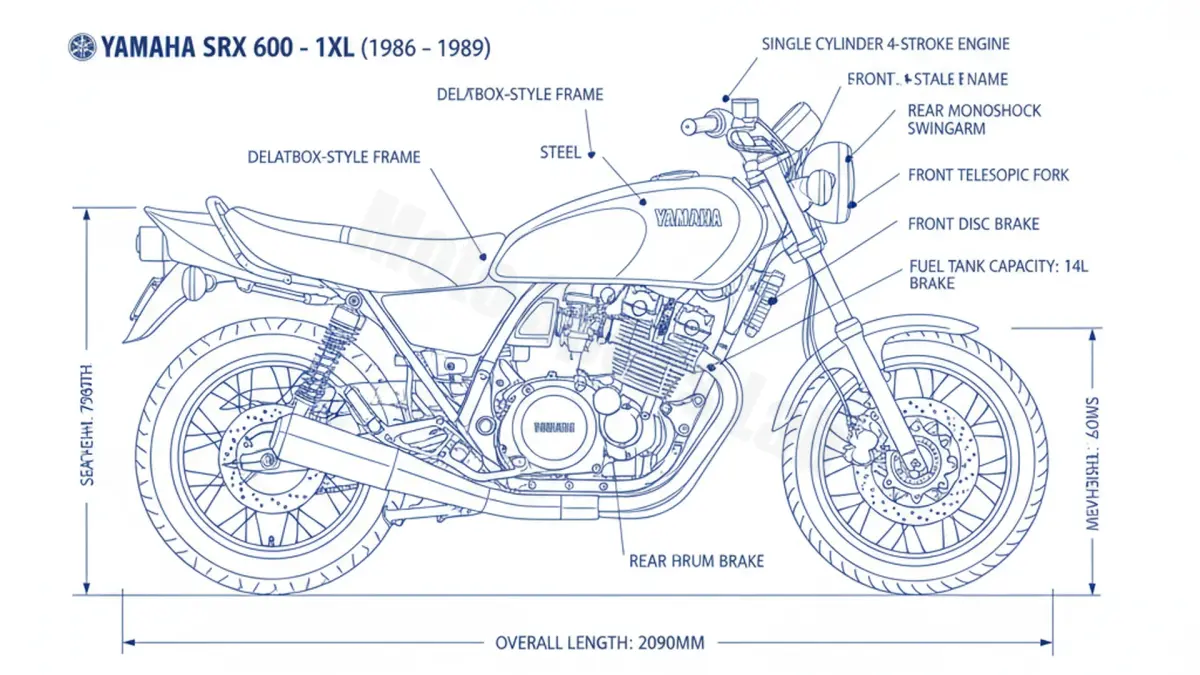
The SRX 600 (1XL) is widely regarded as the spiritual successor to the British ‘Thumper’ tradition, refined through Japanese precision. At its heart lies a 608cc SOHC four-valve engine derived from the XT600 dual-sport, but tuned for the street. The 1XL variant is particularly prized by purists for its kickstart-only configuration, which contributes to its remarkably low dry weight of approximately 149 kg (328 lbs).
The chassis is a slim, steel-tube frame that emphasizes flickability over straight-line stability. With its 18-inch wheels and narrow profile, the SRX 600 offers a level of mechanical feedback that modern bikes often mask with electronic aids. It is a machine designed for the technical ‘twisties’ rather than the highway.
Maintenance Guide & Essentials
Lubrication System
The SRX 600 utilizes a dry-sump lubrication system. When changing the oil, it is critical to follow the correct procedure: drain both the engine crankcase and the external oil tank. The total capacity is 2.4 liters of SAE 10W-40. Ensure the oil meets JASO-MA standards to prevent clutch slippage. Always check the oil level while the bike is upright after a short warm-up period; checking it cold will result in an inaccurate (low) reading.
Ignition and Electrical
The 1XL’s electrical system is relatively simple, but the YB3L-A battery must be kept in peak condition to ensure reliable ignition. The NGK DPR8EA-9 spark plug should be gapped at 0.8–0.9mm. Given the kickstart nature of the bike, a fouled plug or weak coil will immediately manifest as difficult starting.
Tires and Handling
To maintain the agile handling characteristics of the SRX, stick to the factory-specified 18-inch tire sizes. Running 100/80-18 at the front and 120/80-18 at the rear preserves the intended geometry. Maintain 29 psi (Front) and 33 psi (Rear) for optimal contact patch performance.
Expert Verdict
The Yamaha SRX 600 (1XL) remains a masterclass in ‘less is more.’ While its 45 horsepower may seem modest on paper, the torque-to-weight ratio provides an engaging, visceral experience. For the collector or the enthusiast, it represents a peak era of mechanical purity. Maintenance is straightforward, provided one respects the nuances of the dry-sump system and the YDIS carburetion.
FAQ
Q: Is the SRX 600 1XL difficult to kickstart?
A: No, provided the decompression lever is adjusted correctly and the carburetors are clean. It is a technique-heavy process rather than a strength-heavy one.
Q: Can I use synthetic oil?
A: Yes, as long as it is JASO-MA rated. However, many owners prefer high-quality mineral or semi-synthetic 10W-40 due to the engine’s older seal designs.