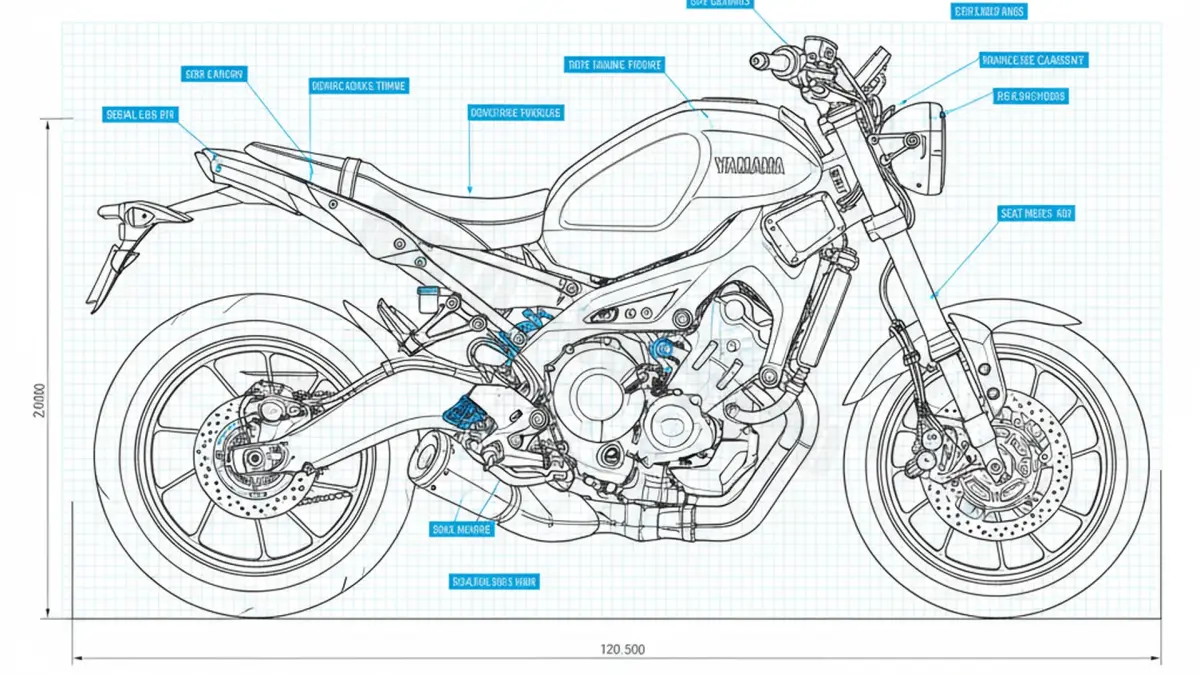
| Specification | Value |
|---|---|
| Production Years | 2022 – Present |
| Engine Type | 890cc Liquid-cooled CP3 Inline-3 |
| Engine Oil | SAE 10W-40 API SG/JASO MA (3.1 L) |
| Spark Plug | NGK LMAR9G |
| Battery | YTZ10S |
| Tire Size (F/R) | 120/70 ZR 17 / 180/55 ZR 17 |
Engineering Highlight: The RN80 generation marks a significant departure from its predecessor through the implementation of Yamaha’s proprietary “SpinForging” technology. This process allows the aluminum wheels to be manufactured with a wall thickness of just 2mm, reducing unsprung mass by 700g compared to the previous model. This engineering feat drastically improves the moment of inertia, resulting in a 14% improvement in agility at the rear wheel.
Technical Overview: The CP3 Evolution
The 2022+ Yamaha XSR 900 (RN80) is built around the revised 890cc CP3 engine. To meet Euro 5 compliance while increasing performance, Yamaha extended the stroke by 3mm, redesigned the fuel injection system to fire directly at the intake valve heads, and implemented a completely new intake and exhaust system. The result is a more linear torque curve and a 6% increase in torque, peaking at 93 Nm at 7,000 rpm.
Maintenance Guide & Fluid Capacities
For the professional technician or the dedicated owner, maintaining the RN80 requires adherence to strict tolerances. The cooling system and lubrication circuits are optimized for 10W-40 weight oils. When performing an oil and filter change, the system requires exactly 3.1 liters to reach the upper level of the sight glass.
Chassis and Suspension
The RN80 utilizes a lower head pipe position compared to the MT-09, providing a more stable, front-biased geometry reminiscent of 1980s GP racers. Maintaining correct tire pressure is critical for this geometry: 2.5 bar (36 psi) in the front and 2.9 bar (42 psi) in the rear. This ensures the 120/70 and 180/55 ZR 17 contact patches remain consistent under heavy lean angles.
Electrical System
The heart of the RN80’s electronics is a 6-axis IMU derived from the YZF-R1. To support these sensitive electronics, the YTZ10S battery must be maintained at a steady voltage. If the bike is stored for more than two weeks, a smart-charger is recommended to prevent CAN-bus communication errors.
FAQ
Q: Which spark plugs are required for the RN80?
A: The RN80 uses the NGK LMAR9G, which features a long-reach thread design for optimized heat dissipation in the high-compression CP3 head.
Q: What is the recommended oil change interval?
A: While Yamaha suggests 10,000 km (6,000 miles), MotoSpecsLab recommends an interval of 5,000 km for riders who frequently utilize the high-RPM range of the triple engine.