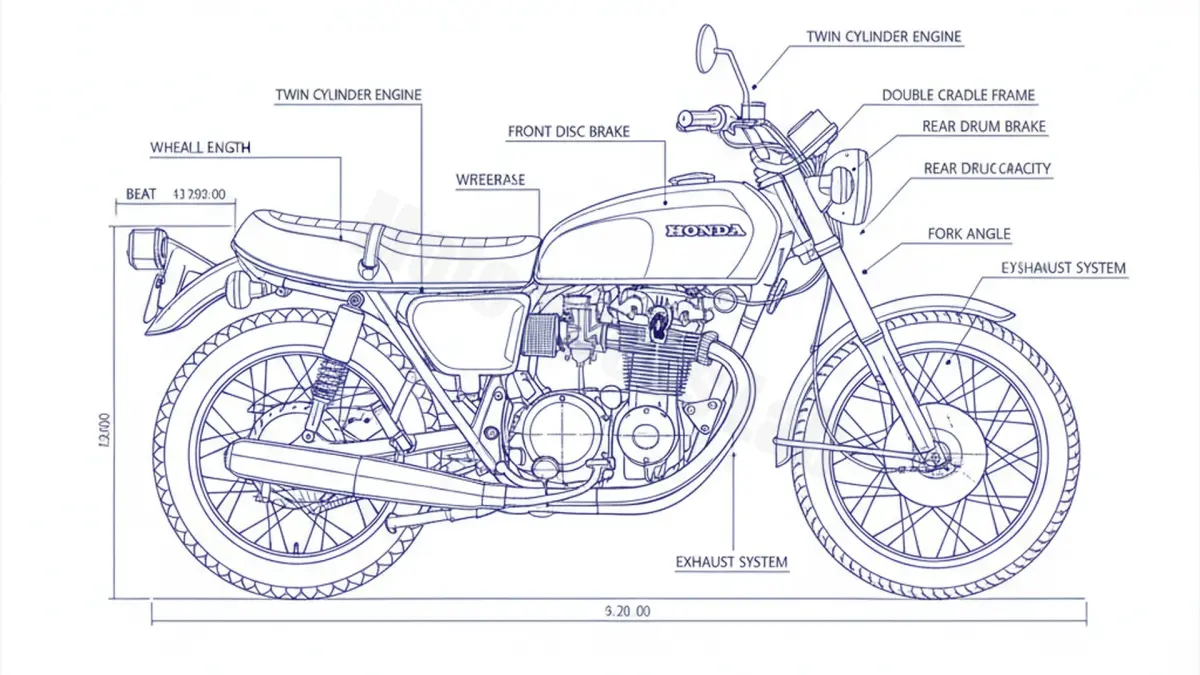
While most manufacturers in the mid-1970s were pivoting toward multi-cylinder engines, Honda delivered the CB500T as a sophisticated evolution of the ‘Black Bomber’ lineage. A unique engineering highlight of this machine is its DOHC (Double OverHead Cam) cylinder head utilizing torsion bar valve springs instead of conventional coil springs—a design choice that allowed for high-RPM stability and reduced valve float, a rarity for mass-produced vertical twins of the era.
| Quick Specs: Honda CB500T (1975-1976) | |
|---|---|
| Engine Type | DOHC Parallel Twin, 4-Stroke |
| Engine Oil | SAE 10W-40 (JASO-MA) (2.8 L) |
| Front Tire | 3.25 – 19 (4PR) |
| Rear Tire | 3.75 – 18 (4PR) |
| Tire Pressure (F/R) | 1.9 bar (28 psi) / 2.2 bar (32 psi) |
| Battery | 12N12A-4A-1 (YB12A-A) |
| Spark Plug | NGK B8ES (Gap: 0.7mm – 0.8mm) |
Technical Review: The Final Evolution of the Big Twin
The Honda CB500T, produced between 1975 and 1976, was a direct descendant of the CB450. By increasing the stroke to 70.6mm, Honda created a 498cc engine that emphasized torque over the peaky performance of its predecessor. Despite the ‘Retro’ styling—characterized by its distinct brown seat and fuel tank knee pads—the CB500T remained a technical marvel. The 180-degree crankshaft configuration provided the classic parallel-twin character, though it necessitated robust vibration management.
From a handling perspective, the CB500T featured a traditional steel cradle frame and a front disc brake, which was a significant safety standard for the time. While it couldn’t match the smoothness of the CB500 Four, the T-model offered a mechanical purity and ease of access that appealed to traditionalists and home mechanics alike.
Maintenance Guide & Critical Specifications
Lubrication System
The CB500T relies on a wet sump system. For optimal protection of the DOHC assembly, MotoSpecsLab recommends using a high-quality SAE 10W-40 oil meeting JASO-MA standards to ensure the wet clutch operates without slipping. The total capacity is 2.8 liters.
Ignition & Electrical
The ignition system is sensitive to plug condition. Always utilize NGK B8ES spark plugs. Ensure the electrode gap is precisely set between 0.7mm and 0.8mm. If the bike experiences hard starting, check the 12N12A-4A-1 (YB12A-A) battery voltage, as the electric starter requires significant amperage to turn the high-compression twin.
Chassis & Tires
Maintaining correct tire pressure is vital for the CB500T’s narrow-profile tires. The 3.25-19 front should be kept at 1.9 bar (28 psi), while the 3.75-18 rear requires 2.2 bar (32 psi). Over-inflation can lead to a harsh ride given the vintage suspension geometry, while under-inflation will sluggishly affect the steering response.
Editorial Verdict
The Honda CB500T is more than just a transitional model; it is a testament to Honda’s willingness to refine a complex DOHC design into a reliable commuter. For the modern collector, it offers a unique ‘tinker-friendly’ platform with a distinct aesthetic that stands out in the sea of UJMs (Universal Japanese Motorcycles).