| Attribute | Specification |
|---|---|
| Production Years | 1978–1982 |
| Engine Type | Parallel Twin, 4-stroke, SOHC 3-Valve |
| Engine Oil | SAE 10W-40 (JASO MA/MA2) |
| Oil Capacity | 2.0 L (Refill) / 2.5 L (Dry) |
| Front Tire | 90/90-19 52S |
| Rear Tire | 110/90-18 59S |
| Spark Plug | NGK DR8ES-L (Gap: 0.6–0.7 mm) |
| Battery | YB12A-A |
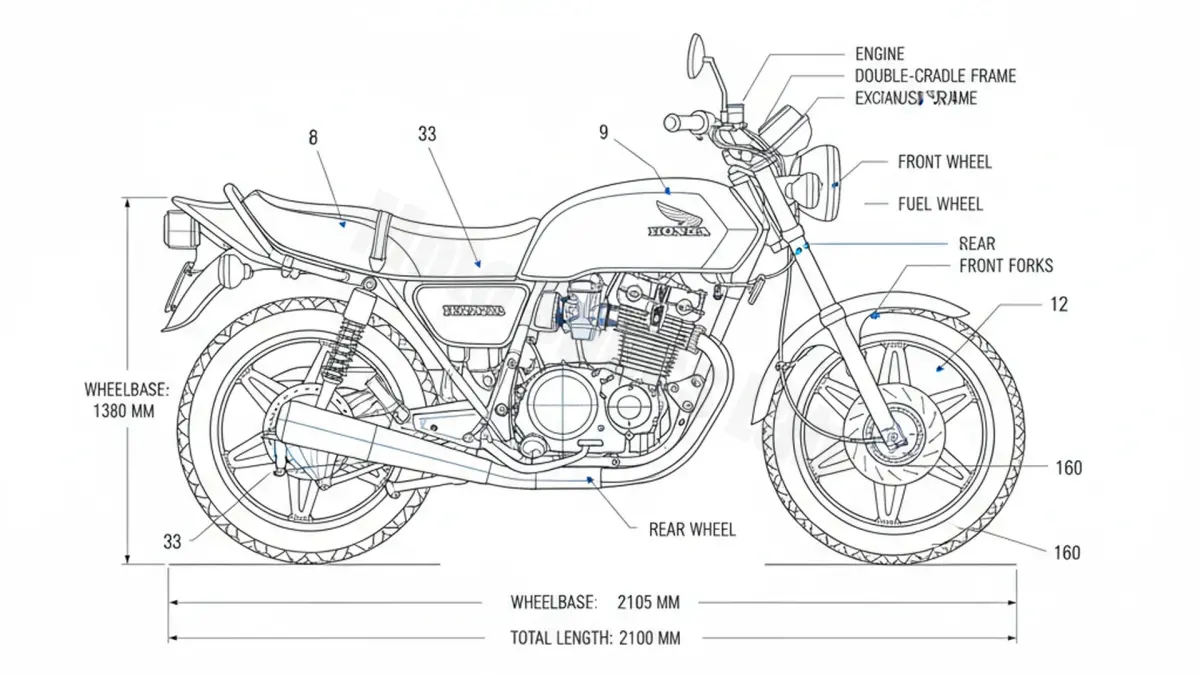
A pivotal moment in Honda’s mid-range history, the Honda CB 250 N (Euro-Sport), often referred to as the ‘Super Dream’, was the first production motorcycle to introduce the revolutionary Comstar wheels. Unlike traditional cast or spoked wheels, Comstars utilized pressed steel blades riveted to the rim, providing the rigidity of a cast wheel with the slight flex of spokes—a critical engineering choice for the evolving handling demands of the late 1970s.
Engineering Deep Dive: The Three-Valve Twin
At the heart of the CB250T is a sophisticated SOHC parallel twin. While competitors were still utilizing two-valve heads, Honda implemented a three-valve per cylinder configuration (two intake, one exhaust). This design allowed for a larger total intake area and improved volumetric efficiency, enabling the 249cc engine to breathe better at high RPMs while maintaining a compact cylinder head profile.
Maintenance Guide
Lubrication System
The CB 250 N relies on a wet sump lubrication system. For optimal protection of the integrated gearbox and wet clutch, we recommend a high-quality SAE 10W-40 synthetic or semi-synthetic oil meeting JASO MA/MA2 standards. A standard oil change requires 2.0 liters, though a completely dry engine (after a rebuild) will necessitate 2.5 liters.
Chassis and Tires
The Euro-Sport’s handling is highly sensitive to tire condition and pressure. The factory-specified 19-inch front and 18-inch rear setup provides stable tracking. Maintain the front at 29 psi (2.0 bar). The rear requires 32 psi (2.25 bar) for solo riding, but must be increased to 40 psi (2.8 bar) when carrying a passenger or heavy luggage to prevent sidewall deformation.
Ignition and Electrical
For consistent ignition timing and fuel combustion, the NGK DR8ES-L is the mandatory spark plug. Ensure the electrode gap is precisely set between 0.6 and 0.7 mm. Electrical reliability is anchored by the YB12A-A lead-acid battery; given the age of these machines, ensuring clean grounding points on the frame is essential for the charging system’s longevity.
Editor’s Verdict
The Honda CB 250 N remains a masterclass in transitional motorcycle design. While its power output is modest by modern standards, its mechanical robustness and historical significance as the ‘Euro-Sport’ make it a highly desirable classic for collectors and restorers alike. Proper adherence to the technical specifications listed above is paramount to preserving its smooth parallel-twin characteristics.