| Specification | Value |
|---|---|
| Production Years | 2003–2017 |
| Engine Oil | SAE 10W-30 API SG+ / JASO MA (1.0 L) |
| Front Tire | 70/100-19 42M |
| Rear Tire | 90/100-16 51M |
| Tire Pressure (F/R) | 1.0 bar (15 psi) / 1.0 bar (15 psi) |
| Battery | YTZ7S (Maintenance Free) |
| Spark Plug (03-05) | NGK DPR8EA-9 |
| Spark Plug (06-17) | NGK CPR8EA-9 |
Engineering Highlight: The Evolution of the Trail-Master
A unique engineering highlight of the Honda CRF 150 F is its significant redesign in 2006. While many manufacturers simply update graphics, Honda performed a major mechanical overhaul, reducing the engine displacement from 156cc to 149cc while simultaneously introducing an electric starter and a lighter crankshaft. This move optimized the bike’s center of gravity and made it the gold standard for transition riders moving from youth cycles to full-sized trail machines.
Technical Review: Performance and Reliability
The CRF 150 F is built around a bulletproof, air-cooled, single-cylinder four-stroke engine. Known for its linear power delivery, the SOHC design prioritizes low-end torque, which is essential for technical trail riding. The 2003–2017 production run proved that simplicity in engineering—relying on a 24mm piston-valve carburetor and a heavy-duty steel frame—results in a machine that can withstand decades of abuse with minimal intervention.
Suspension and Chassis
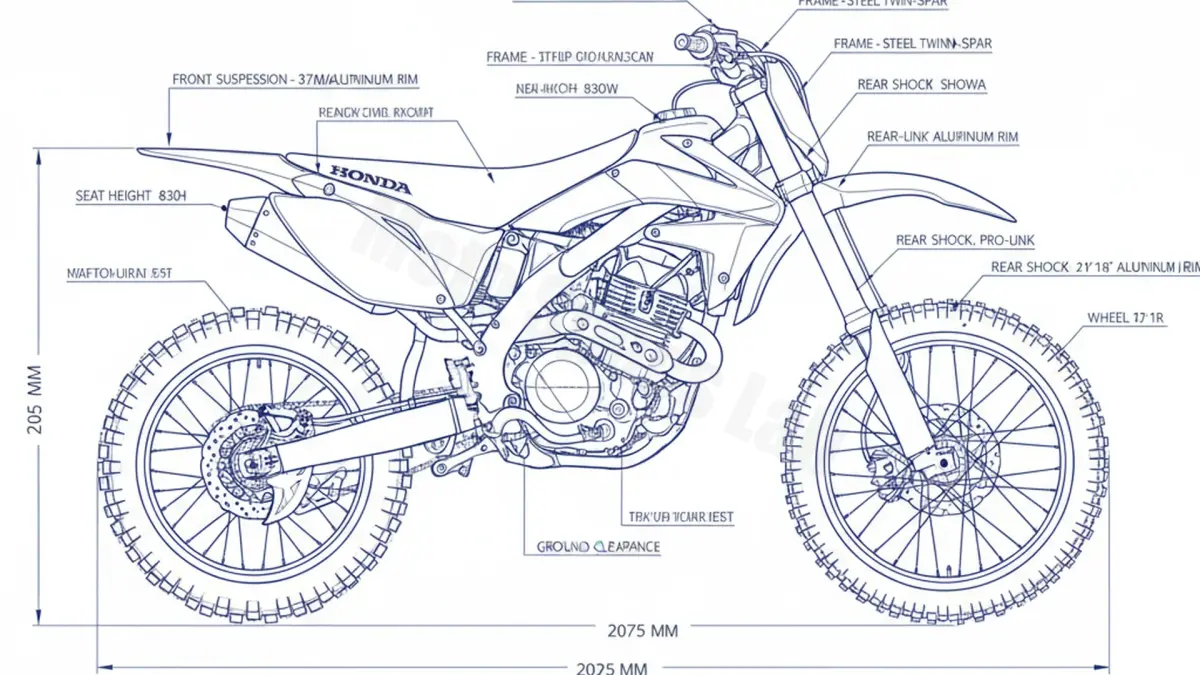
Equipped with 35mm leading-axle Showa forks and a Pro-Link® Showa single shock, the CRF 150 F offers 9.1 inches of front travel and 8.9 inches of rear travel. This setup is specifically tuned for riders who require a lower seat height (32.8 inches) without sacrificing the ground clearance needed for off-road obstacles.
Maintenance Guide: Keeping the Red Rocket Running
1. Lubrication System
The Honda CRF 150 F utilizes a wet sump lubrication system. For optimal protection of the clutch and transmission, use 1.0 liter of SAE 10W-30 oil meeting JASO MA standards. Avoid oils labeled ‘Energy Conserving,’ as these contain friction modifiers that can cause clutch slippage.
2. Ignition and Electrical
The ignition system varies by year. Early models (2003–2005) utilize the NGK DPR8EA-9, while the redesigned 2006–2017 models require the NGK CPR8EA-9. For the electric-start models, the YTZ7S battery is the standard OEM fitment; ensure terminals are clean and the battery is kept on a tender during winter storage to prevent sulfation.
3. Wheels and Tires
Maintaining the 1.0 bar (15 psi) pressure is critical for both rim protection and traction. The 19-inch front and 16-inch rear tire configuration is a specialized ‘small-wheel’ setup that provides excellent agility. Always inspect the spoke tension after the first few hours of riding on new tires.
MotoSpecsLab Verdict
The Honda CRF 150 F remains a high-authority recommendation for recreational trail riders. Its mechanical simplicity, combined with Honda’s legendary build quality, ensures that it retains high resale value and provides a dependable platform for both beginners and intermediate riders.