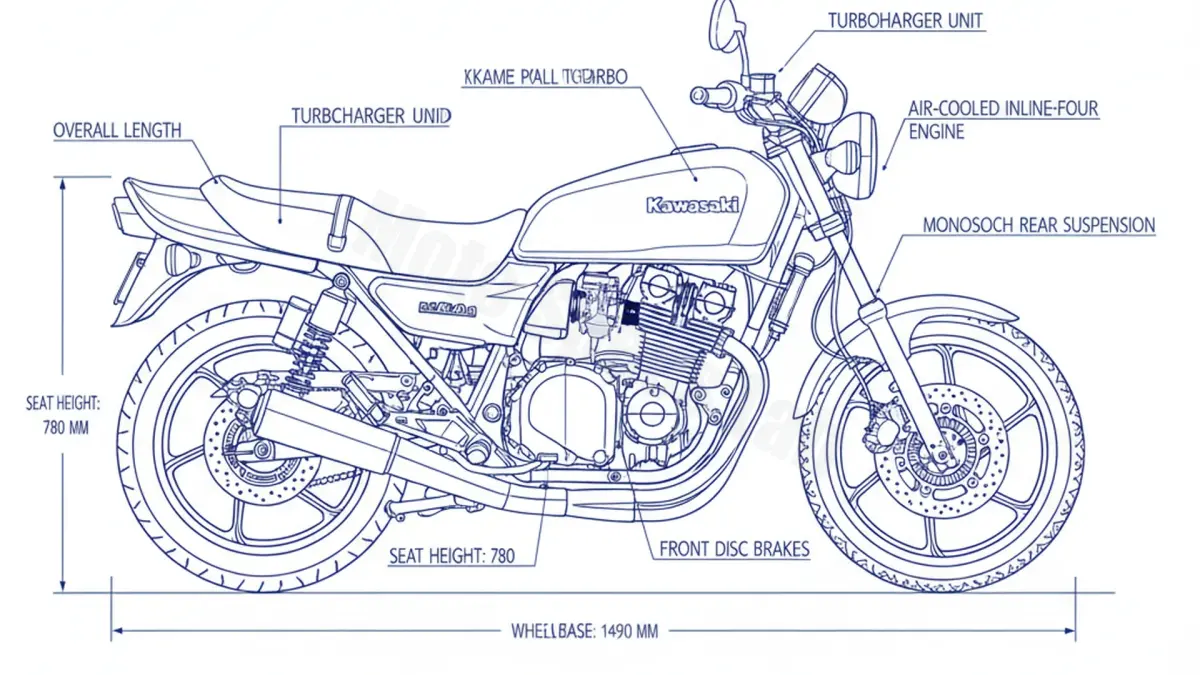
| Engine Type | 738cc Inline-4, Turbocharged |
|---|---|
| Oil Type / Capacity | SAE 10W-40 (API SE/SF) / 3.2 L |
| Front Tire | 110/90-18 61V (2.0 bar / 28 psi) |
| Rear Tire | 130/80-18 66V (2.25 bar / 32 psi) |
| Battery | YB12A-AK |
| Spark Plug | NGK BR9ES (Gap: 0.7–0.8 mm) |
While the ‘Big Four’ Japanese manufacturers all experimented with forced induction in the early 1980s, the Kawasaki Z 750 Turbo (ZX750E) stands alone as the most aggressive and successful implementation of the technology. Unlike its rivals from Honda and Yamaha, which placed their turbochargers behind the engine, Kawasaki engineers strategically positioned the Hitachi HT-10B turbocharger directly in front of the exhaust ports. This design significantly reduced exhaust gas travel distance, minimizing thermal loss and turbo lag, ultimately allowing the ZX750E to outperform many 1100cc naturally aspirated superbikes of its day.
Technical Review: Performance and Architecture
The ZX750E was not merely a GPz750 with a bolt-on blower. The engine featured lower-compression pistons (8.0:1), strengthened main bearings, and a sophisticated digital fuel injection (DFI) system. This allowed the bike to produce a staggering 112 hp at 9,000 rpm. The power delivery is legendary: linear until approximately 5,000 rpm, followed by a violent surge of boost that redefined what a middleweight chassis could handle.
Maintenance Guide & Essential Specifications
To maintain the integrity of the turbocharger and the high-stress internal components, strict adherence to maintenance intervals is required. Turbocharged engines are notoriously sensitive to oil quality and thermal management.
1. Lubrication System
The ZX750E uses SAE 10W-40 (API SE/SF) oil. Given the turbocharger shares the engine oil, we recommend high-thermal-stability lubricants. The total capacity is 3.2 Liters. Always allow the engine to idle for 60 seconds before shutoff to prevent oil coking in the turbo bearings.
2. Ignition and Electrical
For optimal combustion under boost, use NGK BR9ES spark plugs. The gap must be precisely set between 0.7–0.8 mm. A weak spark under high cylinder pressure will lead to misfires. The electrical system is supported by a YB12A-AK battery; ensure terminals are clean to support the DFI computer’s voltage requirements.
3. Chassis and Tires
The ZX750E utilizes an 18-inch wheel configuration. For high-speed stability, the front 110/90-18 should be set to 2.0 bar (28 psi), while the rear 130/80-18 requires 2.25 bar (32 psi). Over-inflating the rear can lead to reduced traction during the turbo’s peak torque curve.
The MotoSpecsLab Verdict
The Kawasaki Z 750 Turbo remains the pinnacle of the 80s turbo craze. It offers a raw, mechanical experience that modern electronics have largely sanitized. For the collector or technician, it represents a masterclass in early electronic fuel injection and forced induction integration. Proper maintenance of the cooling and lubrication systems is the key to preserving this piece of motorcycling history.