| Specification | Value |
|---|---|
| Engine Type | Liquid-cooled, Revolution® V-Twin |
| Oil Requirement | SAE 20W-50 (4.3 Liters) |
| Front Tire | 120/70 ZR 19 |
| Rear Tire | 240/40 R 18 |
| Spark Plug | 10R12A |
| Battery | YTX20HL-BS |
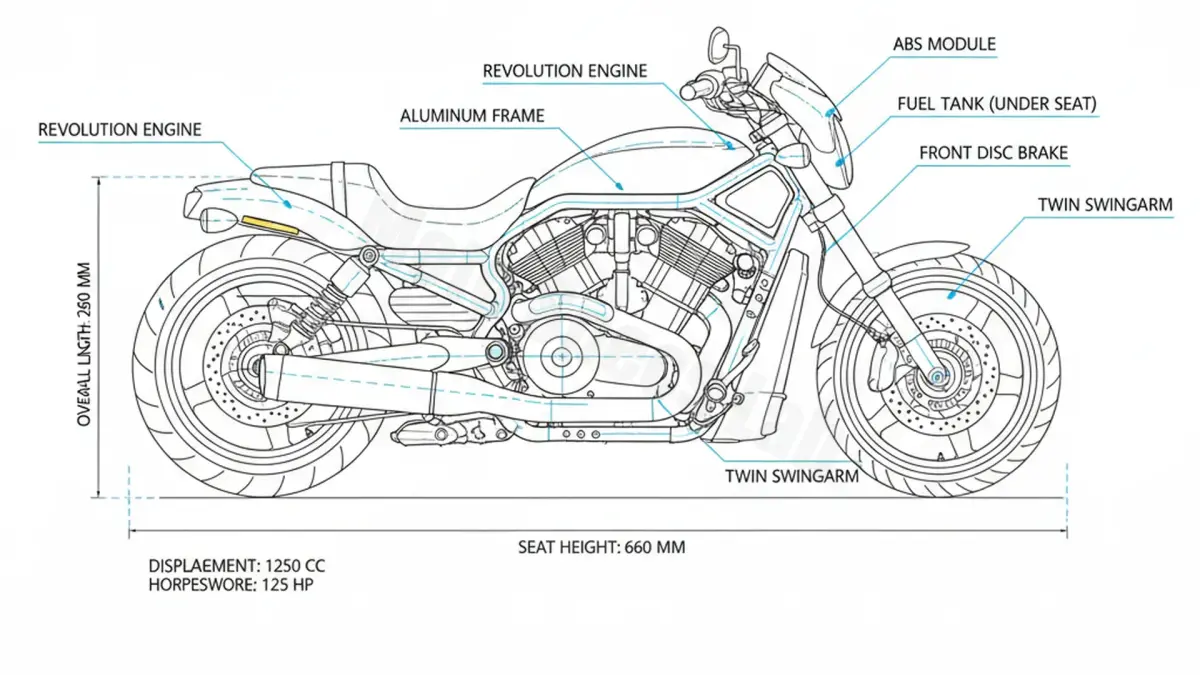
The Harley-Davidson V-Rod VRSCAW represents a pivotal moment in American motorcycling history. Unlike the traditional air-cooled 45-degree V-twins that defined the brand for a century, the VRSCAW features the Revolution® engine, a liquid-cooled 60-degree V-twin co-developed with Porsche Engineering. This specific model (2007-2010) is most notable for introducing the massive 240mm rear tire and an increased fuel capacity, addressing the primary critiques of the early V-Rod iterations.
Technical Engineering Deep-Dive
At the heart of the VRSCAW is a 1250cc (76 cubic inch) power plant that utilizes dual overhead cams and four valves per cylinder. This architecture allows the V-Rod to reach a redline of 9,000 RPM—a figure unheard of in the cruiser segment at the time of its release. The hydroformed frame provides a rigid backbone for the high-torque output, while the optional ABS (standard on later models) offers modern safety performance for the high-inertia machine.
Maintenance Essentials
Maintaining the VRSCAW requires strict adherence to technical tolerances to preserve the longevity of the high-revving Revolution engine. As the Editor-in-Chief of MotoSpecsLab, I recommend the following service parameters:
Lubrication System
The V-Rod uses a wet-sump system. It requires 4.3 Liters of SAE 20W-50 oil. Given the high operating temperatures of a liquid-cooled performance engine, full synthetic oil is mandatory to prevent thermal breakdown. Ensure the oil filter is torqued to factory specifications to avoid leaks near the exhaust headers.
Chassis and Contact Patch
The VRSCAW’s handling is heavily dependent on tire condition. The 240/40 R 18 rear tire provides immense straight-line stability but requires precise pressure management to ensure predictable cornering tip-in. Maintain 2.48 bar (36 psi) in the front and 2.90 bar (42 psi) in the rear.
Electrical and Ignition
The high-compression nature of the 1250cc engine demands a robust electrical system. The YTX20HL-BS battery provides the necessary cold cranking amps (CCA). For ignition, the 10R12A spark plugs should be inspected every 10,000 miles for carbon fouling or electrode wear.
Editorial Review: The MotoSpecsLab Verdict
The VRSCAW is a “Muscle Cruiser” in the truest sense. While purists may miss the ‘potato-potato’ exhaust note of the air-cooled models, the Porsche-derived engineering delivers a linear power band that is addictive. The inclusion of ABS and the wider rear tire transformed the V-Rod from a niche experiment into a formidable performance icon. It remains one of the most reliable Harley-Davidson platforms ever built, provided the cooling system and valve clearances are maintained.
Frequently Asked Questions
A: We recommend a coolant flush every two years or 15,000 miles using a silicate-free long-life coolant to protect the internal aluminum components.
A: Yes, the VRSCAW features a modernized instrument cluster including a fuel gauge, which was an upgrade over the original VRSCA models.