| Specification | Value |
|---|---|
| Production Years | 2018–2022 |
| Engine Oil | SAE 10W-40 (API SG-SM / JASO MA2) |
| Oil Capacity | 2.0 Liters |
| Tire Size (Front/Rear) | 110/70R17 / 150/60R17 |
| Tire Pressure (F/R) | 2.0 bar (28 psi) / 2.3 bar (32 psi) |
| Spark Plug | NGK LMAR9G (0.7–0.8 mm gap) |
| Battery | FTZ8V / YTZ8V |
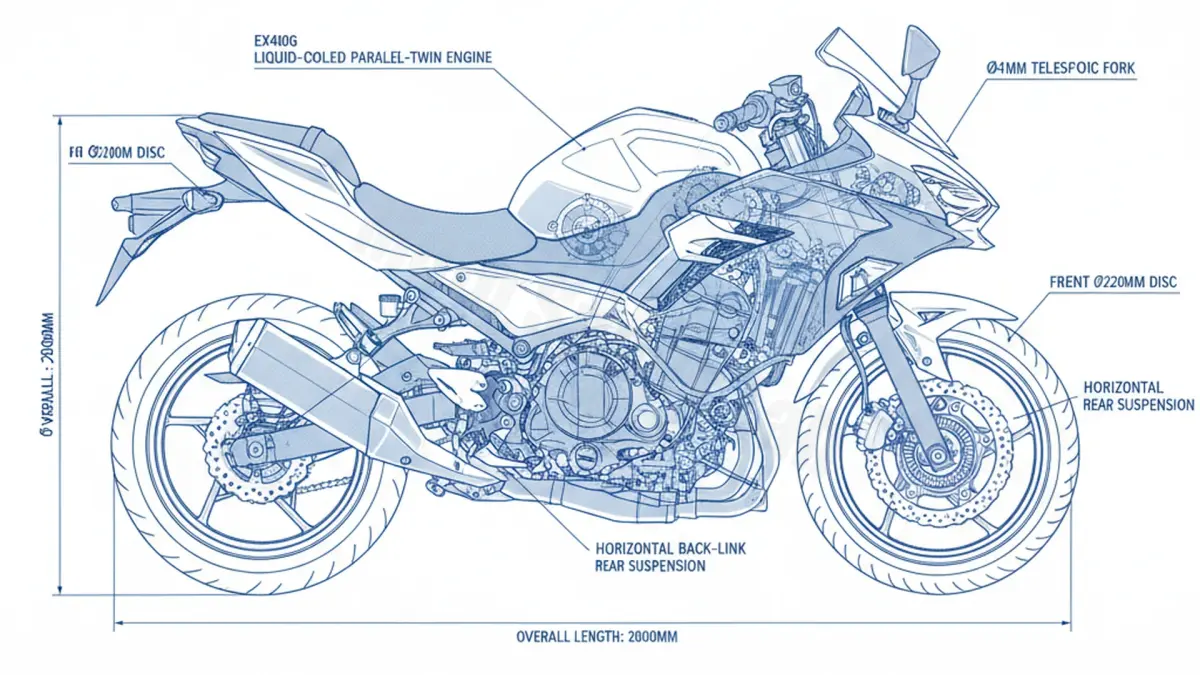
Engineering Highlight: While the Ninja 400 (EX400G) was designed to replace the Ninja 300, it represents a radical departure in chassis philosophy. Kawasaki engineers utilized advanced 3D structural analysis to develop a lightweight trellis frame inspired by the H2 hyperbike. This allowed the 399cc machine to weigh 8kg less than its predecessor while offering significantly higher torsional rigidity and a shorter wheelbase.
Technical Overview
The EX400G series remains a benchmark in the lightweight supersport category. Powered by a 399cc parallel-twin, the engine utilizes a downdraft intake system and a large airbox to maximize volumetric efficiency. This Euro 4 compliant powerplant is tuned for a linear torque delivery that benefits both track enthusiasts and daily commuters.
Maintenance Standards & Fluid Dynamics
To maintain peak performance and longevity, the Ninja 400 requires strict adherence to fluid specifications. We recommend high-performance synthetic 10W-40 oils meeting JASO MA2 standards to protect the Assist & Slipper clutch mechanism. The 2.0-liter capacity (with filter change) ensures adequate thermal management under high-revving conditions.
Ignition and Electrical Systems
The ignition system relies on the NGK LMAR9G long-reach spark plug. It is critical to verify the gap of 0.7–0.8 mm before installation to ensure optimal flame kernel growth. For electrical reliability, the FTZ8V or YTZ8V batteries provide the necessary cold cranking amps required for the high-compression twin-cylinder engine.
Chassis and Contact Patch
The EX400G utilizes radial tires as standard equipment. Maintaining the factory-recommended pressures—2.0 bar (28 psi) in the front and 2.3 bar (32 psi) in the rear—is essential for achieving the flickable handling characteristics the Ninja 400 is famous for. Deviations in pressure can significantly impact the turn-in speed and mid-corner stability.
Expert Verdict
The Kawasaki Ninja 400 EX400G is a masterclass in mass centralization. From a maintenance perspective, it is one of the most accessible modern sportbikes, provided the owner adheres to the specific JASO MA2 oil requirements and spark plug tolerances. It remains a top recommendation for riders seeking a balance between mechanical simplicity and high-performance engineering.