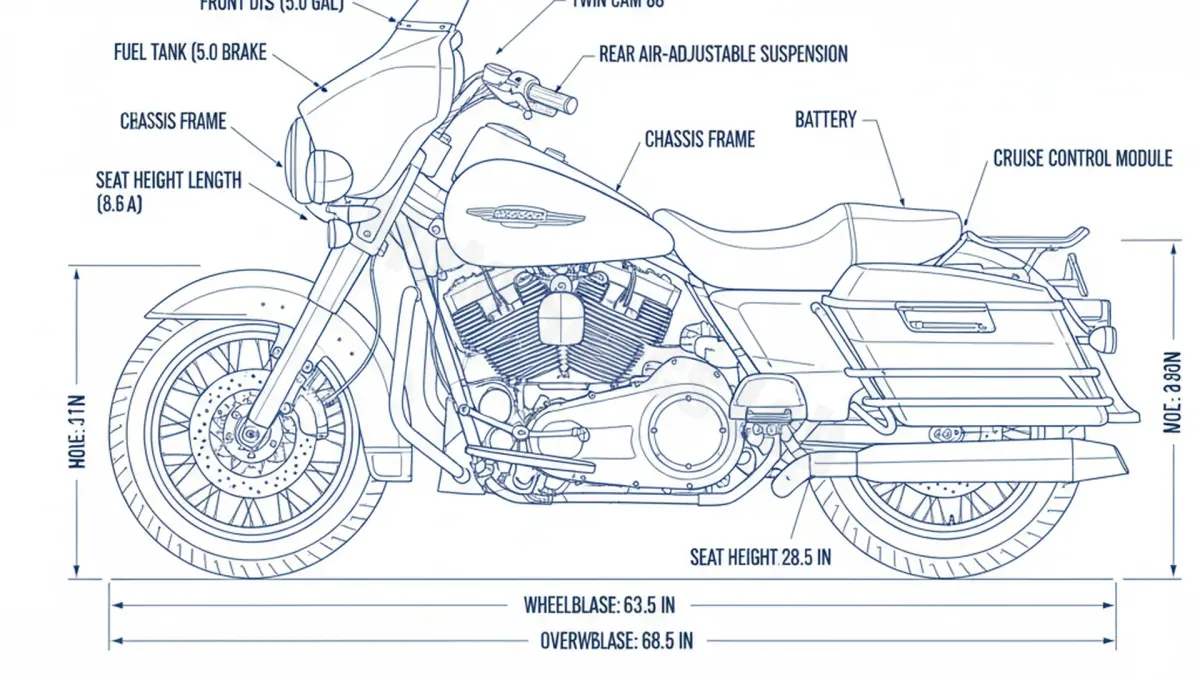
| Component | Specification |
|---|---|
| Production Years | 1989–2019 (Modern Era: 2009–2019) |
| Engine Oil | SAE 20W-50 (3.8 L – 4.5 L) |
| Tire Size | F: 130/80B17 / R: 180/65B16 |
| Tire Pressure | F: 36 psi / R: 40 psi |
| Spark Plugs | 6R12 (Twin Cam) / 6R10 (M8) |
| Battery | 66010-97D |
Historical Engineering Highlight: While the Electra Glide name dates back to 1965, the FLHTCU (Ultra Classic) designation, introduced in 1989, marked Harley-Davidson’s first foray into integrated electronic touring systems, featuring the industry’s first production electronic cruise control and a standard CB radio/intercom system—technologies that defined the luxury touring segment for decades.
Technical Review: The Evolution of the FLHTCU
At MotoSpecsLab, we categorize the FLHTCU as the benchmark for heavy-weight touring. The most significant engineering milestone occurred in 2009, when Harley-Davidson completely redesigned the touring frame. This new chassis replaced the old multi-piece frame with a single-spar backbone and a new swingarm design, significantly increasing the load capacity and eliminating the high-speed “wobble” sometimes associated with earlier rubber-mounted engine models.
The powertrain journey of the FLHTCU transitioned from the 80ci Evolution to the Twin Cam 88, 96, 103, and finally the Milwaukee-Eight (M8) 107. Each iteration focused on thermal management, particularly the introduction of “Twin-Cooled” technology in the High Output Twin Cam 103 units, which utilized liquid-cooled cylinder heads to maintain performance during low-speed parade duty or heavy traffic.
Maintenance Guide & Essential Specifications
1. Lubrication System
For optimal shear stability in air-cooled V-Twin environments, use SAE 20W-50. While mineral-based H-D 360 is sufficient, SYN3 Full Synthetic is recommended for modern M8 and Twin Cam 103 engines to reduce operating temperatures. Capacity ranges from 3.8 to 4.5 liters depending on the oil cooler volume and filter size.
2. Tires and Contact Patch
The FLHTCU demands precise pressure management due to its high curb weight.
- Front (130/80B17 65H): Maintain at 2.48 bar (36 psi).
- Rear (180/65B16 81H): Maintain at 2.76 bar (40 psi).
Failure to maintain these pressures results in “cupping” of the front tread and reduced stability in crosswinds.
3. Electrical and Ignition
The 66010-97D battery is a high-CCA (Cold Cranking Amps) unit essential for turning over high-compression V-twins. For ignition, ensure the gap is set correctly on 6R12 plugs for Twin Cam models, or the newer 6R10 plugs for Milwaukee-Eight engines to prevent low-speed surging.
Editor’s Verdict
The FLHTCU remains a masterpiece of mechanical persistence. Its evolution from the 1980s to 2019 represents a perfection of the “Batwing” fairing aerodynamics and long-haul ergonomics. For the technician, it is a straightforward machine to maintain, provided the critical fasteners (especially the compensator nut and primary chain tensioner) are inspected at 10,000-mile intervals.