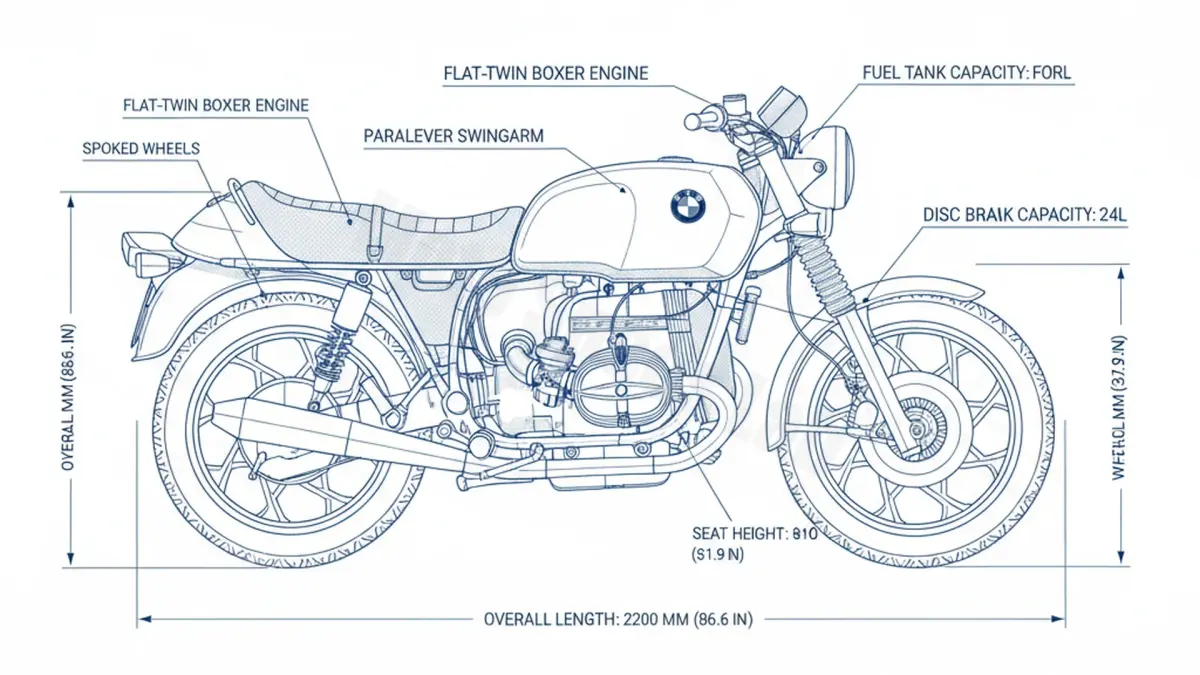
A defining moment in BMW Motorrad history occurred in 1981 when the R 100 CS (Classic Sport) debuted with ‘Galnikal’ cylinders. Unlike the previous cast-iron liners, these nickel-silicon carbide coated bores provided superior heat dissipation and wear resistance, marking the peak of the 980cc air-cooled boxer’s engineering refinement before the advent of the K-series.
| Quick Specs: BMW R 100 CS | |
|---|---|
| Production Years | 1980–1984 |
| Engine Type | 980cc Air-cooled, 4-stroke Boxer Twin |
| Oil Requirement | SAE 20W-50 (Mineral) (2.5 L) |
| Tire Size (Front/Rear) | F: 3.25 S 19 / R: 4.00 S 18 |
| Battery | 52515 (12V 25Ah) |
| Spark Plug | Bosch W 7 DC (Gap: 0.60–0.70 mm) |
Engineering Overview
The R 100 CS was the spiritual successor to the R 90 S and R 100 S, designed to offer high-speed touring capability with a sporting edge. Utilizing the Type 247 ‘Airhead’ engine, the CS produced approximately 70 horsepower in its early iterations. The chassis remained a traditional double-loop steel frame, but the 1981-onward models benefited from the ‘Brembo’ brake upgrade and a lighter clutch assembly, significantly improving the tactile feedback and rideability of the machine.
Maintenance & Service Guidelines
Maintaining a classic BMW Airhead requires adherence to traditional mechanical tolerances. At MotoSpecsLab, we emphasize the importance of using high-quality mineral oils. Synthetic oils often possess detergents and flow characteristics that can be too aggressive for the seals and clearances of an 80s-era Boxer engine.
Lubrication System
The 2.5-liter oil capacity must be monitored closely. The R 100 CS uses a high-pressure lubrication system, and maintaining the level at the upper mark of the dipstick (without overfilling) is critical for cooling the cylinder heads.
Ignition and Electrical
The Bosch W 7 DC spark plugs are the factory standard. Ensuring a precise gap of 0.60–0.70 mm is vital for preventing carbon buildup and ensuring smooth idling. Given the large 25Ah battery (Type 52515), the charging system must be checked regularly, specifically the diode board and brushes, which are known wear points on high-mileage units.
Tire Pressure & Handling
Proper inflation is paramount for the R 100 CS’s stability, especially when equipped with the traditional S-cockpit fairing. For solo riding, maintain 1.9 bar (27.5 psi) in the front and 2.1 bar (30.5 psi) in the rear. When carrying a passenger or full luggage, increase pressures to 2.1 bar (30.5 psi) front and 2.5 bar (36.2 psi) rear to prevent sidewall flex and maintain line accuracy in corners.
Conclusion
The BMW R 100 CS represents the zenith of the twin-shock, large-capacity Airheads. It combines the aesthetic of the 1970s with the metallurgical advancements of the early 80s, making it one of the most desirable and usable classic motorcycles for the modern collector.