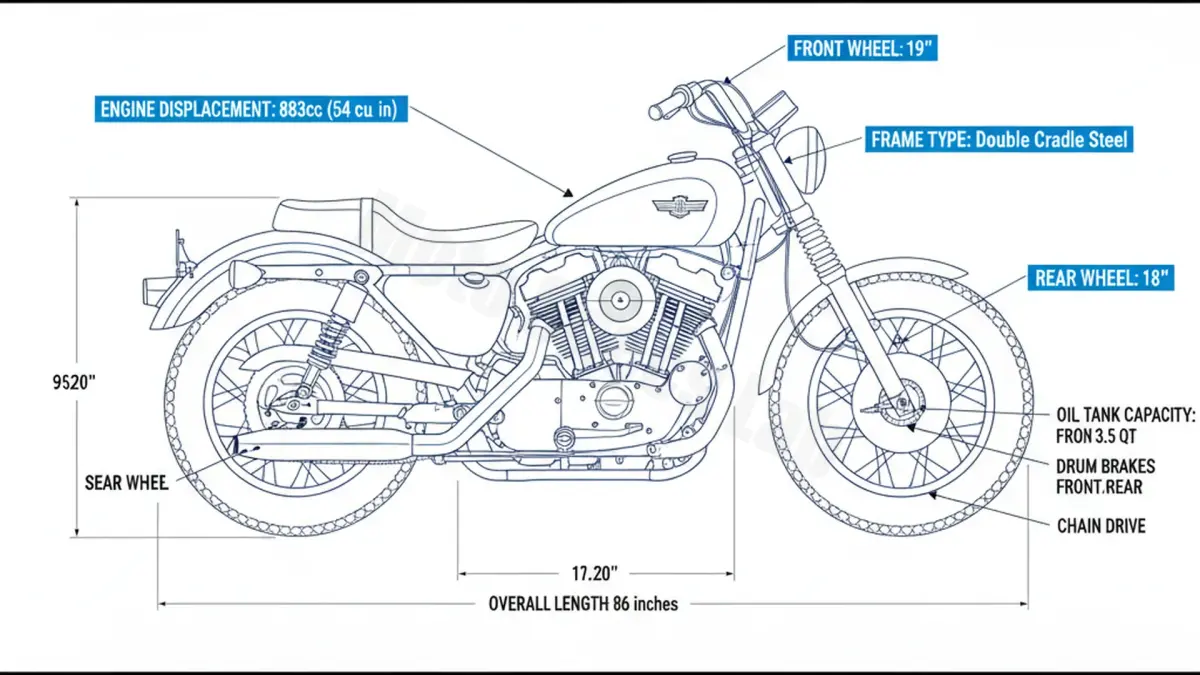
| Component | Specification |
|---|---|
| Model | Harley-Davidson Sportster 900 (66-XLH) |
| Engine Type | 883cc (54 cu in) Ironhead V-Twin |
| Oil Grade | SAE 50 (>40°F) / SAE 60 (>60°F) |
| Oil Capacity | 2.84 Liters (3.0 US Quarts) |
| Tires (F/R) | F: 3.25 x 19″ / R: 4.00 x 18″ |
| Battery | HD 66006-66 (12V 32Ah) |
| Spark Plug / Gap | HD No. 4 / 0.025–0.030 in |
The 1966 Harley-Davidson XLH Sportster stands as a landmark in the evolution of the Milwaukee middleweight. While the “Ironhead” engine architecture was already well-established, 1966 was the pivotal year H-D transitioned the XLH to a 12-volt electrical system. This engineering shift was not merely an incremental update; it was a necessity to support the increasingly popular electric start mechanism, moving the Sportster away from its purely utilitarian roots toward the modern superbike era.
Engineering Overview: The Ironhead Heart
The 66-XLH is powered by the 883cc (54 cubic inch) overhead-valve 45-degree V-twin. Unlike the competition-focused XLCH (Competition Hot) which retained the kick-starter and magneto ignition, the XLH was designed for the highway. The 1966 model features the ‘Ham Can’ air cleaner and, typically, the Tillotson diaphragm carburetor, which replaced the Linkert in late ’66 production, offering better fuel metering under various lean angles.
Maintenance Guide & Technical Specs
Lubrication System
The Ironhead is a dry-sump engine that relies heavily on oil viscosity for both lubrication and cooling. Due to the wide clearances inherent in 1960s metallurgy, heavy-grade straight-weight oils are mandatory. Use SAE 50 for standard conditions and SAE 60 for high-heat environments (above 60°F). Total capacity is 2.84 liters.
Chassis & Tires
Handling on the ’66 Sportster is defined by its narrow profile. Correct tire pressure is critical for stability at speed. For the 3.25 x 19″ front and 4.00 x 18″ rear setup, maintain 20 psi (1.38 bar) in the front. The rear requires 24 psi (1.65 bar) for solo riding, but must be increased to 30 psi (2.07 bar) when carrying a passenger to prevent sidewall deflection.
Electrical & Ignition
With the introduction of the HD 66006-66 12V 32Ah battery, the XLH gained significant cranking power. However, the charging system (generator-based) requires regular inspection of the regulator points. For ignition, ensure the Harley-Davidson No. 4 plugs are gapped precisely to 0.025–0.030 inches to ensure a consistent flame front in the high-compression combustion chamber.
Editor’s Verdict
The 1966 XLH represents the perfect bridge between vintage mechanical purity and modern convenience. While it requires more mechanical sympathy than a modern Evolution-engined bike—specifically regarding oil leaks and primary chain adjustments—the reward is an unfiltered, visceral riding experience that defined an entire generation of American motorcycling.
Frequently Asked Questions
Q: Can I use synthetic oil in my 1966 Sportster?
A: It is generally discouraged for vintage Ironhead engines. Mineral-based straight-weight SAE 50 or 60 provides the necessary film strength and seal compatibility for the gaskets used in 1966.
Q: What is the primary difference between the 1966 XLH and XLCH?
A: The XLH (High Compression) featured the new 12V electrical system and electric start, while the XLCH (Competition Hot) was a lighter, kick-start only model with a magneto ignition.