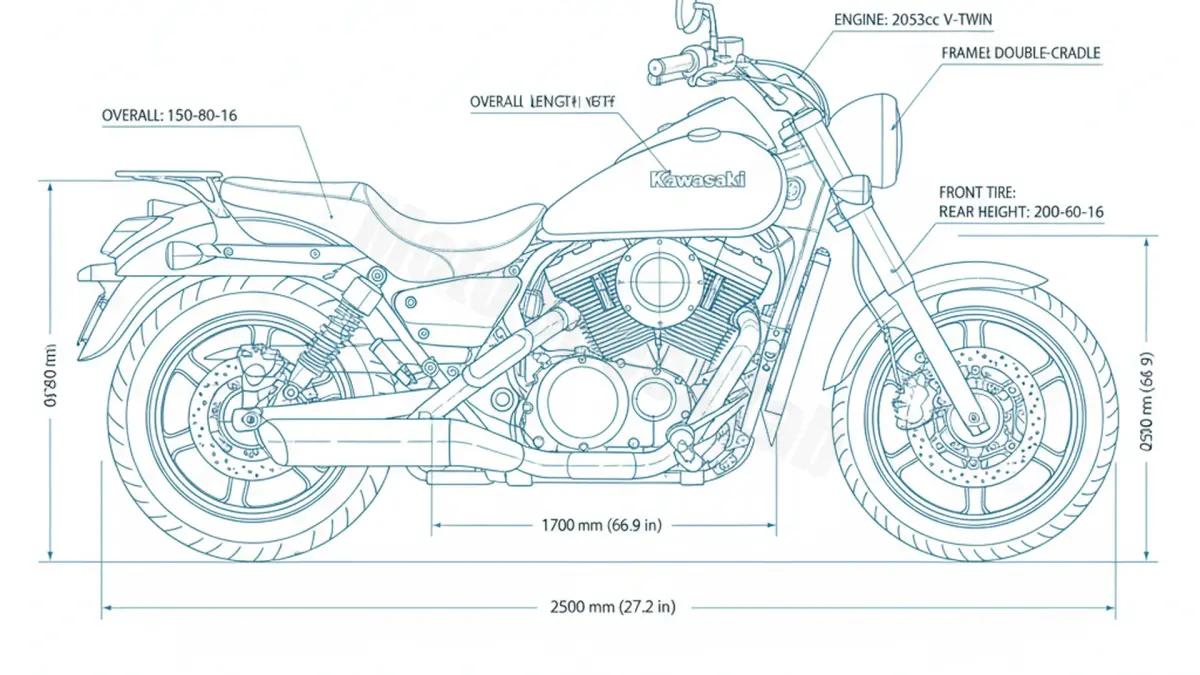
| Component | Specification |
|---|---|
| Production Years | 2004 – 2010 |
| Engine Oil | SAE 10W-40 (4.6 L) |
| Front Tire | 150/80 R16 M/C (71V) |
| Rear Tire | 240/50 R16 M/C (84V) |
| Tire Pressure (F/R) | 2.5 bar / 2.9 bar |
| Battery | YTX20CH-BS |
| Spark Plug | NGK IZFR6F11 |
At its launch in 2004, the Kawasaki VN 2000 (VNW00) didn’t just push the boundaries of the cruiser market—it rewrote them. A unique engineering highlight of this machine is its 103mm forged pistons, which are larger than those found in many high-performance automotive V8 engines. This massive displacement (125 cubic inches) allows the Vulcan 2000 to generate a staggering 177 Nm of torque, most of which is available as low as 3,200 RPM.
Technical Review: Power and Presence
The VNW00 platform is defined by its pushrod-actuated overhead valve (OHV) system, a departure from Kawasaki’s usual overhead cam designs, chosen specifically to keep the engine height manageable despite the 2,053cc displacement. The ‘Classic’ variant offers more traditional styling, but both models share the same robust frame and belt-drive system designed to handle the immense torque output.
Maintenance Guide: Keeping the Beast Healthy
Lubrication System
The VN 2000 utilizes a semi-dry sump system. For optimal performance and clutch longevity, use a high-quality SAE 10W-40 motorcycle-specific oil. The total capacity is 4.6 liters. Given the heat generated by these massive cylinders, regular oil changes every 6,000 km (or annually) are critical for maintaining the hydraulic valve lash adjusters.
Ignition and Electrical
The engine utilizes a dual-plug ignition system for efficient combustion across the large bore. The specified NGK IZFR6F11 iridium plugs are essential for consistent firing. For the electrical system, the heavy-duty YTX20CH-BS battery is required to provide the high cold-cranking amps (CCA) necessary to turn over the high-compression 2.0L V-twin.
Tires and Contact Patch
The VN 2000 is famous for its massive 240/50 R16 rear tire. To ensure handling stability and prevent uneven wear, maintain a strict pressure of 2.9 bar (42 psi) in the rear and 2.5 bar (36 psi) in the 150-section front tire. Under-inflation on a bike this heavy (approx. 370kg dry) will lead to sluggish handling and rapid tire degradation.
Summary for Owners
The Kawasaki VN 2000 remains a pinnacle of cruiser engineering. While its maintenance requirements are straightforward, the scale of its components requires precision. Adhering to the 4.6L oil capacity and correct tire pressures will ensure this legendary ‘Metric Cruiser’ continues to dominate the open road with its unparalleled torque and presence.