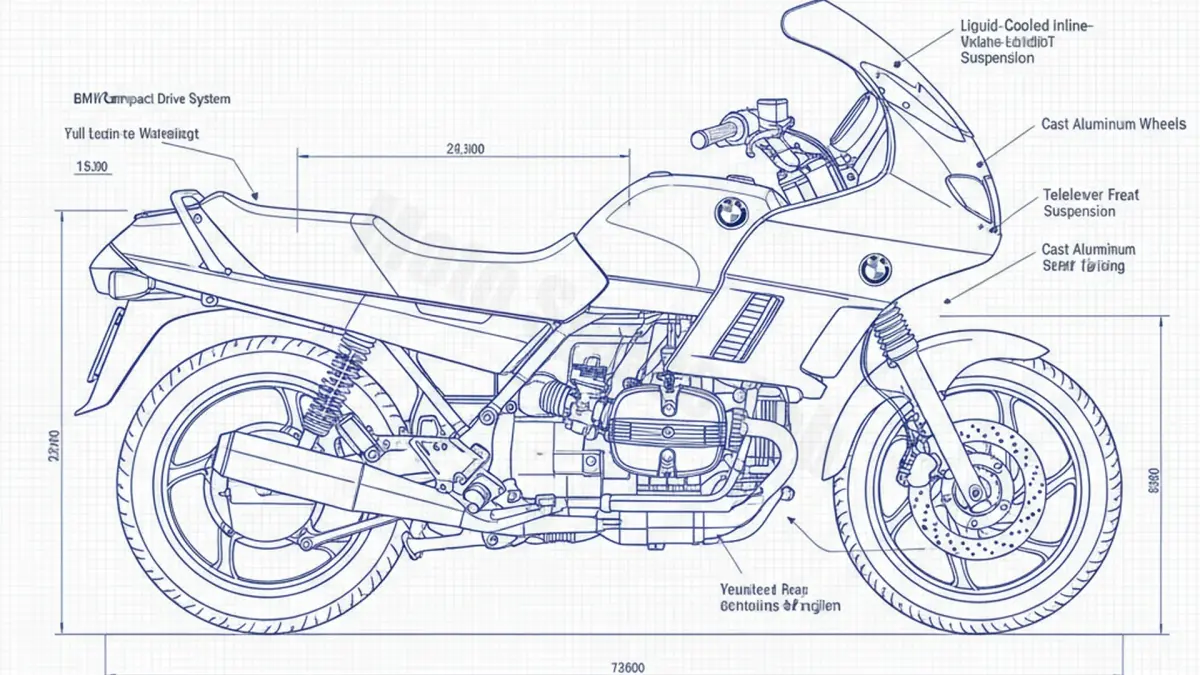
| Specification | Value |
|---|---|
| Production Years | 1989 – 1996 |
| Engine Type | 740cc Liquid-cooled Inline-3 (Horizontal) |
| Oil Requirement | SAE 20W-50 / 15W-40 (3.5 L) |
| Spark Plug | Bosch X5DC |
| Tire Size (F/R) | 100/90-18 / 130/90-17 |
| Battery | DIN 52515 (61 21 1 459 650) |
While its larger sibling, the K 100, earned the nickname ‘The Flying Brick,’ the BMW K 75 RT is arguably the superior engineering achievement of the era. The K 75 series features a unique 120-degree crankshaft paired with a counter-rotating balance shaft—a design so effective at neutralizing secondary vibrations that many mechanical engineers consider it the smoothest internal combustion motorcycle engine ever mass-produced.
Engineering Overview: The Triple Refinement
The K 75 RT (Reise-Tourer) was designed to offer the weather protection and luxury of the K 100 RT but with the agile handling and smoothness of the triple-cylinder powerplant. The Ultima edition, produced toward the end of the run, represents the final evolution of the platform, featuring optimized fairings and improved ergonomics. The 740cc engine utilizes Bosch LE-Jetronic fuel injection, providing consistent performance across various altitudes and temperatures.
Maintenance & Fluid Dynamics
For the longevity of the K75RT engine, lubricant selection is critical. MotoSpecsLab recommends SAE 20W-50 for most climates, ensuring the API rating is SF, SG, or SH. The system requires exactly 3.5 liters during a standard filter change. Unlike modern high-revving triples, the K 75 relies on thermal stability provided by its liquid cooling system and high-viscosity mineral or semi-synthetic oils.
Chassis and Contact Patch
The K 75 RT’s handling is sensitive to tire choice and pressure. The standard fitment utilizes a 100/90 – 18 56V on the front and a 130/90 – 17 68V on the rear. To maintain the neutral steering characteristics intended by BMW engineers, pressures must be strictly maintained at 2.2 bar (31.9 psi) in the front and 2.5 bar (36.3 psi) in the rear.
Electrical System & Ignition
The ignition system is anchored by Bosch X5DC spark plugs. Given the horizontal layout of the cylinders, ensuring a clean seat and correct torque is vital to prevent head damage. The electrical demands of the RT’s full fairing and optional accessories require a robust battery; the DIN 52515 (61 21 1 459 650) is the standard specification, providing the necessary cold cranking amps for the high-compression starter motor.
Expert Verdict
The BMW K 75 RT/ULTIMA remains a masterpiece of late 20th-century touring. Its lack of vibration reduces rider fatigue significantly compared to contemporaries, and its over-engineered drivetrain is known to exceed 200,000 miles with basic maintenance. It is a testament to the era when BMW Motorrad prioritized mechanical perfection over cost-cutting.
Frequently Asked Questions
Q: Can I use synthetic oil in the K 75 RT?
A: Yes, provided it meets the API SF/SG/SH specifications. However, many owners prefer high-quality mineral 20W-50 to ensure seal integrity in older engines.
Q: Why is the K 75 smoother than the K 100?
A: The 120-degree crank spacing of the three-cylinder engine naturally cancels out many of the primary and secondary forces that cause vibration in the 180-degree flat-four K 100.