| Specification | Value |
|---|---|
| Production Years | 1955 – 1960 |
| Engine Type | Opposed Twin (Boxer) |
| Oil Type | Mineral 20W-50 |
| Oil Capacity | 2.0 Liters |
| Tire Size | F/R: 3.50 x 18 |
| Battery | 6V 8Ah (00811) |
| Spark Plug | Bosch W240T1 / NGK B8HS |
Engineering Legacy: The Anti-Dive Revolution
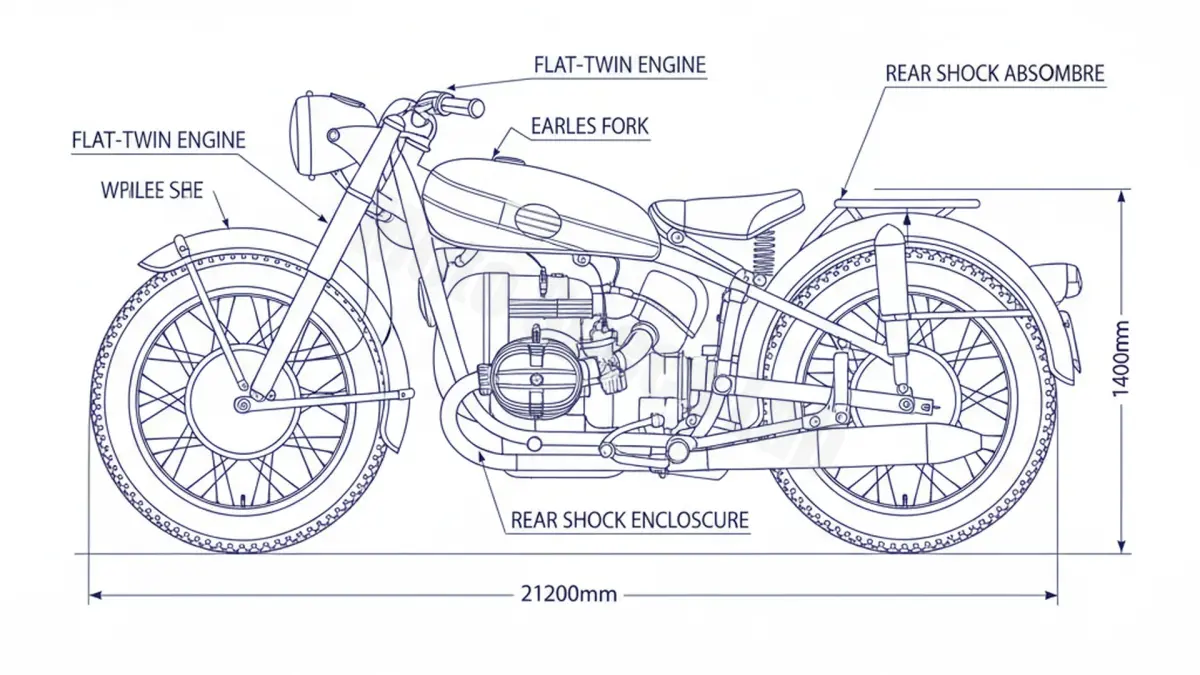
The BMW R 50 (internal designation 252/2) stands as a landmark in motorcycling history for its introduction of the Earles-type front fork. Unlike traditional telescopic forks of the era, this leading-link design was engineered to eliminate front-end dive during heavy braking. This specific geometry actually caused the front of the motorcycle to rise slightly when the brakes were applied, providing unparalleled stability for sidecar use and high-speed touring in the mid-1950s.
Technical Performance & Handling
Powered by a 494cc overhead-valve boxer engine, the R 50 was not built for raw speed but for legendary durability. Producing approximately 26 horsepower, its strength lay in its smooth power delivery and the shaft-drive system which required significantly less maintenance than contemporary chain-driven competitors. The frame, a double-loop tubular steel design, provided the rigidity necessary for the burgeoning ‘Autobahn’ culture in West Germany.
Maintenance Roadmap
Lubrication System
The air-cooled boxer engine relies heavily on its oil for both lubrication and thermal management. At MotoSpecsLab, we recommend using a high-quality Mineral 20W-50 oil. Synthetic oils should be avoided in these vintage units as they can lead to seal seepage. The total capacity is 2.0 Liters. Changes should be performed every 2,500 miles or annually.
Electrical & Ignition
The R 50 utilizes a 6-volt electrical system. Ensure the 6V 8Ah battery is kept on a dedicated 6V maintainer during storage. For ignition, the Bosch W240T1 (or the modern NGK B8HS) is the standard. Proper gapping is essential to prevent fouling, especially during cold starts.
Tires and Safety
The R 50 uses identical 3.50 x 18 tires for both front and rear. Maintaining correct pressure is vital for the unique handling characteristics of the Earles fork: 1.6 bar (23.2 psi) in the front and 1.9 bar (27.5 psi) in the rear. If carrying a passenger or sidecar, the rear pressure should be increased to 2.1 bar.
Frequently Asked Questions
What is the fuel capacity of the R 50?
The standard tank holds 17 liters, including a small reserve portion accessed via the fuel petcock.
Can I convert the R 50 to 12 Volts?
Yes, many owners opt for a 12V electronic ignition conversion for better lighting and reliability, though it detracts from original ‘concours’ status.
Why does the front end rise when I brake?
This is a characteristic of the Earles-type swingarm fork. It is a mechanical feature designed to maintain suspension travel even under hard deceleration.