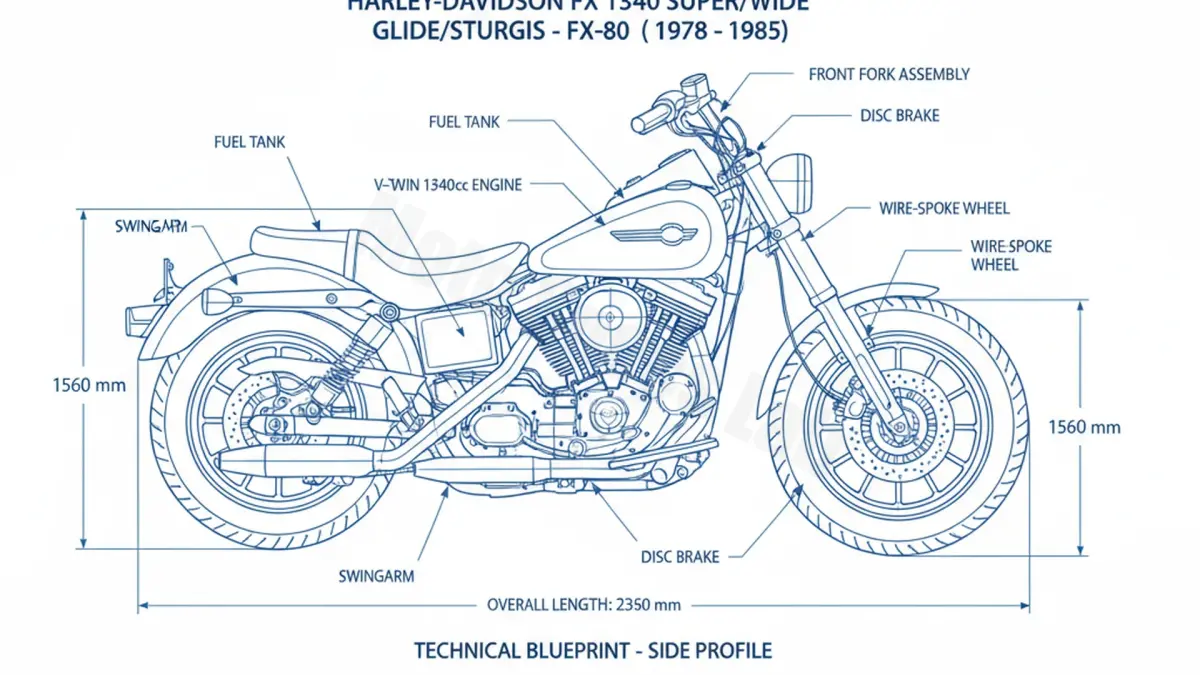
| Component | Specification |
|---|---|
| Engine | 1340cc (80 ci) V-Twin Shovelhead |
| Production Years | 1979-1984 |
| Oil Capacity | 3.8 Liters (HD 50 / 60 / 20W-50) |
| Spark Plug | HD 5R6A (Gap: 0.96-1.1mm) |
| Battery | 66006-70 |
| Front Tire | 100/90-19 (FX/FXE/FXB) / 80/90-21 (FXWG) |
| Rear Tire | 130/90-16 |
The Engineering Milestone: The Birth of the 80-Inch Shovelhead
A pivotal moment in Milwaukee engineering occurred in 1980 with the release of the FXB Sturgis. It was Harley-Davidson’s first production motorcycle to implement a dual-belt drive system—utilizing belts for both the primary and secondary drives. This innovation significantly reduced maintenance requirements and noise, marking a transition point between the raw mechanical nature of the early Shovelheads and the refined reliability of the upcoming Evolution era.
Technical Analysis: The FX-80 Platform
The 1340cc (80 cubic inch) power plant was introduced to provide the torque necessary for the heavier chassis of the late 70s and early 80s. While the 74ci engines were legendary, the FX-80 series offered better highway cruising capabilities. The platform varied significantly in geometry: the FXWG Wide Glide featured 21-inch front wheels and a raked-out front end, providing the classic chopper silhouette, while the FX/FXE Super Glide maintained a more nimble 19-inch front configuration for superior urban handling.
Maintenance Guide & Lubrication Strategy
Proper lubrication is the lifeblood of the air-cooled Shovelhead. Due to the high thermal loads of the 1340cc engine, oil viscosity must be matched to the ambient operating temperature:
- HD 50: Optimal for temperatures above 60°F.
- HD 60: Required for extreme heat (above 80°F) to maintain oil film strength.
- 20W-50: The modern standard for all-weather riding.
The system requires 3.8 Liters of oil. Always check levels with the bike upright to ensure the dry-sump system is accurately measured.
Ignition and Electrical
The FX-80 series utilizes the HD 5R6A spark plug. To ensure optimal combustion and prevent fouling, the gap must be precisely set between 0.96mm and 1.1mm. Electrical stability is managed by the 66006-70 battery; given the high compression of the 80ci engine, ensuring a high cold-cranking amp (CCA) output is essential for reliable starting.
Tire Pressure & Chassis Dynamics
Handling characteristics on these vintage frames are highly sensitive to tire pressure. The FXWG (Wide Glide) requires a lower front pressure of 1.5 bar (22 psi) due to its narrower 21-inch tire, whereas the Super Glide/Sturgis models (19-inch) should be set to 1.8 bar (26 psi). For the rear 130/90-16 tire, 1.5 bar (22 psi) is sufficient for solo riding, but it must be increased to 2.1 bar (30 psi) when carrying a passenger to prevent sidewall wallowing in corners.