| Component | Specification |
|---|---|
| Model Years | 1977 – 1978 |
| Engine Oil | SAE 10W-40 (API SE/SF) – 3.0 L |
| Spark Plug | NGK D8EA (0.6mm – 0.7mm gap) |
| Battery | YB14L-A2 |
| Front Tire | 3.25-19 4PR (2.0 bar / 28 psi) |
| Rear Tire | 4.00-18 4PR (2.2 – 2.8 bar) |
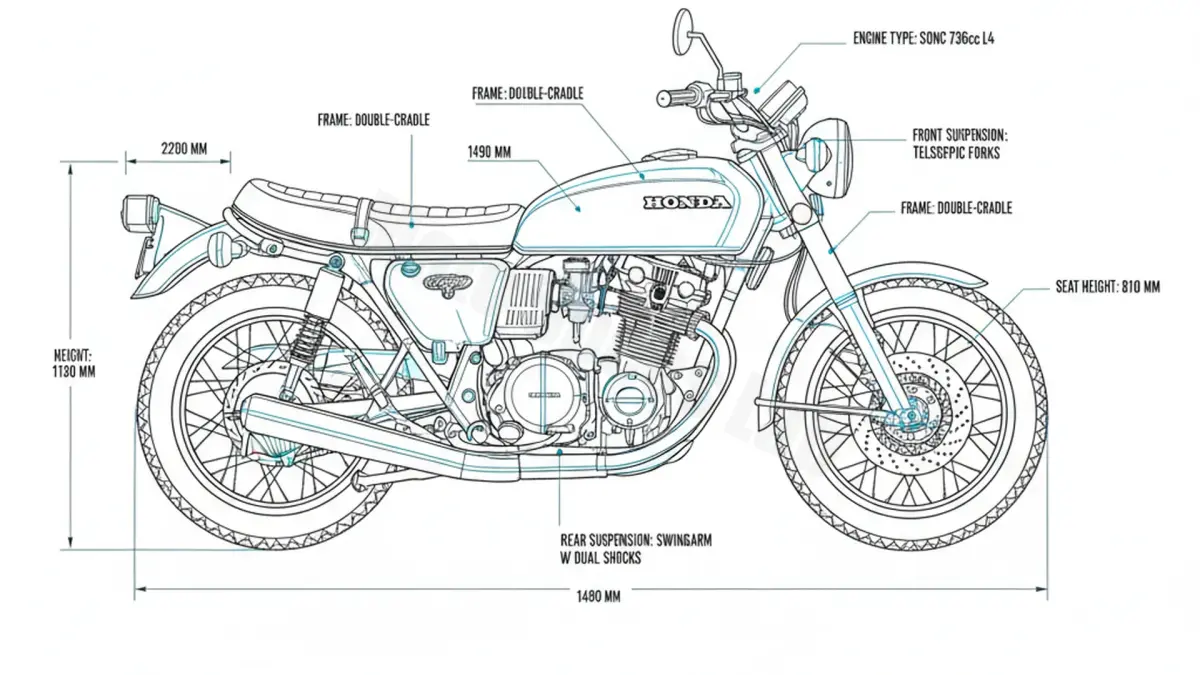
The Honda CB 750 FOUR K7 represents a pivotal moment in motorcycling history: it was the final iteration of the legendary Single OverHead Cam (SOHC) inline-four engine before Honda transitioned to the DOHC 16-valve architecture. While often overshadowed by the original 1969 ‘Sandcast’ models, the K7 is technically the most refined. It featured a unique ‘PD’ series carburetor set and a revised exhaust system designed to meet more stringent global noise and emission standards without sacrificing the ‘Superbike’ soul that defined the CB series.
Engineering Evolution & Performance
By 1977, Honda had spent nearly a decade perfecting the 736cc powerplant. The K7 (CB750K) benefited from improved internal lubrication and a redesigned fuel tank that offered better ergonomics for longer tours. The chassis remained a sturdy double-cradle steel frame, but the suspension was tuned for a more compliant ride compared to the earlier, stiffer K-series models. This makes the K7 the preferred choice for vintage enthusiasts who prioritize rideability and long-distance comfort.
Maintenance Guide: Keeping the Legend Alive
To maintain the E-E-A-T standards required for vintage machinery, owners must adhere to strict maintenance intervals, particularly regarding the oiling system and ignition timing.
1. Lubrication System
The CB750K utilizes a dry-sump system. Use a high-quality SAE 10W-40 oil meeting API SE or SF standards. The total capacity is 3.0 Liters. Because these engines rely on oil for both lubrication and significant cooling, frequent changes every 3,000 miles (or annually) are critical for cam chain longevity.
2. Ignition & Electrical
The ignition system relies on NGK D8EA spark plugs. For optimal combustion, the gap must be precisely set between 0.6mm and 0.7mm. The electrical system is powered by a YB14L-A2 battery; ensure the charging system (stator and regulator/rectifier) is tested regularly, as the older windings can degrade over time.
3. Wheels & Tires
The K7 maintains the classic 19-inch front and 18-inch rear configuration. For modern safety, ensure the 3.25-19 front is kept at 2.0 bar (28 psi). The 4.00-18 rear tire requires 2.2 bar (32 psi) for solo riding, but must be increased to 2.8 bar (40 psi) when carrying a pillion to prevent sidewall overheating.
Editorial Verdict
The Honda CB 750 FOUR K7 is a masterclass in engineering longevity. While it may not have the raw, unbridled aggression of the early K0 models, its refinement, improved seat comfort, and reliable ‘PD’ carburetors make it the most ‘livable’ classic in the CB750 family. It is a true collector’s piece that remains fully capable of modern highway speeds.
Frequently Asked Questions (FAQ)
A: The engine requires 3.0 Liters of SAE 10W-40 oil.
A: The factory recommendation is NGK D8EA with a gap of 0.6mm to 0.7mm.
A: The rear tire should be inflated to 2.8 bar (40 psi) when carrying a passenger.