| Component | Specification |
|---|---|
| Engine Type | 999.8 cc, Inline-4, Liquid-cooled |
| Oil Type | SAE 10W-30 (API SG+; JASO T 903 MA) |
| Oil Capacity | 3.0 L (with filter change) |
| Tires (F/R) | 120/70 ZR 17 / 190/50 ZR 17 |
| Tire Pressure | F: 2.5 bar (36 psi) / R: 2.9 bar (42 psi) |
| Battery | YTZ10S |
| Spark Plugs | NGK IMR9E-9HES / DENSO VUH27D |
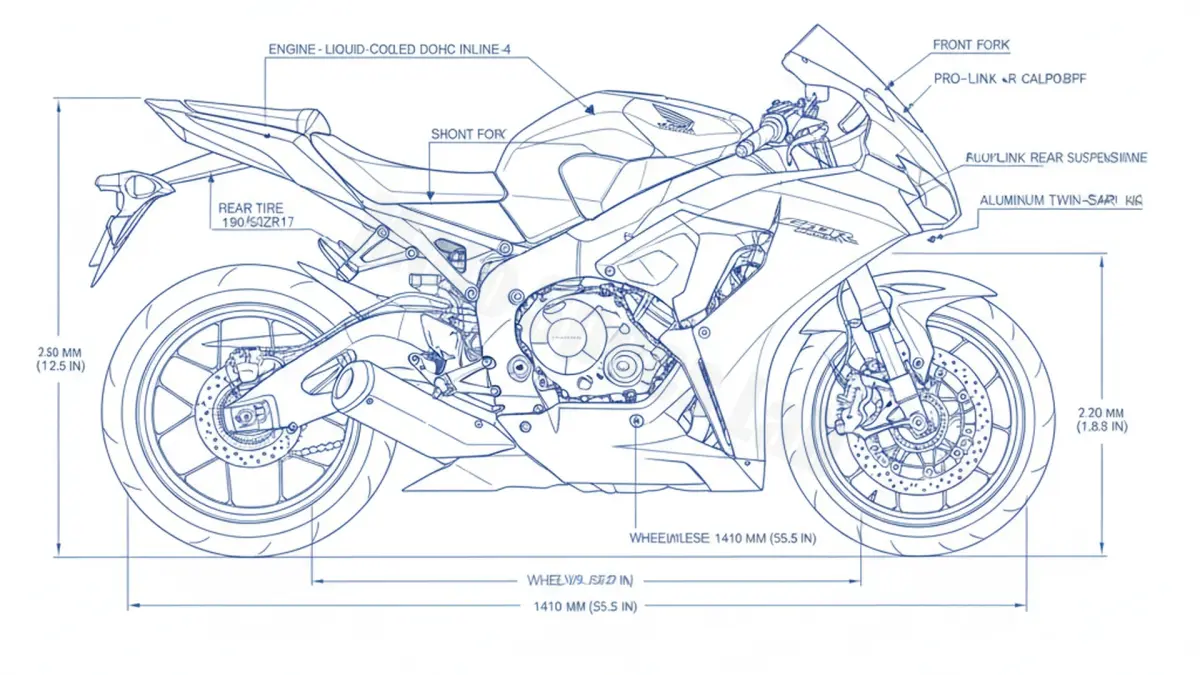
The Honda CBR 1000 RR SC59 represents a pivotal shift in superbike philosophy; it was the first Fireblade to abandon the iconic under-seat exhaust for a low-slung, underslung unit to achieve radical mass centralization. This engineering decision, combined with the introduction of Honda’s first production slipper clutch, transformed the Fireblade from a stable high-speed cruiser into a razor-sharp, agile track weapon that redefined the liter-bike class upon its 2008 debut.
Engineering Excellence & Evolution
The SC59 generation spanned nearly a decade, receiving a significant mid-cycle refresh in 2012. Early models focused on raw weight reduction, shedding nearly 5kg compared to the preceding SC57. In 2009, Honda introduced the world’s first electronically controlled Combined ABS (C-ABS) for sportbikes, a system designed to prevent pitch during hard braking without sacrificing the feel required for aggressive riding. The 2012 update further refined the chassis with the inclusion of Showa’s Big Piston Forks (BPF) and a Balance Free Rear Cushion (BFRC) shock, which improved damping consistency and road contact.
Maintenance Guide: Keeping the Blade Sharp
Adhering to strict maintenance intervals is critical for the SC59’s high-revving 999cc engine. Honda specifies the use of SAE 10W-30 oil. While some owners opt for 10W-40 in hotter climates, the internal tolerances of the SC59 are optimized for the thinner 10W-30 weight to ensure proper lubrication of the cylinder walls and transmission. A standard oil change with a filter requires exactly 3.0 liters.
For ignition, the SC59 utilizes high-performance Iridium plugs. The NGK IMR9E-9HES or DENSO VUH27D are the only recommended options to maintain combustion efficiency and prevent fouling. Given the compact nature of the frame, accessing the spark plugs requires removing the fuel tank and airbox, making it a labor-intensive but necessary service every 24,000 miles (40,000 km).
Handling and Footprint
The SC59’s handling characteristics are highly sensitive to tire condition and pressure. Running the factory-recommended 2.5 bar (36 psi) front and 2.9 bar (42 psi) rear is essential for street longevity and stability. For track use, these pressures are typically lowered, but for general operation, the 190/50 rear profile provides the specific contact patch geometry the swingarm was designed to leverage.
Common Technical FAQ
What battery is required for the SC59?
The SC59 uses the YTZ10S battery. Due to the high compression ratio of the engine, ensuring a battery with strong Cold Cranking Amps (CCA) is vital for reliable starting.
Does the 2008-2016 Fireblade have a slipper clutch?
Yes, the SC59 was the first generation of the Fireblade to feature a factory-installed slipper clutch, which helps stabilize the rear wheel during aggressive downshifts.
How often should I check the valve clearances?
Honda recommends checking valve clearances every 16,000 miles (24,000 km). Neglecting this can lead to power loss or, in extreme cases, burnt valves.