| Specification | Data |
|---|---|
| Production Years | 2004 – 2006 |
| Engine Oil | SAE 10W-40 (JASO MA / API SG) (1.0 L) |
| Tire Size (Front) | 80/90-17 M/C 44P |
| Tire Size (Rear) | 100/80-17 M/C 52P |
| Tire Pressure (Solo) | F: 2.00 bar (29 psi) / R: 2.00 bar (29 psi) |
| Tire Pressure (Dual) | F: 2.00 bar (29 psi) / R: 2.25 bar (33 psi) |
| Battery Type | YTZ7S |
| Spark Plug | NGK CR8E (Gap: 0.7–0.8 mm) |
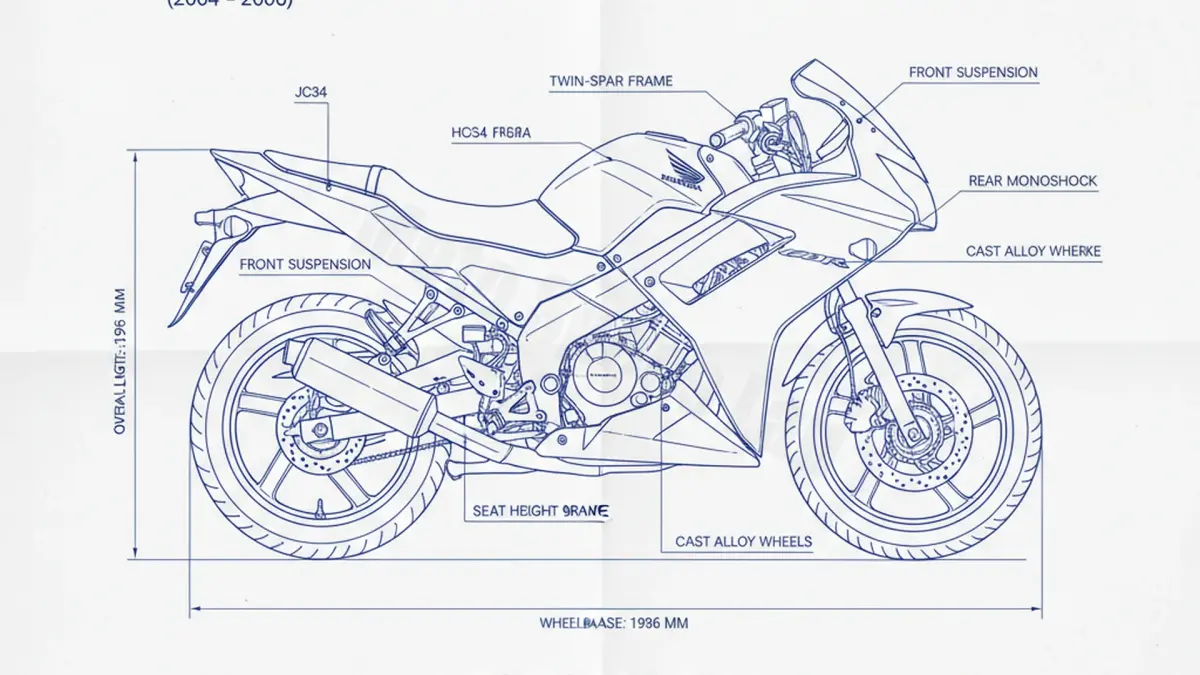
The Honda CBR 125 R (JC34) holds a significant place in motorcycling history as the machine that effectively ended the reign of the high-maintenance 2-stroke 125cc sportbikes in Europe. While its predecessors like the NSR125 were known for raw power and smoke, the JC34 was engineered with a focus on mechanical longevity and fuel efficiency, marking Honda’s strategic shift toward meeting stringent Euro 2 emission standards without sacrificing the ‘CBR’ racing aesthetic.
Engineering Overview
At the heart of the JC34 is a liquid-cooled, 124.7cc single-cylinder SOHC engine. Unlike many of its contemporaries that utilized air-cooling to save costs, Honda opted for liquid cooling to ensure consistent thermal performance during urban commuting and prolonged high-RPM usage. The narrow chassis design and 17-inch wheels were specifically chosen to provide a ‘big bike’ feel while maintaining a dry weight that makes it exceptionally accessible for novice riders.
Maintenance Guide
Lubrication System
For the JC34, Honda specifies 1.0 liter of SAE 10W-40 oil. It is critical to use oil that meets the JASO MA standard to ensure the wet clutch does not slip. Given the engine’s high-revving nature, we recommend oil changes every 4,000 km (2,500 miles) to prevent viscosity breakdown.
Ignition and Electrical
The electrical system relies on a compact YTZ7S battery. Starting issues are often traced back to the spark plug. Use an NGK CR8E and ensure the electrode gap is precisely set to 0.7–0.8 mm. A gap outside this range can lead to poor cold starts and erratic idling.
Chassis and Tires
The JC34 is sensitive to tire pressure due to its narrow tire profiles (80/90 front, 100/80 rear). Maintaining the correct pressure is vital for cornering stability. For solo riding, 2.00 bar (29 psi) is standard for both ends, but the rear should be increased to 2.25 bar (33 psi) when carrying a pillion passenger.
Expert Verdict
The Honda CBR 125 R JC34 remains a benchmark for reliability in the learner category. While it lacks the top-end rush of modern DOHC 125s, its build quality and ease of maintenance make it an ideal platform for those beginning their mechanical journey. Its legacy is not one of speed, but of indestructible engineering.